 English (United States)
 Spanish
 Portuguese
 English (UK)
 German
 French
 Italian
 Japanese
 Chinese (China)
 Korean
 Arabic
 Indonesian
 Thai
 Chinese (Hong Kong)

Galapagos Sky
| Trip dates | Trip dates | Itinerary | Days/Nights | Start Place | End Place |
|---|---|---|---|---|---|
| 29 Nov 2026 | Galapagos 7 Nights | 8D/7N | San Cristobal | San Cristobal | |
| 13 Dec 2026 | Galapagos 7 Nights | 8D/7N | San Cristobal | San Cristobal | |
| 20 Dec 2026 | Galapagos 7 Nights | 8D/7N | San Cristobal | San Cristobal | |
| 27 Dec 2026 | Galapagos 7 Nights | 8D/7N | San Cristobal | San Cristobal | |
| 07 Feb 2027 | Galapagos 7 Nights | 8D/7N | San Cristobal | San Cristobal | |
| 14 Feb 2027 | Galapagos 7 Nights | 8D/7N | San Cristobal | San Cristobal | |
| 21 Feb 2027 | Galapagos 7 Nights | 8D/7N | San Cristobal | San Cristobal | |
| 07 Mar 2027 | Galapagos 7 Nights | 8D/7N | San Cristobal | San Cristobal | |
| 14 Mar 2027 | Galapagos 7 Nights | 8D/7N | San Cristobal | San Cristobal | |
| 28 Mar 2027 | Galapagos 7 Nights | 8D/7N | San Cristobal | San Cristobal | |
| 04 Apr 2027 | Galapagos 7 Nights | 8D/7N | San Cristobal | San Cristobal | |
| 11 Apr 2027 | Galapagos 7 Nights | 8D/7N | San Cristobal | San Cristobal | |
| 18 Apr 2027 | Galapagos 7 Nights | 8D/7N | San Cristobal | San Cristobal | |
| 25 Apr 2027 | Galapagos 7 Nights | 8D/7N | San Cristobal | San Cristobal | |
| 02 May 2027 | Galapagos 7 Nights | 8D/7N | San Cristobal | San Cristobal | |
| 09 May 2027 | Galapagos 7 Nights | 8D/7N | San Cristobal | San Cristobal | |
| 16 May 2027 | Galapagos 7 Nights | 8D/7N | San Cristobal | San Cristobal | |
| 23 May 2027 | Galapagos 7 Nights | 8D/7N | San Cristobal | San Cristobal | |
| 30 May 2027 | Galapagos 7 Nights | 8D/7N | San Cristobal | San Cristobal | |
| 06 Jun 2027 | Galapagos 7 Nights | 8D/7N | San Cristobal | San Cristobal | |
| 27 Jun 2027 | Galapagos 7 Nights | 8D/7N | San Cristobal | San Cristobal | |
| 04 Jul 2027 | Galapagos 7 Nights | 8D/7N | San Cristobal | San Cristobal | |
| 25 Jul 2027 | Galapagos 7 Nights | 8D/7N | San Cristobal | San Cristobal | |
| 21 Nov 2027 | Galapagos 7 nights | 8D/7N | Ayora | Ayora | |
| 05 Dec 2027 | Galapagos 7 Nights | 8D/7N | San Cristobal | San Cristobal | |
| 12 Dec 2027 | Galapagos 7 Nights | 8D/7N | San Cristobal | San Cristobal | |
| 19 Dec 2027 | Galapagos 7 Nights | 8D/7N | San Cristobal | San Cristobal | |
| 26 Dec 2027 | Galapagos 7 Nights | 8D/7N | San Cristobal | San Cristobal | |
| 02 Jan 2028 | Galapagos 7 Nights | 8D/7N | San Cristobal | San Cristobal | |
| 09 Jan 2028 | Galapagos 7 Nights | 8D/7N | San Cristobal | San Cristobal | |
| 16 Jan 2028 | Galapagos 7 Nights | 8D/7N | San Cristobal | San Cristobal | |
| 23 Jan 2028 | Galapagos 7 Nights | 8D/7N | San Cristobal | San Cristobal | |
| 30 Jan 2028 | Galapagos 7 Nights | 8D/7N | San Cristobal | San Cristobal | |
| 06 Feb 2028 | Galapagos 7 Nights | 8D/7N | San Cristobal | San Cristobal | |
| 13 Feb 2028 | Galapagos 7 Nights | 8D/7N | San Cristobal | San Cristobal | |
| 20 Feb 2028 | Galapagos 7 Nights | 8D/7N | San Cristobal | San Cristobal | |
| 27 Feb 2028 | Galapagos 7 Nights | 8D/7N | San Cristobal | San Cristobal | |
| 05 Mar 2028 | Galapagos 7 Nights | 8D/7N | San Cristobal | San Cristobal | |
| 12 Mar 2028 | Galapagos 7 Nights | 8D/7N | San Cristobal | San Cristobal | |
| 19 Mar 2028 | Galapagos 7 Nights | 8D/7N | San Cristobal | San Cristobal | |
| 26 Mar 2028 | Galapagos 7 Nights | 8D/7N | San Cristobal | San Cristobal | |
| 02 Apr 2028 | Galapagos 7 Nights | 8D/7N | San Cristobal | San Cristobal | |
| 09 Apr 2028 | Galapagos 7 Nights | 8D/7N | San Cristobal | San Cristobal | |
| 16 Apr 2028 | Galapagos 7 Nights | 8D/7N | San Cristobal | San Cristobal | |
| 23 Apr 2028 | Galapagos 7 Nights | 8D/7N | San Cristobal | San Cristobal | |
| 30 Apr 2028 | Galapagos 7 Nights | 8D/7N | San Cristobal | San Cristobal | |
| 07 May 2028 | Galapagos 7 Nights | 8D/7N | San Cristobal | San Cristobal | |
| 14 May 2028 | Galapagos 7 Nights | 8D/7N | San Cristobal | San Cristobal | |
| 21 May 2028 | Galapagos 10 nights | 11D/10N | Ayora | Ayora | |
| 01 Jun 2028 | Galapagos 10 nights | 11D/10N | Ayora | Ayora | |
| 11 Jun 2028 | Galapagos 7 Nights | 8D/7N | San Cristobal | San Cristobal | |
| 18 Jun 2028 | Galapagos 7 Nights | 8D/7N | San Cristobal | San Cristobal | |
| 25 Jun 2028 | Galapagos 7 Nights | 8D/7N | San Cristobal | San Cristobal | |
| 02 Jul 2028 | Galapagos 7 Nights | 8D/7N | San Cristobal | San Cristobal | |
| 16 Jul 2028 | Galapagos 7 Nights | 8D/7N | San Cristobal | San Cristobal | |
| 30 Jul 2028 | Galapagos 7 Nights | 8D/7N | San Cristobal | San Cristobal | |
| 20 Aug 2028 | Galapagos 10 nights | 11D/10N | Ayora | Ayora | |
| 31 Aug 2028 | Galapagos 10 nights | 11D/10N | Ayora | Ayora | |
| 10 Sep 2028 | Galapagos 7 Nights | 8D/7N | San Cristobal | San Cristobal | |
| 17 Sep 2028 | Galapagos 7 Nights | 8D/7N | San Cristobal | San Cristobal | |
| 24 Sep 2028 | Galapagos 7 Nights | 8D/7N | San Cristobal | San Cristobal | |
| 22 Oct 2028 | Galapagos 7 Nights | 8D/7N | San Cristobal | San Cristobal | |
| 12 Nov 2028 | Galapagos 7 Nights | 8D/7N | San Cristobal | San Cristobal | |
| 19 Nov 2028 | Galapagos 7 Nights | 8D/7N | San Cristobal | San Cristobal | |
| 03 Dec 2028 | Galapagos 7 Nights | 8D/7N | San Cristobal | San Cristobal | |
| 10 Dec 2028 | Galapagos 7 Nights | 8D/7N | San Cristobal | San Cristobal | |
| 17 Dec 2028 | Galapagos 7 Nights | 8D/7N | San Cristobal | San Cristobal | |
| 24 Dec 2028 | Galapagos 7 Nights | 8D/7N | San Cristobal | San Cristobal | |
| 31 Dec 2028 | Galapagos 7 Nights | 8D/7N | San Cristobal | San Cristobal |
| Cabins | Preview | Name | Available Cabins | Price/Persons | ||||||||||||||||||||||||||||||||||||||||||||||||||||||||||||||||||||||||||||||||||||||||||||||||||||||||||||||||||||||||||||||||||||||||||||||||||||||||||||||||||||||||||||||||||||||||||||||||||||||||||||||||||||||||||||||||||||||||||||||||||||||||||||||||||||||||||||||||||||||||||||||||||||||||||||||||||||||||||||||||||||||||||||||||||||||||||||||||||||||||||||||||||||||||||||||||||||||||||||||||||||||||||||||||||||||||||||||||||||||||||||||||||||||||||||||||||||||||||||||||||||||||||||||||||||||||||||||||||||||||||||||||||||||||||||||||||||||||||||||||||||||||||||||||||||||||||||||||||||||||||||||||||||||||||||||||||||||||||||||||||||||||||||||||||||||||||||||||||||||||||||||||||||||||||||||||||||||||||||||||||||||||||||||||||||||||||||||||||||||||||||||||||||||||||||||||||||||||||||||||||||||||||||||||||||||||||||||||||||||||||||||||||||||||||||||||||||||||||||||
|---|---|---|---|---|---|---|---|---|---|---|---|---|---|---|---|---|---|---|---|---|---|---|---|---|---|---|---|---|---|---|---|---|---|---|---|---|---|---|---|---|---|---|---|---|---|---|---|---|---|---|---|---|---|---|---|---|---|---|---|---|---|---|---|---|---|---|---|---|---|---|---|---|---|---|---|---|---|---|---|---|---|---|---|---|---|---|---|---|---|---|---|---|---|---|---|---|---|---|---|---|---|---|---|---|---|---|---|---|---|---|---|---|---|---|---|---|---|---|---|---|---|---|---|---|---|---|---|---|---|---|---|---|---|---|---|---|---|---|---|---|---|---|---|---|---|---|---|---|---|---|---|---|---|---|---|---|---|---|---|---|---|---|---|---|---|---|---|---|---|---|---|---|---|---|---|---|---|---|---|---|---|---|---|---|---|---|---|---|---|---|---|---|---|---|---|---|---|---|---|---|---|---|---|---|---|---|---|---|---|---|---|---|---|---|---|---|---|---|---|---|---|---|---|---|---|---|---|---|---|---|---|---|---|---|---|---|---|---|---|---|---|---|---|---|---|---|---|---|---|---|---|---|---|---|---|---|---|---|---|---|---|---|---|---|---|---|---|---|---|---|---|---|---|---|---|---|---|---|---|---|---|---|---|---|---|---|---|---|---|---|---|---|---|---|---|---|---|---|---|---|---|---|---|---|---|---|---|---|---|---|---|---|---|---|---|---|---|---|---|---|---|---|---|---|---|---|---|---|---|---|---|---|---|---|---|---|---|---|---|---|---|---|---|---|---|---|---|---|---|---|---|---|---|---|---|---|---|---|---|---|---|---|---|---|---|---|---|---|---|---|---|---|---|---|---|---|---|---|---|---|---|---|---|---|---|---|---|---|---|---|---|---|---|---|---|---|---|---|---|---|---|---|---|---|---|---|---|---|---|---|---|---|---|---|---|---|---|---|---|---|---|---|---|---|---|---|---|---|---|---|---|---|---|---|---|---|---|---|---|---|---|---|---|---|---|---|---|---|---|---|---|---|---|---|---|---|---|---|---|---|---|---|---|---|---|---|---|---|---|---|---|---|---|---|---|---|---|---|---|---|---|---|---|---|---|---|---|---|---|---|---|---|---|---|---|---|---|---|---|---|---|---|---|---|---|---|---|---|---|---|---|---|---|---|---|---|---|---|---|---|---|---|---|---|---|---|---|---|---|---|---|---|---|---|---|---|---|---|---|---|---|---|---|---|---|---|---|---|---|---|---|---|---|---|---|---|---|---|---|---|---|---|---|---|---|---|---|---|---|---|---|---|---|---|---|---|---|---|---|---|---|---|---|---|---|---|---|---|---|---|---|---|---|---|---|---|---|---|---|---|---|---|---|---|---|---|---|---|---|---|---|---|---|---|---|---|---|---|---|---|---|---|---|---|---|---|---|---|---|---|---|---|---|---|---|---|---|---|---|---|---|---|---|---|---|---|---|---|---|---|---|---|---|---|---|---|---|---|---|---|---|---|---|---|---|---|---|---|---|---|---|---|---|---|---|---|---|---|---|---|---|---|---|---|---|---|---|---|---|---|---|---|---|---|---|---|---|---|---|---|---|---|---|---|---|---|---|---|---|---|---|---|---|---|---|---|---|---|---|---|---|---|---|---|---|---|---|---|---|---|---|---|---|---|---|---|---|---|---|---|---|---|---|---|---|---|---|---|---|---|---|---|---|---|---|---|---|---|---|---|---|---|---|---|---|---|---|---|---|---|---|---|---|---|---|---|---|---|---|---|---|---|---|---|---|---|---|---|---|---|---|---|---|---|---|---|---|---|---|---|---|---|---|---|---|---|---|---|---|---|---|---|---|---|---|---|---|---|---|---|---|---|---|---|---|---|---|---|---|---|---|---|---|---|---|---|---|---|---|---|---|---|---|---|---|---|---|---|---|---|---|---|---|---|---|---|---|---|---|---|---|---|---|---|---|---|---|---|---|---|---|---|---|---|---|---|---|---|---|---|---|---|
| Deluxe Twin | Select Trip | FULL | FULL | FULL | 4 Cabins 8 Availability | 4 Cabins 8 Availability | 4 Cabins 8 Availability | 4 Cabins 8 Availability | 4 Cabins 8 Availability | 3 Cabins 6 Availability | 4 Cabins 8 Availability | 4 Cabins 8 Availability | 4 Cabins 8 Availability | 4 Cabins 8 Availability | 4 Cabins 8 Availability | 4 Cabins 7 Availability | 4 Cabins 8 Availability | 4 Cabins 8 Availability | FULL | 4 Cabins 8 Availability | 4 Cabins 8 Availability | 2 Cabins 3 Availability | FULL | 2 Cabins 4 Availability | FULL | FULL | FULL | FULL | FULL | FULL | 3 Cabins 6 Availability | 3 Cabins 6 Availability | 4 Cabins 8 Availability | 1 Cabins 2 Availability | 3 Cabins 5 Availability | 4 Cabins 8 Availability | 2 Cabins 4 Availability | 4 Cabins 8 Availability | 1 Cabins 2 Availability | 4 Cabins 8 Availability | FULL | 2 Cabins 3 Availability | 4 Cabins 8 Availability | 4 Cabins 8 Availability | 3 Cabins 6 Availability | 1 Cabins 1 Availability | FULL | 1 Cabins 1 Availability | FULL | FULL | FULL | FULL | FULL | 4 Cabins 8 Availability | 2 Cabins 4 Availability | 2 Cabins 4 Availability | 1 Cabins 1 Availability | 2 Cabins 4 Availability | 2 Cabins 4 Availability | 4 Cabins 8 Availability | FULL | 3 Cabins 6 Availability | 1 Cabins 2 Availability | 1 Cabins 2 Availability | 2 Cabins 3 Availability | FULL | FULL | FULL | FULL | 3 Cabins 6 Availability | FULL | FULL | 4 Cabins 8 Availability | 2 Cabins 3 Availability | 1 Cabins 2 Availability | 4 Cabins 8 Availability | 4 Cabins 8 Availability | 3 Cabins 6 Availability | 4 Cabins 8 Availability | 4 Cabins 8 Availability | 4 Cabins 8 Availability | FULL | 4 Cabins 8 Availability | FULL | 1 Cabins 1 Availability | 2 Cabins 4 Availability | 4 Cabins 8 Availability | FULL | 1 Cabins 2 Availability | 4 Cabins 8 Availability | FULL | 1 Cabins 2 Availability | 1 Cabins 1 Availability | 2 Cabins 3 Availability | 2 Cabins 4 Availability | 2 Cabins 4 Availability | FULL | 3 Cabins 6 Availability | 3 Cabins 5 Availability | 3 Cabins 6 Availability | FULL | 3 Cabins 5 Availability | FULL | 4 Cabins 8 Availability | 4 Cabins 8 Availability | 1 Cabins 1 Availability | 1 Cabins 1 Availability | 3 Cabins 6 Availability | 1 Cabins 1 Availability | FULL | 3 Cabins 5 Availability | FULL | 1 Cabins 2 Availability | 3 Cabins 6 Availability | FULL | 2 Cabins 3 Availability | 4 Cabins 8 Availability | FULL | FULL | FULL | FULL | FULL | FULL | FULL | FULL | FULL | FULL | 1 Cabins 1 Availability | FULL | 1 Cabins 1 Availability | 4 Cabins 8 Availability | 2 Cabins 3 Availability | 3 Cabins 5 Availability | 4 Cabins 8 Availability | FULL | 2 Cabins 3 Availability | 3 Cabins 5 Availability | 4 Cabins 8 Availability | 2 Cabins 3 Availability | 2 Cabins 4 Availability | 2 Cabins 3 Availability | 4 Cabins 7 Availability | 3 Cabins 6 Availability | 1 Cabins 2 Availability | 4 Cabins 8 Availability | 4 Cabins 8 Availability | 4 Cabins 8 Availability | FULL | 1 Cabins 1 Availability | 1 Cabins 1 Availability | FULL | 4 Cabins 8 Availability | 3 Cabins 5 Availability | 2 Cabins 3 Availability | FULL | FULL | 4 Cabins 8 Availability | FULL | 3 Cabins 5 Availability | 4 Cabins 8 Availability | 4 Cabins 8 Availability | 4 Cabins 8 Availability | FULL | FULL | 3 Cabins 5 Availability | 2 Cabins 3 Availability | FULL | 4 Cabins 8 Availability | 3 Cabins 5 Availability | 4 Cabins 8 Availability | 4 Cabins 8 Availability | 4 Cabins 8 Availability | 4 Cabins 8 Availability | 4 Cabins 8 Availability | 4 Cabins 8 Availability | 4 Cabins 8 Availability | 4 Cabins 8 Availability | 4 Cabins 8 Availability | 4 Cabins 7 Availability | 4 Cabins 8 Availability | 3 Cabins 5 Availability | 4 Cabins 8 Availability | 1 Cabins 1 Availability | FULL | 4 Cabins 8 Availability | 4 Cabins 8 Availability | 4 Cabins 8 Availability | 4 Cabins 8 Availability | 4 Cabins 8 Availability | 3 Cabins 6 Availability | FULL | 4 Cabins 8 Availability | 4 Cabins 8 Availability | 1 Cabins 2 Availability | 3 Cabins 5 Availability | FULL | 4 Cabins 8 Availability | 3 Cabins 6 Availability | 1 Cabins 1 Availability | FULL | FULL | FULL | 4 Cabins 8 Availability | 4 Cabins 8 Availability | 1 Cabins 2 Availability | FULL | 2 Cabins 4 Availability | 4 Cabins 8 Availability | 3 Cabins 5 Availability | 3 Cabins 5 Availability | FULL | 4 Cabins 8 Availability | 4 Cabins 8 Availability | FULL | FULL | 4 Cabins 8 Availability | 2 Cabins 3 Availability | FULL | FULL | FULL | FULL | FULL | FULL | FULL | FULL | FULL | FULL | FULL | FULL | FULL | FULL | FULL | FULL | FULL | FULL | FULL | FULL | 2 Cabins 4 Availability | 4 Cabins 8 Availability | 4 Cabins 8 Availability | 4 Cabins 8 Availability | FULL | 4 Cabins 8 Availability | 4 Cabins 8 Availability | 4 Cabins 8 Availability | 1 Cabins 1 Availability | 4 Cabins 8 Availability | 1 Cabins 1 Availability | 4 Cabins 8 Availability | 1 Cabins 1 Availability | 1 Cabins 1 Availability | 1 Cabins 1 Availability | FULL | 1 Cabins 2 Availability | 4 Cabins 8 Availability | 4 Cabins 8 Availability | FULL | FULL | 1 Cabins 1 Availability | FULL | FULL | FULL | FULL | FULL | FULL | FULL | FULL | FULL | FULL | 4 Cabins 8 Availability | 4 Cabins 8 Availability | 4 Cabins 8 Availability | 1 Cabins 2 Availability | FULL | FULL | 4 Cabins 7 Availability | FULL | 1 Cabins 2 Availability | 1 Cabins 2 Availability | 4 Cabins 7 Availability | 4 Cabins 8 Availability | FULL | 2 Cabins 3 Availability | FULL | FULL | FULL | FULL | FULL | FULL | 4 Cabins 8 Availability | 3 Cabins 5 Availability | 2 Cabins 4 Availability | 4 Cabins 8 Availability | FULL | FULL | FULL | FULL | FULL | FULL | FULL | FULL | FULL | FULL | FULL | FULL | FULL | FULL | FULL | FULL | 2 Cabins 3 Availability | 1 Cabins 1 Availability | FULL | FULL | 1 Cabins 2 Availability | FULL | FULL | FULL | FULL | FULL | FULL | FULL | FULL | FULL | FULL | FULL | FULL | FULL | 1 Cabins 1 Availability | FULL | FULL | FULL | FULL | 4 Cabins 8 Availability | FULL | 4 Cabins 8 Availability | 4 Cabins 7 Availability | 1 Cabins 1 Availability | FULL | FULL | FULL | FULL | FULL | 4 Cabins 8 Availability | 4 Cabins 8 Availability | 4 Cabins 8 Availability | FULL | 3 Cabins 6 Availability | 2 Cabins 3 Availability | FULL | 1 Cabins 1 Availability | 4 Cabins 8 Availability | 4 Cabins 8 Availability | 4 Cabins 7 Availability | 4 Cabins 8 Availability | 3 Cabins 6 Availability | 3 Cabins 6 Availability | 4 Cabins 8 Availability | 4 Cabins 8 Availability | 4 Cabins 8 Availability | 3 Cabins 6 Availability | FULL | FULL | 3 Cabins 6 Availability | 3 Cabins 6 Availability | FULL | FULL | 1 Cabins 1 Availability | FULL | FULL | FULL | 4 Cabins 8 Availability | 4 Cabins 8 Availability | FULL | FULL | FULL | FULL | FULL | FULL | FULL | FULL | 4 Cabins 8 Availability | FULL | 1 Cabins 1 Availability | FULL | 4 Cabins 7 Availability | 4 Cabins 8 Availability | 4 Cabins 8 Availability | 4 Cabins 8 Availability | 4 Cabins 8 Availability | FULL | 4 Cabins 8 Availability | FULL | 4 Cabins 8 Availability | 4 Cabins 8 Availability | 4 Cabins 8 Availability | 4 Cabins 8 Availability | 4 Cabins 7 Availability | 4 Cabins 8 Availability | 4 Cabins 8 Availability | 4 Cabins 8 Availability | 4 Cabins 8 Availability | 4 Cabins 8 Availability | 4 Cabins 8 Availability | 4 Cabins 8 Availability | 4 Cabins 8 Availability | 4 Cabins 8 Availability | 4 Cabins 8 Availability | 4 Cabins 8 Availability | 4 Cabins 8 Availability | 4 Cabins 8 Availability | 4 Cabins 8 Availability | 4 Cabins 8 Availability | 4 Cabins 8 Availability | 4 Cabins 8 Availability | 4 Cabins 8 Availability | 4 Cabins 8 Availability | 4 Cabins 8 Availability | 4 Cabins 8 Availability | 4 Cabins 8 Availability | FULL | 3 Cabins 6 Availability | FULL | 4 Cabins 8 Availability | FULL | FULL | 3 Cabins 6 Availability | 4 Cabins 8 Availability | 4 Cabins 8 Availability | 3 Cabins 6 Availability | FULL | FULL | FULL | 4 Cabins 8 Availability | FULL | FULL | 4 Cabins 8 Availability | 4 Cabins 8 Availability | FULL | 4 Cabins 8 Availability | 4 Cabins 8 Availability | 4 Cabins 8 Availability | 4 Cabins 8 Availability | 4 Cabins 7 Availability | 4 Cabins 8 Availability | Select Trip | $6,805.00 | $6,805.00 | $6,805.00 | $6,805.00 | $6,805.00 | $6,805.00 | $6,805.00 | $6,805.00 | $8,140.00 | $6,395.00 | $6,805.00 | $6,805.00 | $6,805.00 | $6,805.00 | $6,805.00 | $6,805.00 | $6,805.00 | $6,805.00 | $6,805.00 | $6,805.00 | $6,805.00 | $6,805.00 | $6,805.00 | $6,395.00 | $6,395.00 | $6,395.00 | $6,395.00 | $6,395.00 | $6,395.00 | $6,805.00 | $6,805.00 | $6,805.00 | $6,805.00 | $6,805.00 | $6,805.00 | $6,805.00 | $6,805.00 | $6,805.00 | $6,805.00 | $6,805.00 | $6,805.00 | $6,805.00 | $6,805.00 | $6,805.00 | $6,805.00 | $7,295.00 | $7,295.00 | $7,295.00 | $7,295.00 | $7,295.00 | $7,295.00 | $7,295.00 | $7,295.00 | $7,295.00 | $7,295.00 | $7,295.00 | $7,295.00 | $7,295.00 | $8,140.00 | $8,140.00 | $7,295.00 | $7,295.00 | $8,140.00 | $8,140.00 | $7,295.00 | $7,295.00 | $7,295.00 | $7,295.00 | $7,295.00 | $7,295.00 | $7,295.00 | $7,295.00 | $7,295.00 | $7,295.00 | $7,295.00 | $7,295.00 | $7,295.00 | $7,295.00 | $7,295.00 | $7,295.00 | $7,295.00 | $7,295.00 | $7,295.00 | $7,295.00 | $7,295.00 | $7,295.00 | $7,295.00 | $7,295.00 | $7,295.00 | $7,295.00 | $7,295.00 | $7,295.00 | $7,295.00 | $7,295.00 | $7,295.00 | $7,295.00 | $7,295.00 | $7,295.00 | $7,295.00 | $7,295.00 | $7,295.00 | $7,295.00 | $7,295.00 | $7,295.00 | $7,295.00 | $7,295.00 | $7,295.00 | $7,295.00 | $7,295.00 | $7,295.00 | $7,295.00 | $7,295.00 | $7,295.00 | $7,295.00 | $7,295.00 | $7,195.00 | $7,295.00 | $0.00 | $7,295.00 | $0.00 | $7,395.00 | $0.00 | $0.00 | $0.00 | $0.00 | $7,395.00 | $7,195.00 | $7,195.00 | $7,195.00 | $7,195.00 | $7,195.00 | $7,195.00 | $7,195.00 | $7,195.00 | $7,295.00 | $7,295.00 | $8,140.00 | $8,340.00 | $7,295.00 | $7,295.00 | $7,395.00 | $7,295.00 | $7,395.00 | $7,295.00 | $7,295.00 | $7,295.00 | $7,295.00 | $7,295.00 | $7,295.00 | $7,295.00 | $7,295.00 | $7,295.00 | $7,195.00 | $7,195.00 | $7,195.00 | $7,195.00 | $7,195.00 | $7,195.00 | $7,195.00 | $8,340.00 | $8,340.00 | $7,395.00 | $7,395.00 | $7,395.00 | $7,195.00 | $7,195.00 | $7,195.00 | $7,195.00 | $7,195.00 | $7,195.00 | $7,195.00 | $7,195.00 | $7,195.00 | $0.00 | $7,195.00 | $0.00 | $7,195.00 | $7,195.00 | $7,195.00 | $7,195.00 | $7,195.00 | $7,195.00 | $7,195.00 | $7,195.00 | $7,195.00 | $7,195.00 | $7,395.00 | $7,395.00 | $7,395.00 | $7,395.00 | $7,395.00 | $7,395.00 | $7,395.00 | $7,395.00 | $7,395.00 | $7,395.00 | $7,395.00 | $7,395.00 | $7,395.00 | $7,395.00 | $7,395.00 | $7,395.00 | $7,395.00 | $8,540.00 | $8,540.00 | $7,395.00 | $7,395.00 | $7,395.00 | $7,395.00 | $7,395.00 | $7,395.00 | $7,395.00 | $7,395.00 | $7,395.00 | $7,395.00 | $7,395.00 | $7,395.00 | $7,395.00 | $8,540.00 | $8,540.00 | $7,395.00 | $7,395.00 | $7,395.00 | $7,395.00 | $7,395.00 | $7,395.00 | $7,395.00 | $7,395.00 | $0.00 | $0.00 | $0.00 | $0.00 | $0.00 | $0.00 | $7,395.00 | $7,395.00 | $0.00 | $0.00 | $0.00 | $0.00 | $0.00 | $7,395.00 | $6,655.00 | $6,655.00 | $6,655.00 | $7,395.00 | $6,655.00 | $7,395.00 | $7,395.00 | $6,655.00 | $7,395.00 | $6,655.00 | $7,395.00 | $7,395.00 | $7,395.00 | $7,395.00 | $7,395.00 | $7,395.00 | $8,540.00 | $10,443.00 | $7,395.00 | $7,395.00 | $7,395.00 | $7,295.00 | $7,395.00 | $7,395.00 | $7,395.00 | $7,395.00 | $0.00 | $0.00 | $7,395.00 | $6,655.00 | $6,655.00 | $7,395.00 | $7,395.00 | $6,655.00 | $6,655.00 | $6,655.00 | $8,890.00 | $8,890.00 | $6,745.00 | $6,745.00 | $6,745.00 | $6,745.00 | $6,745.00 | $6,745.00 | $7,495.00 | $7,495.00 | $7,495.00 | $7,495.00 | $7,495.00 | $7,495.00 | $7,495.00 | $7,495.00 | $7,495.00 | $7,495.00 | $7,495.00 | $7,495.00 | $7,495.00 | $7,495.00 | $7,495.00 | $7,495.00 | $7,495.00 | $7,495.00 | $7,495.00 | $7,495.00 | $7,495.00 | $7,495.00 | $7,495.00 | $7,495.00 | $8,890.00 | $8,890.00 | $7,495.00 | $7,495.00 | $7,495.00 | $7,495.00 | $7,495.00 | $7,495.00 | $7,495.00 | $7,495.00 | $7,495.00 | $7,495.00 | $7,495.00 | $7,495.00 | $7,495.00 | $7,495.00 | $7,495.00 | $7,495.00 | $7,495.00 | $7,495.00 | $7,495.00 | $7,495.00 | $7,495.00 | $7,495.00 | $7,495.00 | $7,495.00 | $7,495.00 | $7,495.00 | $7,495.00 | $7,495.00 | $7,495.00 | $7,495.00 | $7,495.00 | $7,495.00 | $7,495.00 | $7,495.00 | $7,495.00 | $7,495.00 | $7,495.00 | $7,495.00 | $7,495.00 | $7,495.00 | $7,495.00 | $7,495.00 | $7,495.00 | $7,495.00 | $7,495.00 | $7,495.00 | $7,495.00 | $7,495.00 | $8,890.00 | $7,395.00 | $7,395.00 | $7,495.00 | $7,495.00 | $7,495.00 | $7,495.00 | $7,495.00 | $7,495.00 | $7,495.00 | $8,890.00 | $7,395.00 | $7,495.00 | $7,495.00 | $7,495.00 | $7,495.00 | $7,495.00 | $7,695.00 | $7,495.00 | $7,395.00 | $8,890.00 | $7,395.00 | $8,890.00 | $8,140.00 | $7,795.00 | $7,795.00 | $7,795.00 | $7,795.00 | $7,795.00 | $7,795.00 | $7,795.00 | $7,795.00 | $7,795.00 | $7,795.00 | $7,795.00 | $7,795.00 | $7,795.00 | $7,795.00 | $7,795.00 | $7,795.00 | $7,795.00 | $7,795.00 | $7,795.00 | $7,795.00 | $10,715.00 | $10,715.00 | $7,795.00 | $7,795.00 | $7,795.00 | $7,795.00 | $7,795.00 | $7,795.00 | $7,795.00 | $7,795.00 | $7,795.00 | $7,795.00 | $10,715.00 | $7,795.00 | $7,795.00 | $7,795.00 | $7,795.00 | $7,795.00 | $7,795.00 | $7,795.00 | $7,795.00 | $7,795.00 | $7,795.00 | $7,795.00 | $7,795.00 | $7,795.00 | $7,795.00 | $7,795.00 | $7,795.00 | $10,715.00 | $10,715.00 |
|
| Master | Select Trip | FULL | FULL | FULL | 4 Cabins 8 Availability | 4 Cabins 8 Availability | 4 Cabins 8 Availability | 4 Cabins 8 Availability | 4 Cabins 8 Availability | 4 Cabins 8 Availability | 4 Cabins 8 Availability | 4 Cabins 8 Availability | 4 Cabins 8 Availability | 4 Cabins 8 Availability | 4 Cabins 8 Availability | FULL | 4 Cabins 8 Availability | 4 Cabins 8 Availability | FULL | 4 Cabins 8 Availability | 4 Cabins 8 Availability | FULL | 3 Cabins 6 Availability | FULL | FULL | FULL | FULL | FULL | FULL | FULL | 4 Cabins 8 Availability | 4 Cabins 8 Availability | 4 Cabins 8 Availability | FULL | 1 Cabins 2 Availability | 4 Cabins 8 Availability | 2 Cabins 3 Availability | FULL | 2 Cabins 3 Availability | 1 Cabins 1 Availability | FULL | 2 Cabins 4 Availability | 4 Cabins 8 Availability | 3 Cabins 6 Availability | FULL | FULL | FULL | FULL | 1 Cabins 1 Availability | FULL | FULL | FULL | FULL | 4 Cabins 8 Availability | FULL | FULL | FULL | 1 Cabins 2 Availability | 1 Cabins 1 Availability | 4 Cabins 8 Availability | FULL | FULL | FULL | FULL | 1 Cabins 1 Availability | FULL | FULL | FULL | FULL | 1 Cabins 1 Availability | FULL | FULL | 4 Cabins 8 Availability | FULL | FULL | 4 Cabins 8 Availability | 4 Cabins 8 Availability | FULL | 4 Cabins 8 Availability | FULL | 4 Cabins 8 Availability | 1 Cabins 1 Availability | 1 Cabins 1 Availability | FULL | FULL | 1 Cabins 2 Availability | 4 Cabins 8 Availability | FULL | FULL | FULL | FULL | FULL | 2 Cabins 3 Availability | FULL | FULL | FULL | FULL | 2 Cabins 4 Availability | 2 Cabins 4 Availability | 1 Cabins 2 Availability | FULL | 2 Cabins 4 Availability | 1 Cabins 1 Availability | 4 Cabins 8 Availability | 3 Cabins 6 Availability | FULL | FULL | 2 Cabins 4 Availability | FULL | FULL | FULL | FULL | 1 Cabins 1 Availability | 1 Cabins 2 Availability | FULL | 3 Cabins 6 Availability | 4 Cabins 8 Availability | FULL | FULL | FULL | FULL | FULL | FULL | FULL | 1 Cabins 1 Availability | FULL | FULL | FULL | 1 Cabins 2 Availability | FULL | 4 Cabins 8 Availability | 2 Cabins 4 Availability | 1 Cabins 1 Availability | 4 Cabins 8 Availability | FULL | 1 Cabins 2 Availability | FULL | 4 Cabins 8 Availability | 1 Cabins 2 Availability | 1 Cabins 2 Availability | 4 Cabins 7 Availability | FULL | 3 Cabins 6 Availability | 2 Cabins 4 Availability | 4 Cabins 8 Availability | 4 Cabins 8 Availability | 4 Cabins 8 Availability | FULL | FULL | FULL | FULL | 3 Cabins 6 Availability | FULL | 1 Cabins 1 Availability | FULL | FULL | 4 Cabins 8 Availability | 1 Cabins 2 Availability | 2 Cabins 4 Availability | 4 Cabins 8 Availability | 4 Cabins 8 Availability | 4 Cabins 8 Availability | FULL | FULL | 3 Cabins 5 Availability | 1 Cabins 2 Availability | FULL | 2 Cabins 4 Availability | FULL | 4 Cabins 8 Availability | 4 Cabins 8 Availability | 4 Cabins 8 Availability | 4 Cabins 8 Availability | 4 Cabins 8 Availability | 4 Cabins 8 Availability | 4 Cabins 8 Availability | 4 Cabins 8 Availability | 4 Cabins 8 Availability | 1 Cabins 2 Availability | FULL | FULL | 4 Cabins 8 Availability | FULL | FULL | 4 Cabins 8 Availability | 4 Cabins 8 Availability | 4 Cabins 8 Availability | 4 Cabins 8 Availability | 4 Cabins 8 Availability | FULL | FULL | 4 Cabins 8 Availability | 4 Cabins 8 Availability | 1 Cabins 2 Availability | 3 Cabins 6 Availability | FULL | 4 Cabins 8 Availability | FULL | 2 Cabins 4 Availability | FULL | FULL | FULL | 4 Cabins 8 Availability | 4 Cabins 8 Availability | 2 Cabins 3 Availability | FULL | FULL | FULL | FULL | 2 Cabins 3 Availability | FULL | 4 Cabins 8 Availability | 4 Cabins 8 Availability | FULL | FULL | 4 Cabins 8 Availability | 2 Cabins 3 Availability | FULL | FULL | FULL | FULL | FULL | FULL | FULL | FULL | FULL | FULL | FULL | FULL | FULL | FULL | FULL | FULL | FULL | FULL | FULL | FULL | 1 Cabins 2 Availability | 4 Cabins 8 Availability | 4 Cabins 8 Availability | 4 Cabins 8 Availability | FULL | 4 Cabins 8 Availability | 4 Cabins 8 Availability | 4 Cabins 8 Availability | FULL | 4 Cabins 8 Availability | FULL | 4 Cabins 8 Availability | 1 Cabins 1 Availability | FULL | FULL | FULL | 1 Cabins 1 Availability | 4 Cabins 8 Availability | 4 Cabins 8 Availability | FULL | FULL | FULL | FULL | FULL | FULL | FULL | FULL | FULL | FULL | FULL | 1 Cabins 1 Availability | FULL | 4 Cabins 8 Availability | 4 Cabins 8 Availability | 4 Cabins 8 Availability | FULL | FULL | FULL | FULL | FULL | FULL | 2 Cabins 3 Availability | 2 Cabins 4 Availability | 4 Cabins 8 Availability | FULL | 1 Cabins 2 Availability | FULL | FULL | FULL | FULL | FULL | FULL | 4 Cabins 8 Availability | FULL | FULL | 4 Cabins 8 Availability | 1 Cabins 1 Availability | FULL | FULL | FULL | FULL | FULL | FULL | FULL | FULL | FULL | FULL | FULL | FULL | FULL | FULL | FULL | FULL | FULL | FULL | FULL | FULL | FULL | FULL | FULL | FULL | FULL | FULL | FULL | FULL | FULL | FULL | FULL | FULL | FULL | FULL | FULL | FULL | FULL | FULL | 4 Cabins 8 Availability | FULL | 4 Cabins 8 Availability | 2 Cabins 4 Availability | FULL | FULL | FULL | FULL | FULL | FULL | 4 Cabins 8 Availability | 4 Cabins 8 Availability | 4 Cabins 8 Availability | FULL | 1 Cabins 2 Availability | FULL | FULL | FULL | 4 Cabins 8 Availability | 2 Cabins 4 Availability | 1 Cabins 2 Availability | 4 Cabins 8 Availability | 2 Cabins 4 Availability | 4 Cabins 8 Availability | 1 Cabins 2 Availability | 4 Cabins 8 Availability | 4 Cabins 8 Availability | FULL | FULL | FULL | FULL | FULL | FULL | FULL | FULL | FULL | FULL | FULL | 4 Cabins 8 Availability | 4 Cabins 8 Availability | FULL | FULL | FULL | FULL | FULL | FULL | FULL | FULL | 4 Cabins 8 Availability | FULL | FULL | FULL | 4 Cabins 8 Availability | 4 Cabins 8 Availability | 4 Cabins 8 Availability | 2 Cabins 4 Availability | 4 Cabins 8 Availability | FULL | 4 Cabins 8 Availability | FULL | 4 Cabins 8 Availability | 4 Cabins 8 Availability | 4 Cabins 8 Availability | 4 Cabins 8 Availability | 4 Cabins 8 Availability | 4 Cabins 8 Availability | 4 Cabins 8 Availability | 4 Cabins 8 Availability | 4 Cabins 8 Availability | 4 Cabins 8 Availability | 4 Cabins 8 Availability | 4 Cabins 8 Availability | 4 Cabins 8 Availability | 4 Cabins 8 Availability | 4 Cabins 8 Availability | 4 Cabins 8 Availability | 4 Cabins 8 Availability | 4 Cabins 8 Availability | 4 Cabins 8 Availability | 4 Cabins 8 Availability | 4 Cabins 8 Availability | 4 Cabins 8 Availability | 4 Cabins 8 Availability | 4 Cabins 8 Availability | 3 Cabins 6 Availability | 4 Cabins 8 Availability | 4 Cabins 8 Availability | FULL | 4 Cabins 8 Availability | FULL | 4 Cabins 8 Availability | FULL | FULL | FULL | 4 Cabins 7 Availability | 4 Cabins 8 Availability | 2 Cabins 4 Availability | FULL | FULL | FULL | 2 Cabins 4 Availability | FULL | FULL | 4 Cabins 8 Availability | 3 Cabins 6 Availability | FULL | 4 Cabins 8 Availability | 4 Cabins 8 Availability | 4 Cabins 8 Availability | 4 Cabins 8 Availability | FULL | 4 Cabins 8 Availability | Select Trip | $7,095.00 | $7,095.00 | $7,095.00 | $7,095.00 | $7,095.00 | $7,095.00 | $7,095.00 | $7,095.00 | $8,440.00 | $6,595.00 | $7,095.00 | $7,095.00 | $7,095.00 | $7,095.00 | $7,095.00 | $7,095.00 | $7,095.00 | $7,095.00 | $7,095.00 | $7,095.00 | $7,095.00 | $7,095.00 | $7,095.00 | $6,595.00 | $6,595.00 | $6,595.00 | $6,595.00 | $6,595.00 | $6,595.00 | $7,095.00 | $7,095.00 | $7,095.00 | $7,095.00 | $7,095.00 | $7,095.00 | $7,095.00 | $7,095.00 | $7,095.00 | $7,095.00 | $7,095.00 | $7,095.00 | $7,095.00 | $7,095.00 | $7,095.00 | $7,095.00 | $7,595.00 | $7,595.00 | $7,595.00 | $7,595.00 | $7,595.00 | $7,595.00 | $7,595.00 | $7,595.00 | $7,595.00 | $7,595.00 | $7,595.00 | $7,595.00 | $7,595.00 | $8,440.00 | $8,440.00 | $7,595.00 | $7,595.00 | $8,440.00 | $8,440.00 | $7,595.00 | $7,595.00 | $7,595.00 | $7,595.00 | $7,595.00 | $7,595.00 | $7,595.00 | $7,595.00 | $7,595.00 | $7,595.00 | $7,595.00 | $7,595.00 | $7,595.00 | $7,595.00 | $7,595.00 | $7,595.00 | $7,595.00 | $7,595.00 | $7,595.00 | $7,595.00 | $7,595.00 | $7,595.00 | $7,595.00 | $7,595.00 | $7,595.00 | $7,595.00 | $7,595.00 | $7,595.00 | $7,595.00 | $7,595.00 | $7,595.00 | $7,595.00 | $7,595.00 | $7,595.00 | $7,595.00 | $7,595.00 | $7,595.00 | $7,595.00 | $7,595.00 | $7,595.00 | $7,595.00 | $7,595.00 | $7,595.00 | $7,595.00 | $7,595.00 | $7,595.00 | $7,595.00 | $7,595.00 | $7,595.00 | $7,595.00 | $7,595.00 | $7,495.00 | $7,595.00 | $0.00 | $7,595.00 | $0.00 | $7,695.00 | $0.00 | $0.00 | $0.00 | $0.00 | $7,695.00 | $7,495.00 | $7,495.00 | $7,495.00 | $7,495.00 | $7,495.00 | $7,495.00 | $7,495.00 | $7,495.00 | $7,595.00 | $7,595.00 | $8,440.00 | $8,740.00 | $7,595.00 | $7,595.00 | $7,695.00 | $7,595.00 | $7,695.00 | $7,595.00 | $7,595.00 | $7,595.00 | $7,595.00 | $7,595.00 | $7,595.00 | $7,595.00 | $7,595.00 | $7,595.00 | $7,495.00 | $7,495.00 | $7,495.00 | $7,495.00 | $7,495.00 | $7,495.00 | $7,495.00 | $8,740.00 | $8,740.00 | $7,695.00 | $7,695.00 | $7,695.00 | $7,495.00 | $7,495.00 | $7,495.00 | $7,495.00 | $7,495.00 | $7,495.00 | $7,495.00 | $7,495.00 | $7,495.00 | $0.00 | $7,495.00 | $0.00 | $7,495.00 | $7,495.00 | $7,495.00 | $7,495.00 | $7,495.00 | $7,495.00 | $7,495.00 | $7,495.00 | $7,495.00 | $7,495.00 | $7,695.00 | $7,695.00 | $7,695.00 | $7,695.00 | $7,695.00 | $7,695.00 | $7,695.00 | $7,695.00 | $7,695.00 | $7,695.00 | $7,695.00 | $7,695.00 | $7,695.00 | $7,695.00 | $7,695.00 | $7,695.00 | $7,695.00 | $8,940.00 | $8,940.00 | $7,695.00 | $7,695.00 | $7,695.00 | $7,695.00 | $7,695.00 | $7,695.00 | $7,695.00 | $7,695.00 | $7,695.00 | $7,695.00 | $7,695.00 | $7,695.00 | $7,695.00 | $8,940.00 | $8,940.00 | $7,695.00 | $7,695.00 | $7,695.00 | $7,695.00 | $7,695.00 | $7,695.00 | $7,695.00 | $7,695.00 | $0.00 | $0.00 | $0.00 | $0.00 | $0.00 | $0.00 | $7,695.00 | $7,695.00 | $0.00 | $0.00 | $0.00 | $0.00 | $0.00 | $7,695.00 | $6,925.00 | $6,925.00 | $6,925.00 | $7,695.00 | $6,925.00 | $7,695.00 | $7,695.00 | $6,925.00 | $7,695.00 | $6,925.00 | $7,695.00 | $7,695.00 | $7,695.00 | $7,695.00 | $7,695.00 | $7,695.00 | $8,940.00 | $10,855.00 | $7,695.00 | $7,695.00 | $7,695.00 | $7,595.00 | $7,695.00 | $7,695.00 | $7,695.00 | $7,695.00 | $0.00 | $0.00 | $7,695.00 | $6,925.00 | $6,925.00 | $7,695.00 | $7,695.00 | $6,925.00 | $6,925.00 | $6,925.00 | $9,290.00 | $9,290.00 | $7,015.00 | $7,015.00 | $7,015.00 | $7,015.00 | $7,015.00 | $7,015.00 | $7,795.00 | $7,795.00 | $7,795.00 | $7,795.00 | $7,795.00 | $7,795.00 | $7,795.00 | $7,795.00 | $7,795.00 | $7,795.00 | $7,795.00 | $7,795.00 | $7,795.00 | $7,795.00 | $7,795.00 | $7,795.00 | $7,795.00 | $7,795.00 | $7,795.00 | $7,795.00 | $7,795.00 | $7,795.00 | $7,795.00 | $7,795.00 | $9,290.00 | $9,290.00 | $7,795.00 | $7,795.00 | $7,795.00 | $7,795.00 | $7,795.00 | $7,795.00 | $7,795.00 | $7,795.00 | $7,795.00 | $7,795.00 | $7,795.00 | $7,795.00 | $7,795.00 | $7,795.00 | $7,795.00 | $7,795.00 | $7,795.00 | $7,795.00 | $7,795.00 | $7,795.00 | $7,795.00 | $7,795.00 | $7,795.00 | $7,795.00 | $7,795.00 | $7,795.00 | $7,795.00 | $7,795.00 | $7,795.00 | $7,795.00 | $7,795.00 | $7,795.00 | $7,795.00 | $7,795.00 | $7,795.00 | $7,795.00 | $7,795.00 | $7,795.00 | $7,795.00 | $7,795.00 | $7,795.00 | $7,795.00 | $7,795.00 | $7,795.00 | $7,795.00 | $7,795.00 | $7,795.00 | $7,795.00 | $9,290.00 | $7,695.00 | $7,695.00 | $7,795.00 | $7,795.00 | $7,795.00 | $7,795.00 | $7,795.00 | $7,795.00 | $7,795.00 | $9,290.00 | $7,695.00 | $7,795.00 | $7,795.00 | $7,795.00 | $7,795.00 | $7,795.00 | $7,995.00 | $7,795.00 | $7,695.00 | $9,290.00 | $7,695.00 | $9,290.00 | $9,140.00 | $8,095.00 | $8,095.00 | $8,095.00 | $8,095.00 | $8,095.00 | $8,095.00 | $8,095.00 | $8,095.00 | $8,095.00 | $8,095.00 | $8,095.00 | $8,095.00 | $8,095.00 | $8,095.00 | $8,095.00 | $8,095.00 | $8,095.00 | $8,095.00 | $8,095.00 | $8,095.00 | $11,142.00 | $11,142.00 | $8,095.00 | $8,095.00 | $8,095.00 | $8,095.00 | $8,095.00 | $8,095.00 | $8,095.00 | $8,095.00 | $8,095.00 | $8,095.00 | $11,142.00 | $8,095.00 | $8,095.00 | $8,095.00 | $8,095.00 | $8,095.00 | $8,095.00 | $8,095.00 | $8,095.00 | $8,095.00 | $8,095.00 | $8,095.00 | $8,095.00 | $8,095.00 | $8,095.00 | $8,095.00 | $8,095.00 | $11,142.00 | $11,142.00 |
Message
×
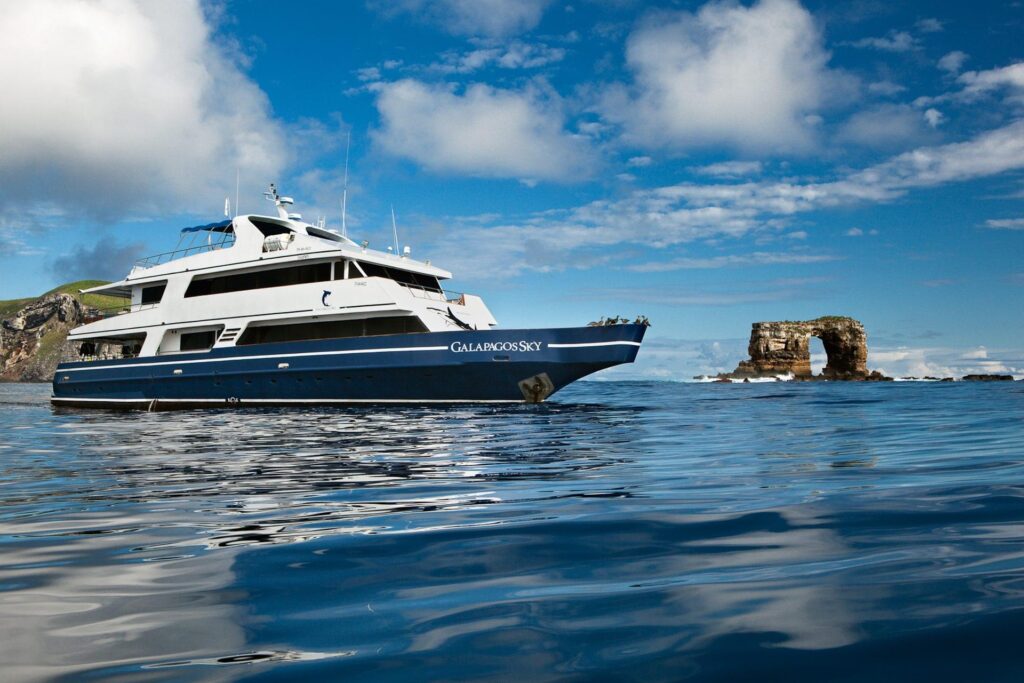
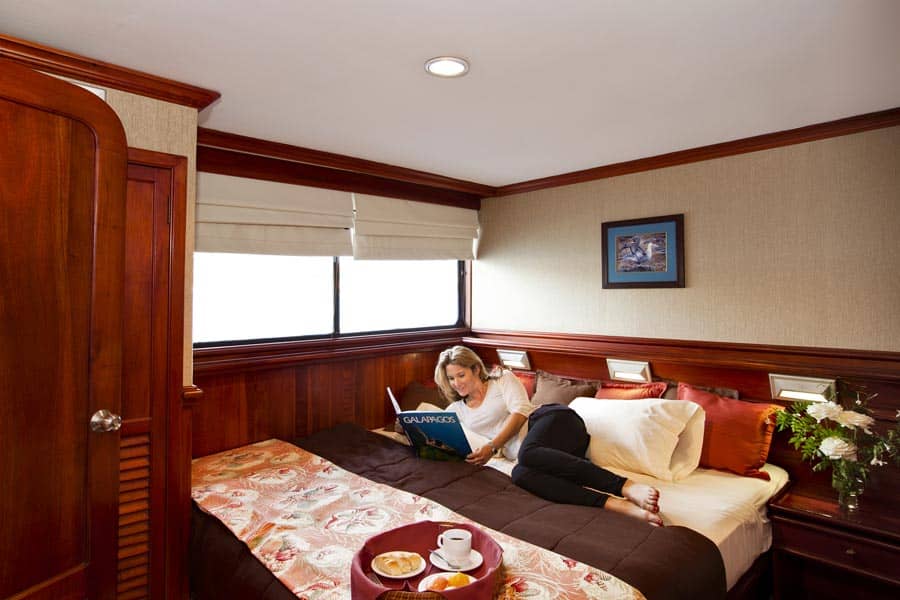
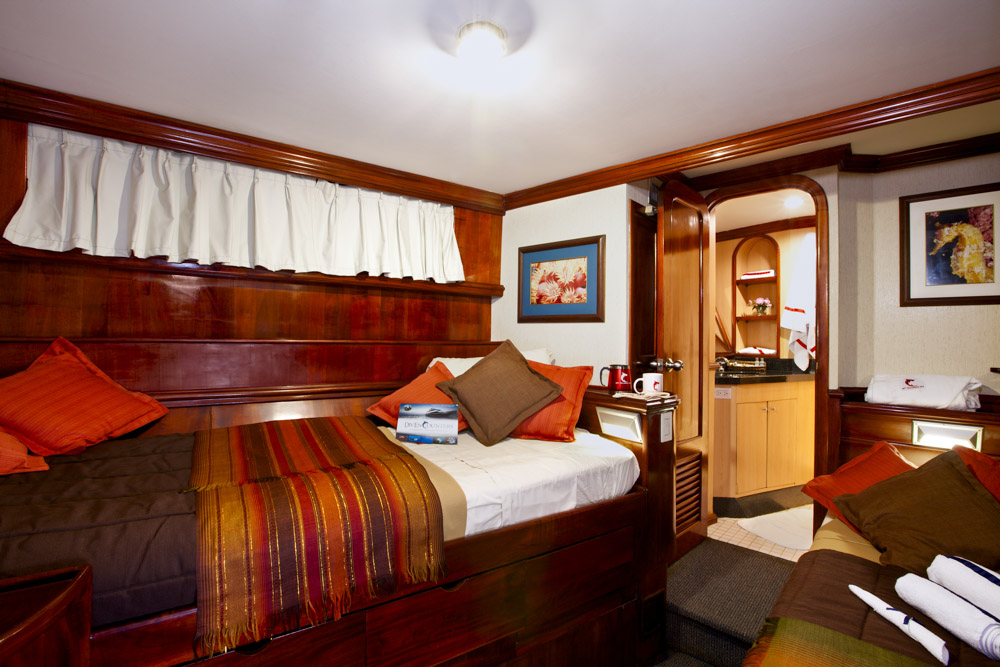
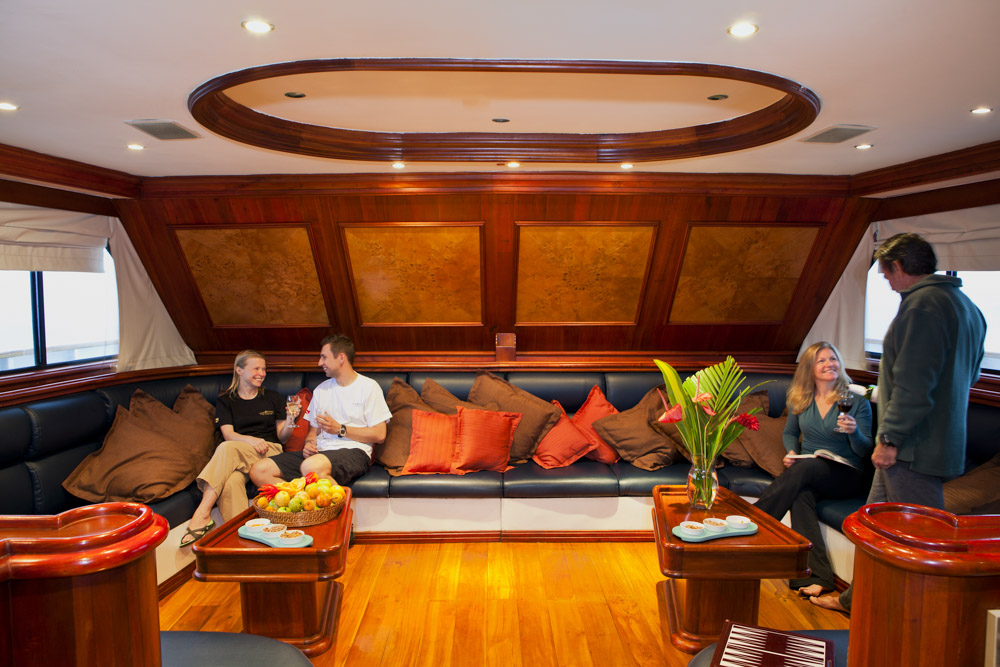
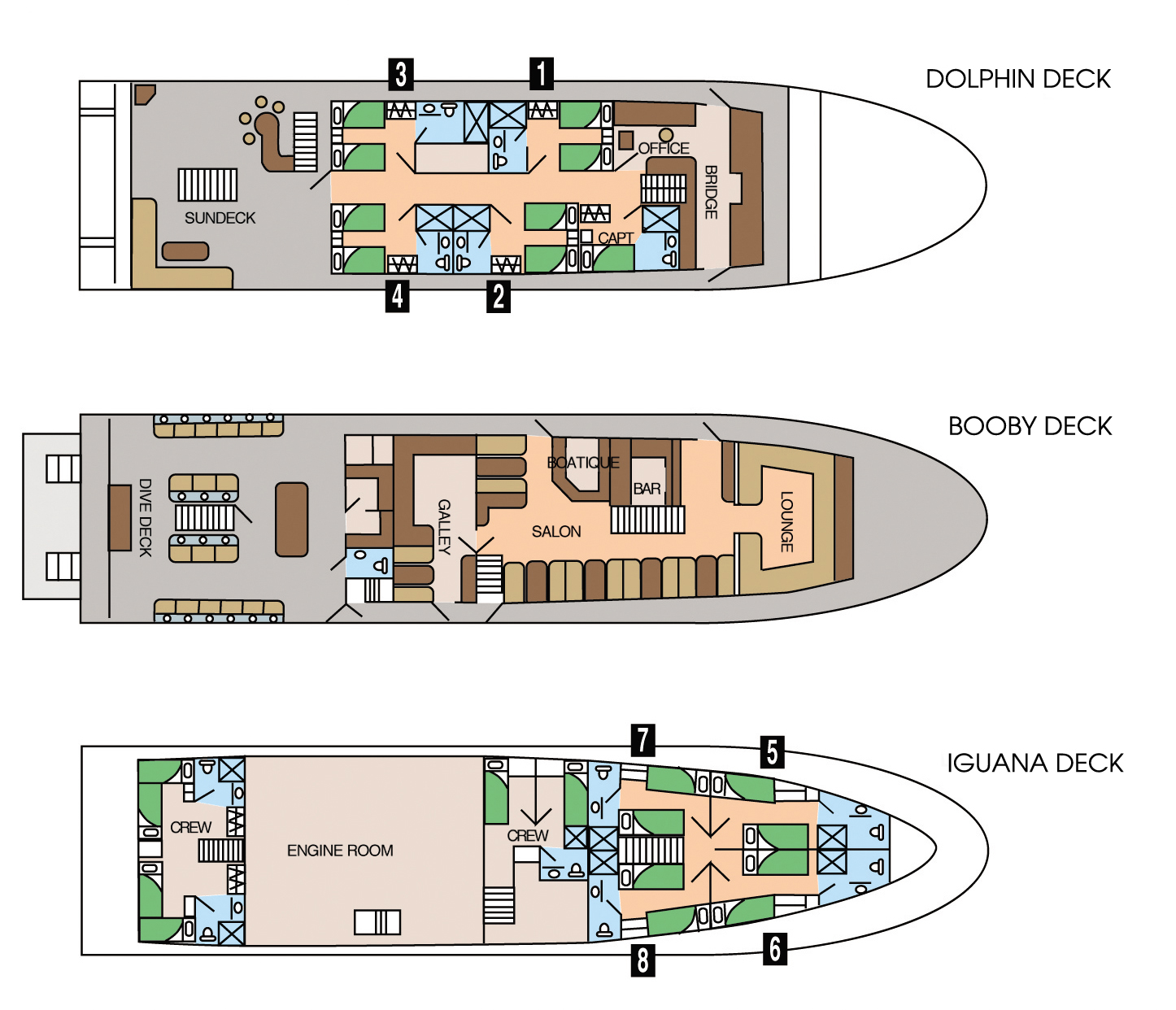
The luxury liveaboard M/V Galapagos Sky is a 33m state-of-the-art live-aboard diving yacht exploring the fabled waters of the Galapagos Islands. The ship has 8 cabins for a total number of 16 guests. The staterooms ranging from Master Staterooms to Deluxe Staterooms. All cabins are equipped with a private head/shower, mirrored cabinet and wardrobe, bathrobes, hairdryer, and marine safe (biodegradable) toiletries.
The elegant M/V Galapagos Sky is fully air-conditioned and features a spacious lounge area and a separate fine dining area. The main salon is also equipped with a TV and entertainment system, perfect to relax after your day of diving.
The vessel is designed to cruise with all international safety standards. On top guests can expect five-star-service of all crewmembers.
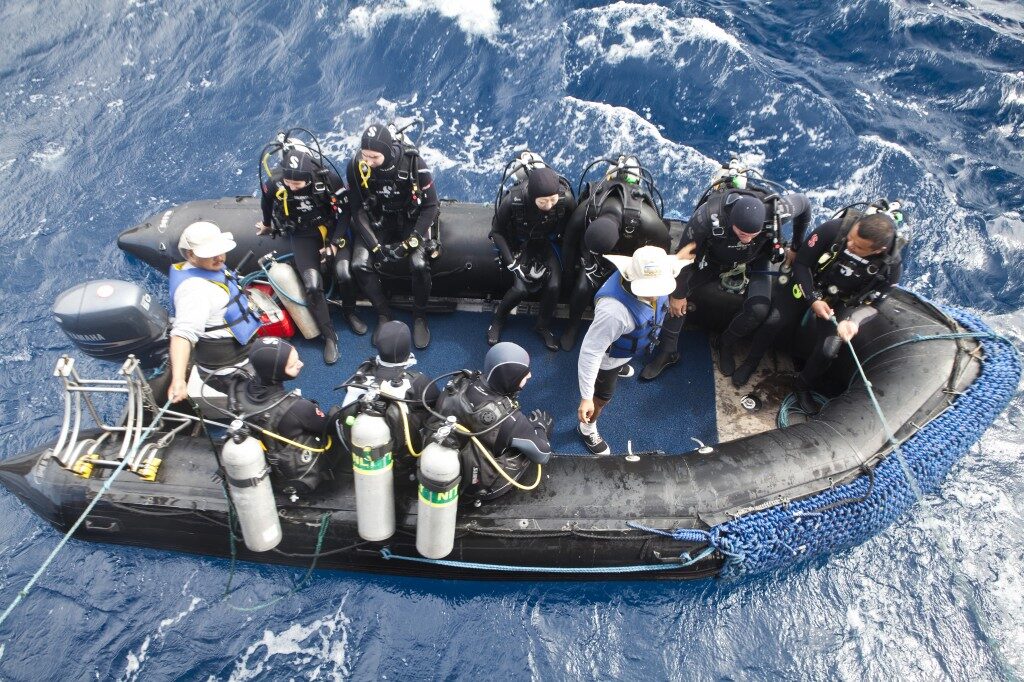
A huge dive platform is equipped with fresh hot water showers and enough space to enter and exit the water comfortably. Two dive masters and up to four dives a day ensure that your voyage will have ample underwater time to discover the magic of Galapagos diving.
Our Live-Aboard Diving Cruises to Galapagos are seven-night cruises, and the itinerary offers a total of approximately 17 – 19 dives (check out dive included). All weather, current and sea condition dependant and 3 land excursions on every trip.
Please note: Diving in Galapagos IS considered ADVANCED diving as it occurs in the presence of strong currents, cold water and at times limited visibility. Diving from tenders/pangas (small inflatable boats) is also the rule and not an exception in this world-renowned destination. Temperatures range from low 60’s to upper 70’s in different areas of the itinerary and seasons. Divers must be comfortable in these conditions, as well as have very good buoyancy and be able to do negative (sometimes rapid) back-roll entries/descents from small boats. Recommended requirements include 50-100 open water dives, experience in currents, ability in removing gear in water and ability in getting into small boats in choppy seas.
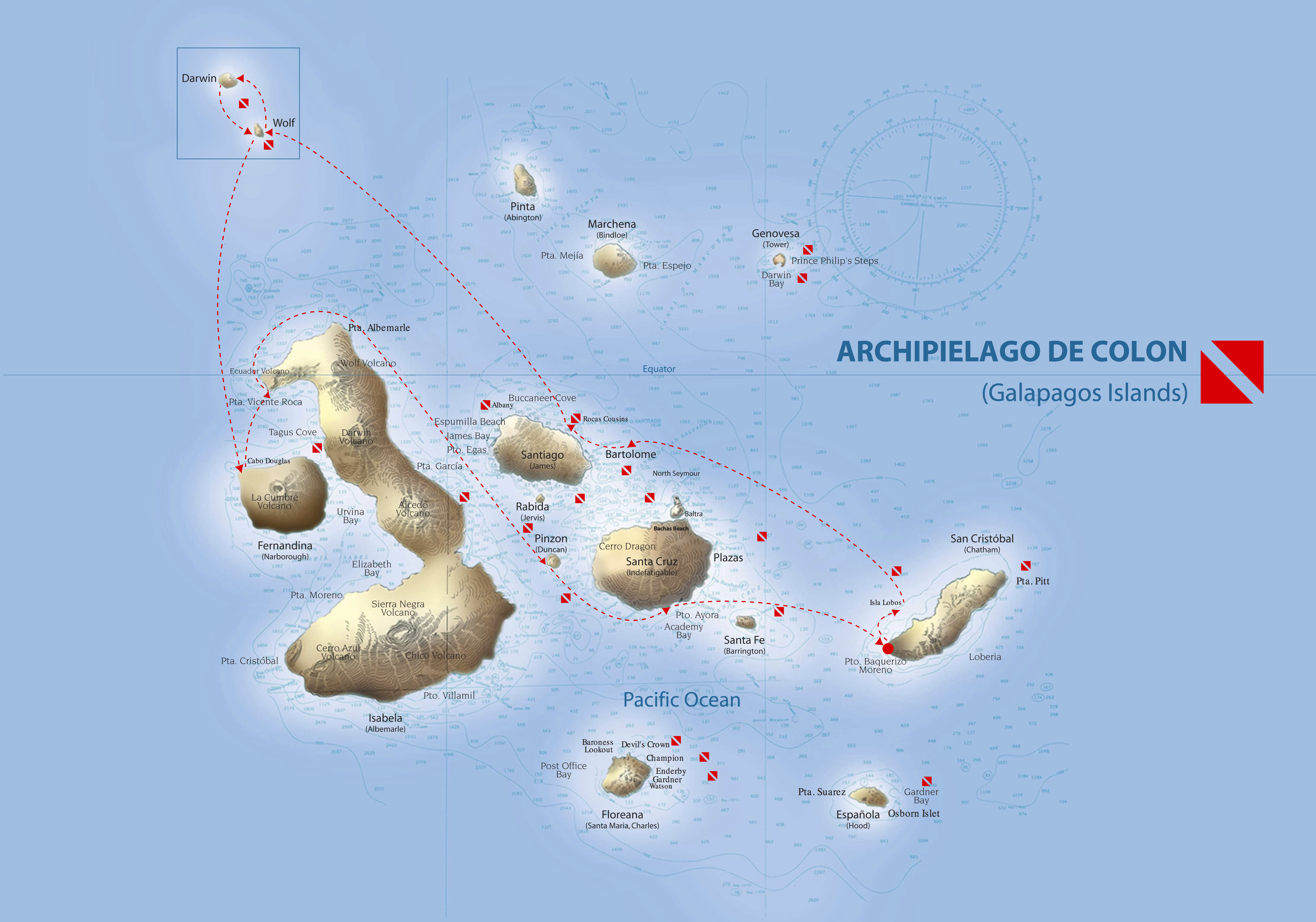
Your Galapagos Cruise Itinerary:
Sunday (Embarkation day): Isla Lobos- Check out dive
When you arrive at the airport at San Cristobal on Sunday (Avianca flight 1636), the crew of the Galapagos Sky will personally meet you, collect your luggage, and escort you to the Galapagos Sky. Your luggage will be delivered to the dive deck for you. After everyone is on board, we will introduce you to the boat and do our mandatory safety briefings and drills. Then, we cruise to the area of Los Lobos for your check-out dive.
This will be your first underwater introduction to Galapagos sea lions and fur seals! Watch them Zoom in and out and dance playfully for you!
Even on the first day of your liveaboard cruise – you begin to see the myriad and diverse land formations that comprise the Galapagos Islands topside. It is then you realize you will see nothing like it in your lifetime.
Monday: Bartolome – 1 dive and land walk, Cousins 2 dives
Bartolome – Penguins can be seen at this dive site. Bartolome is a lovely area where guests enjoy a favorite land tour where they can climb to the top of the hill to where breathe taking views to abound.
Cousins Rocks– this dive is an itinerary favorite and is done along a beautiful wall and allows for great viewing opportunities for corals, frogfish, sea horses, scorpion fish and octopus. It is also a great dive for large schools of Barracuda and also Hammerhead shark sightings. Sea lions will be your companions upon entry and on the safety stops.
By definition, the entire Galapagos Archipelago is geographically remote. But after this day of your live-aboard cruise finds you heading toward the most isolated, northernmost part of the Galapagos Islands – the uninhabited, untouched, twin cathedrals of world-class diving – Wolf and Darwin Islands.
Tuesday-Thursday: Wolf & Darwin
– Tues – 4 Dives a day at Wolf plus a night dive
– Wed – 4 dives at Darwin
– Thurs – 3 Dives total, 2 at Darwin and 1 afternoon dive at Wolf before long transit back to central islands
Diving Wolf and Darwin
You’ll spend the next three days diving (up to four dives per day plus a night dive) the legendary islands of WOLF & DARWIN.
Most experienced divers will agree, Wolf and Darwin can provide some of the best diving encounters in the world! Whale sharks are common here from mid May through November. At The Arch at Darwin, you will see hammerhead sharks either individually, in small groups, or large schools. Bottlenose dolphins are common. The reef contains many warm water varieties of fish found nowhere else in the Islands.
Once you see Wolf and Darwin – you’ll immediately understand why there are no shore excursions on this part of the cruise – there is no way up the vertical cliffs!
Darwin Island: Considered by many experienced divers as the very best dive site in the world, The Arch at Darwin island (actually several dive sites depending on where you enter, currents, etc) honors its reputation. It is warmer by a few degrees than the central islands. In one single dive you can find schooling hammerhead sharks, Galapagos sharks, large pods of dolphins, thick schools of skipjack and yellow fin tuna, big eye jacks, mobula rays, and silky sharks. From June to November, it is not uncommon to encounter whale sharks in multiple numbers on one single dive. The presence of occasional tiger sharks, black and blue marlin, and killer whales adds on to this amazing diving experience. If you still have time to look for smaller stuff, you’ll find octopus, flounders, and an enormous variety and abundance of tropical fish. Darwin Island is the biggest jewel on the Galapagos Crown.
Wolf Island: One of those magical islands, with several dive sites to choose from. If you want to see sharks, you are at the right spot. This is a place for schooling hammerhead sharks, large aggregations of Galapagos sharks, and occasionally whale sharks. Seeing dolphins, large schools of tuna, spotted eagle rays, barracudas, sea lions and sea turtles is common. The bottom is littered with hundreds of moray eels, many of them free swimming. Being several degrees warmer than the central islands, you can look for many representatives of the Indo-Pacific underwater fauna. On a night dive here you will also enjoy spotting and watching the Red Lipped bat fish walk along the bottom of the sea!
Friday: Cabo Douglas 1 dive (marine iguana dive), Punta Vicente Roca up to 2 dives and Panga ride if time allows.
Cabo Douglas: On the western side of Fernandina Island, we will do 1 dive Friday morning. Here you can expect to see Galapagos Penguins, Marine Iguanas, Flightless Cormorants, Sea Lions, Seahorse, Sea Turtles, Horn Sharks, Red Lipped Batfish, and occasional hammerhead sharks and white tip sharks. Also keep an eye out for chevron barracuda, snappers, yellowfin tuna, rainbow runners, and wahoo. There are also a lot of smaller fishes like creole fishes, parrotfishes, scrawled filefishes, pacific box fishes, and tiger snake eels.
Punta Vincente Roca: Our coldest yet rapidly increasing favorite dive – a steep, deep vertical wall covered in soft coral, sponges, and endemic black coral. Regular sightings of mola mola (oceanic sunfish,) sea horses, bullhead sharks, red-lipped batfish, various shrimp and many other marine invertebrates. Keep your eyes open for flybys from the flightless cormorants, penguins and maybe even a marine iguana. Our after-dive panga ride offers great topside photo ops for penguins, flightless cormorants, marine iguanas, sea lions, blue-footed & Nazca booby Bird, magnificent frigates and noddy terns. The diving here is chilly (particularly below the thermocline – but not to be missed!).
Saturday: Northeast tip of Isla Pinzon/Islote Dumb- 1 dive, Puerto Ayora/Highlands tour
Isla Pinzon – While diving Isla Pinzon you will be provided opportunities for encounters with a variety of species of sharks, sea lions, mantas, eagle rays, and moray eels. Many species of fish and tropicals including yellow-tailed surgeonfish, king angelfish, Moorish idols, steel pompanos, snappers, grunts, creole fish, and barracuda.
This dive is then followed by a transit to Itabaca Channel where guests will be transferred by bus (at approx. 1400h and approx.. 45-minute ground transfer) to visit the Highlands of Santa Cruz to see the Galapagos Tortoises in their natural environment, and visit Puerto Ayora. Guests will then be transferred back to Itabaca Channel to board the Galapagos Sky approx. 1900h for dinner on board. The Sky will then return to San Cristobal for Sunday morning cruise completion
Sunday Morning- Land Tour and Day of Departure
Interpretation center.
Arrive San Cristobal—(Land Excursion) visit the Interpretation Center where an interesting human history of Galapagos is presented, town walk (last chance for shopping). Late morning departure.
We look forward to sharing our Exceptional Underwater Adventures with you!
Inclusions
Exclusions
- Hyperbaric Chamber Fee: 35.00 USD
Our most popular question! The M/V Galapagos Sky offers live-aboard cruising all twelve months of the year – since 2001 – and visits the unbelievable islands of Wolf and Darwin on every trip. There are two “seasons” for Galapagos diving – WHALE SHARK SEASON (from June to November) and MANTA SEASON (December through May). Many of our guests are repeat visitors as BOTH seasons provide equally exciting encounters… The diving in the Galapagos Islands is simply phenomenal.
Our second most popular question and, emphatically, “Yes – on every trip”. The Galapagos Sky visits what divers consistently consider to be the most “High Octane” dive sites in the Galapagos Archipelago if not the world (weather permitting). Galapagos Sky schedules up to four dives a day (and a night dive) out at the remote islands of Wolf and Darwin for the pleasure of the divers. See our detailed itinerary for more info.
The 15 main islands (and numerous smaller ones) which make up the Galapagos archipelago lie 605 miles west of mainland Ecuador, the islands’ home country. These islands straddle the Equator with Wolf and Darwin islands at the northern most tip.
Yes. A trip to the Galapagos Islands would not be complete without seeing some of the unbelievable flora and fauna of this fabled archipelago. You cannot go ashore on Wolf and Darwin (they are uninhabited and have sheer cliffs rising right out of the sea) but we do feature 3 guided land tours on other islands (see our itinerary for details)
The M/V Galapagos Sky luxury live-aboard was launched in June of 2001 by it’s current owner, Santiago Dunn. It has been in continuous diving operation in the Galapagos Islands for the last decade. The vessel receives frequent upgrades and routine maintenance to stay in peak operating condition.
DivEncounters, Inc. is the worldwide representative for the M/V Galapagos Sky located in Miami, FL, USA. It was formed by Peter A. Hughes and Santiago Dunn, the owner of Galapagos Sky. Santiago is also the President of Ecoventura, a well respected Galapagos travel company since 1990.
Miami to Guayaquil, Ecuador is a 4 hour, 10 minutes flight. Flights to the Galapagos Islands from Guayaquil via Avianca (formerly Aerogal) are 1 hour and 40 minutes. International flight schedules do not allow most passengers to make the connection in one day – so most of our guests overnight in either Guayaquil or Quito, Ecuador on both ends of the trip. We are happy to make hotel arrangements for you.
Yes. For guests traveling through the capital city of Guayaquil, we recommend a one night stay at both ends of your live-aboard cruise. If you wish to stay in Ecuador for several days (or longer) we recommend that you stay (on one end of the trip) in the highlands city of Quito, Ecuador. It’s an amazing place filled with continuous vistas of the Andes mountains, a proud and friendly indigenous culture, world famous for its crafts, and has multiple opportunities for rain forest tours.
Manta Season is the “warm season” in the Galapagos Islands. Air temps go up a few degrees from Whale Shark Season, but shifting oceanic currents bring warmer water to the Galapagos, particularly to the northernmost Wolf and Darwin Islands. Expect anything from 70 to 82 degree water during this season. The Hammerhead action is fantastic (as it is all year) but during the warm season we see a tremendous increase in manta and ray activity. It’s possible to see giant mantas, large (200 plus) schools of mobula rays, spotted eagle rays, golden rays, cow-nosed rays, and marble rays. In general, seas are calmer topside in the Manta Season (less wind) but the underwater currents (responsible in a large part for the diversity and abundance of Galapagos marine life) will be present! Expect a brief rain shower in the central islands – but typically Wolf and Darwin are dry and warm.
As the name suggests – Whale Sharks! Up to 35 feet in length, these giant fish (the largest in the sea) may be seen at any time of the year in Galapagos – but with startling regularity during these 7 months. Water temperature is 60 – 75 F, 15 -24 C, so we do advise 5 – 7mm wetsuits. During these months, the prevailing trade winds blow at 10 – 15 mph at different times during the day. Multiple whale shark encounters on multiple days are not uncommon.
- Year built 2001
- Length 30 m
- Beam 7 m
- Cruising speed 12 knots
- Engines 2 x 500HP Caterpillar 3408
- Max guests 16
- Number of cabins 8
- Number of bathrooms 8
- Tenders Yes
- Water capacity 6'000 gallons
- Fuel capacity 8'000 gallons
- Freshwater maker 4'500 gallons per day
The luxury liveaboard M/V Galapagos Sky is a 33m state-of-the-art live-aboard diving yacht exploring the fabled waters of the Galapagos Islands. The ship has 8 cabins for a total number of 16 guests. The staterooms ranging from Master Staterooms to Deluxe Staterooms. All cabins are equipped with a private head/shower, mirrored cabinet and wardrobe, bathrobes, hairdryer, and marine safe (biodegradable) toiletries.
The elegant M/V Galapagos Sky is fully air-conditioned and features a spacious lounge area and a separate fine dining area. The main salon is also equipped with a TV and entertainment system, perfect to relax after your day of diving.
The vessel is designed to cruise with all international safety standards. On top guests can expect five-star-service of all crewmembers.
A huge dive platform is equipped with fresh hot water showers and enough space to enter and exit the water comfortably. Two dive masters and up to four dives a day ensure that your voyage will have ample underwater time to discover the magic of Galapagos diving.
Our Live-Aboard Diving Cruises to Galapagos are seven-night cruises, and the itinerary offers a total of approximately 17 – 19 dives (check out dive included). All weather, current and sea condition dependant and 3 land excursions on every trip.
Please note: Diving in Galapagos IS considered ADVANCED diving as it occurs in the presence of strong currents, cold water and at times limited visibility. Diving from tenders/pangas (small inflatable boats) is also the rule and not an exception in this world-renowned destination. Temperatures range from low 60’s to upper 70’s in different areas of the itinerary and seasons. Divers must be comfortable in these conditions, as well as have very good buoyancy and be able to do negative (sometimes rapid) back-roll entries/descents from small boats. Recommended requirements include 50-100 open water dives, experience in currents, ability in removing gear in water and ability in getting into small boats in choppy seas.
Your Galapagos Cruise Itinerary:
Sunday (Embarkation day): Isla Lobos- Check out dive
When you arrive at the airport at San Cristobal on Sunday (Avianca flight 1636), the crew of the Galapagos Sky will personally meet you, collect your luggage, and escort you to the Galapagos Sky. Your luggage will be delivered to the dive deck for you. After everyone is on board, we will introduce you to the boat and do our mandatory safety briefings and drills. Then, we cruise to the area of Los Lobos for your check-out dive.
This will be your first underwater introduction to Galapagos sea lions and fur seals! Watch them Zoom in and out and dance playfully for you!
Even on the first day of your liveaboard cruise – you begin to see the myriad and diverse land formations that comprise the Galapagos Islands topside. It is then you realize you will see nothing like it in your lifetime.
Monday: Bartolome – 1 dive and land walk, Cousins 2 dives
Bartolome – Penguins can be seen at this dive site. Bartolome is a lovely area where guests enjoy a favorite land tour where they can climb to the top of the hill to where breathe taking views to abound.
Cousins Rocks– this dive is an itinerary favorite and is done along a beautiful wall and allows for great viewing opportunities for corals, frogfish, sea horses, scorpion fish and octopus. It is also a great dive for large schools of Barracuda and also Hammerhead shark sightings. Sea lions will be your companions upon entry and on the safety stops.
By definition, the entire Galapagos Archipelago is geographically remote. But after this day of your live-aboard cruise finds you heading toward the most isolated, northernmost part of the Galapagos Islands – the uninhabited, untouched, twin cathedrals of world-class diving – Wolf and Darwin Islands.
Tuesday-Thursday: Wolf & Darwin
– Tues – 4 Dives a day at Wolf plus a night dive
– Wed – 4 dives at Darwin
– Thurs – 3 Dives total, 2 at Darwin and 1 afternoon dive at Wolf before long transit back to central islands
Diving Wolf and Darwin
You’ll spend the next three days diving (up to four dives per day plus a night dive) the legendary islands of WOLF & DARWIN.
Most experienced divers will agree, Wolf and Darwin can provide some of the best diving encounters in the world! Whale sharks are common here from mid May through November. At The Arch at Darwin, you will see hammerhead sharks either individually, in small groups, or large schools. Bottlenose dolphins are common. The reef contains many warm water varieties of fish found nowhere else in the Islands.
Once you see Wolf and Darwin – you’ll immediately understand why there are no shore excursions on this part of the cruise – there is no way up the vertical cliffs!
Darwin Island: Considered by many experienced divers as the very best dive site in the world, The Arch at Darwin island (actually several dive sites depending on where you enter, currents, etc) honors its reputation. It is warmer by a few degrees than the central islands. In one single dive you can find schooling hammerhead sharks, Galapagos sharks, large pods of dolphins, thick schools of skipjack and yellow fin tuna, big eye jacks, mobula rays, and silky sharks. From June to November, it is not uncommon to encounter whale sharks in multiple numbers on one single dive. The presence of occasional tiger sharks, black and blue marlin, and killer whales adds on to this amazing diving experience. If you still have time to look for smaller stuff, you’ll find octopus, flounders, and an enormous variety and abundance of tropical fish. Darwin Island is the biggest jewel on the Galapagos Crown.
Wolf Island: One of those magical islands, with several dive sites to choose from. If you want to see sharks, you are at the right spot. This is a place for schooling hammerhead sharks, large aggregations of Galapagos sharks, and occasionally whale sharks. Seeing dolphins, large schools of tuna, spotted eagle rays, barracudas, sea lions and sea turtles is common. The bottom is littered with hundreds of moray eels, many of them free swimming. Being several degrees warmer than the central islands, you can look for many representatives of the Indo-Pacific underwater fauna. On a night dive here you will also enjoy spotting and watching the Red Lipped bat fish walk along the bottom of the sea!
Friday: Cabo Douglas 1 dive (marine iguana dive), Punta Vicente Roca up to 2 dives and Panga ride if time allows.
Cabo Douglas: On the western side of Fernandina Island, we will do 1 dive Friday morning. Here you can expect to see Galapagos Penguins, Marine Iguanas, Flightless Cormorants, Sea Lions, Seahorse, Sea Turtles, Horn Sharks, Red Lipped Batfish, and occasional hammerhead sharks and white tip sharks. Also keep an eye out for chevron barracuda, snappers, yellowfin tuna, rainbow runners, and wahoo. There are also a lot of smaller fishes like creole fishes, parrotfishes, scrawled filefishes, pacific box fishes, and tiger snake eels.
Punta Vincente Roca: Our coldest yet rapidly increasing favorite dive – a steep, deep vertical wall covered in soft coral, sponges, and endemic black coral. Regular sightings of mola mola (oceanic sunfish,) sea horses, bullhead sharks, red-lipped batfish, various shrimp and many other marine invertebrates. Keep your eyes open for flybys from the flightless cormorants, penguins and maybe even a marine iguana. Our after-dive panga ride offers great topside photo ops for penguins, flightless cormorants, marine iguanas, sea lions, blue-footed & Nazca booby Bird, magnificent frigates and noddy terns. The diving here is chilly (particularly below the thermocline – but not to be missed!).
Saturday: Northeast tip of Isla Pinzon/Islote Dumb- 1 dive, Puerto Ayora/Highlands tour
Isla Pinzon – While diving Isla Pinzon you will be provided opportunities for encounters with a variety of species of sharks, sea lions, mantas, eagle rays, and moray eels. Many species of fish and tropicals including yellow-tailed surgeonfish, king angelfish, Moorish idols, steel pompanos, snappers, grunts, creole fish, and barracuda.
This dive is then followed by a transit to Itabaca Channel where guests will be transferred by bus (at approx. 1400h and approx.. 45-minute ground transfer) to visit the Highlands of Santa Cruz to see the Galapagos Tortoises in their natural environment, and visit Puerto Ayora. Guests will then be transferred back to Itabaca Channel to board the Galapagos Sky approx. 1900h for dinner on board. The Sky will then return to San Cristobal for Sunday morning cruise completion
Sunday Morning- Land Tour and Day of Departure
Interpretation center.
Arrive San Cristobal—(Land Excursion) visit the Interpretation Center where an interesting human history of Galapagos is presented, town walk (last chance for shopping). Late morning departure.
We look forward to sharing our Exceptional Underwater Adventures with you!
Inclusions
Exclusions
- Hyperbaric Chamber Fee: 35.00 USD
Our most popular question! The M/V Galapagos Sky offers live-aboard cruising all twelve months of the year – since 2001 – and visits the unbelievable islands of Wolf and Darwin on every trip. There are two “seasons” for Galapagos diving – WHALE SHARK SEASON (from June to November) and MANTA SEASON (December through May). Many of our guests are repeat visitors as BOTH seasons provide equally exciting encounters… The diving in the Galapagos Islands is simply phenomenal.
Our second most popular question and, emphatically, “Yes – on every trip”. The Galapagos Sky visits what divers consistently consider to be the most “High Octane” dive sites in the Galapagos Archipelago if not the world (weather permitting). Galapagos Sky schedules up to four dives a day (and a night dive) out at the remote islands of Wolf and Darwin for the pleasure of the divers. See our detailed itinerary for more info.
The 15 main islands (and numerous smaller ones) which make up the Galapagos archipelago lie 605 miles west of mainland Ecuador, the islands’ home country. These islands straddle the Equator with Wolf and Darwin islands at the northern most tip.
Yes. A trip to the Galapagos Islands would not be complete without seeing some of the unbelievable flora and fauna of this fabled archipelago. You cannot go ashore on Wolf and Darwin (they are uninhabited and have sheer cliffs rising right out of the sea) but we do feature 3 guided land tours on other islands (see our itinerary for details)
The M/V Galapagos Sky luxury live-aboard was launched in June of 2001 by it’s current owner, Santiago Dunn. It has been in continuous diving operation in the Galapagos Islands for the last decade. The vessel receives frequent upgrades and routine maintenance to stay in peak operating condition.
DivEncounters, Inc. is the worldwide representative for the M/V Galapagos Sky located in Miami, FL, USA. It was formed by Peter A. Hughes and Santiago Dunn, the owner of Galapagos Sky. Santiago is also the President of Ecoventura, a well respected Galapagos travel company since 1990.
Miami to Guayaquil, Ecuador is a 4 hour, 10 minutes flight. Flights to the Galapagos Islands from Guayaquil via Avianca (formerly Aerogal) are 1 hour and 40 minutes. International flight schedules do not allow most passengers to make the connection in one day – so most of our guests overnight in either Guayaquil or Quito, Ecuador on both ends of the trip. We are happy to make hotel arrangements for you.
Yes. For guests traveling through the capital city of Guayaquil, we recommend a one night stay at both ends of your live-aboard cruise. If you wish to stay in Ecuador for several days (or longer) we recommend that you stay (on one end of the trip) in the highlands city of Quito, Ecuador. It’s an amazing place filled with continuous vistas of the Andes mountains, a proud and friendly indigenous culture, world famous for its crafts, and has multiple opportunities for rain forest tours.
Manta Season is the “warm season” in the Galapagos Islands. Air temps go up a few degrees from Whale Shark Season, but shifting oceanic currents bring warmer water to the Galapagos, particularly to the northernmost Wolf and Darwin Islands. Expect anything from 70 to 82 degree water during this season. The Hammerhead action is fantastic (as it is all year) but during the warm season we see a tremendous increase in manta and ray activity. It’s possible to see giant mantas, large (200 plus) schools of mobula rays, spotted eagle rays, golden rays, cow-nosed rays, and marble rays. In general, seas are calmer topside in the Manta Season (less wind) but the underwater currents (responsible in a large part for the diversity and abundance of Galapagos marine life) will be present! Expect a brief rain shower in the central islands – but typically Wolf and Darwin are dry and warm.
As the name suggests – Whale Sharks! Up to 35 feet in length, these giant fish (the largest in the sea) may be seen at any time of the year in Galapagos – but with startling regularity during these 7 months. Water temperature is 60 – 75 F, 15 -24 C, so we do advise 5 – 7mm wetsuits. During these months, the prevailing trade winds blow at 10 – 15 mph at different times during the day. Multiple whale shark encounters on multiple days are not uncommon.
- Year built 2001
- Length 30 m
- Beam 7 m
- Cruising speed 12 knots
- Engines 2 x 500HP Caterpillar 3408
- Max guests 16
- Number of cabins 8
- Number of bathrooms 8
- Tenders Yes
- Water capacity 6'000 gallons
- Fuel capacity 8'000 gallons
- Freshwater maker 4'500 gallons per day
The luxury liveaboard M/V Galapagos Sky is a 33m state-of-the-art live-aboard diving yacht exploring the fabled waters of the Galapagos Islands. The ship has 8 cabins for a total number of 16 guests. The staterooms ranging from Master Staterooms to Deluxe Staterooms. All cabins are equipped with a private head/shower, mirrored cabinet and wardrobe, bathrobes, hairdryer, and marine safe (biodegradable) toiletries.
The elegant M/V Galapagos Sky is fully air-conditioned and features a spacious lounge area and a separate fine dining area. The main salon is also equipped with a TV and entertainment system, perfect to relax after your day of diving.
The vessel is designed to cruise with all international safety standards. On top guests can expect five-star-service of all crewmembers.
A huge dive platform is equipped with fresh hot water showers and enough space to enter and exit the water comfortably. Two dive masters and up to four dives a day ensure that your voyage will have ample underwater time to discover the magic of Galapagos diving.
Our Live-Aboard Diving Cruises to Galapagos are seven-night cruises, and the itinerary offers a total of approximately 17 – 19 dives (check out dive included). All weather, current and sea condition dependant and 3 land excursions on every trip.
Please note: Diving in Galapagos IS considered ADVANCED diving as it occurs in the presence of strong currents, cold water and at times limited visibility. Diving from tenders/pangas (small inflatable boats) is also the rule and not an exception in this world-renowned destination. Temperatures range from low 60’s to upper 70’s in different areas of the itinerary and seasons. Divers must be comfortable in these conditions, as well as have very good buoyancy and be able to do negative (sometimes rapid) back-roll entries/descents from small boats. Recommended requirements include 50-100 open water dives, experience in currents, ability in removing gear in water and ability in getting into small boats in choppy seas.
Your Galapagos Cruise Itinerary:
Sunday (Embarkation day): Isla Lobos- Check out dive
When you arrive at the airport at San Cristobal on Sunday (Avianca flight 1636), the crew of the Galapagos Sky will personally meet you, collect your luggage, and escort you to the Galapagos Sky. Your luggage will be delivered to the dive deck for you. After everyone is on board, we will introduce you to the boat and do our mandatory safety briefings and drills. Then, we cruise to the area of Los Lobos for your check-out dive.
This will be your first underwater introduction to Galapagos sea lions and fur seals! Watch them Zoom in and out and dance playfully for you!
Even on the first day of your liveaboard cruise – you begin to see the myriad and diverse land formations that comprise the Galapagos Islands topside. It is then you realize you will see nothing like it in your lifetime.
Monday: Bartolome – 1 dive and land walk, Cousins 2 dives
Bartolome – Penguins can be seen at this dive site. Bartolome is a lovely area where guests enjoy a favorite land tour where they can climb to the top of the hill to where breathe taking views to abound.
Cousins Rocks– this dive is an itinerary favorite and is done along a beautiful wall and allows for great viewing opportunities for corals, frogfish, sea horses, scorpion fish and octopus. It is also a great dive for large schools of Barracuda and also Hammerhead shark sightings. Sea lions will be your companions upon entry and on the safety stops.
By definition, the entire Galapagos Archipelago is geographically remote. But after this day of your live-aboard cruise finds you heading toward the most isolated, northernmost part of the Galapagos Islands – the uninhabited, untouched, twin cathedrals of world-class diving – Wolf and Darwin Islands.
Tuesday-Thursday: Wolf & Darwin
– Tues – 4 Dives a day at Wolf plus a night dive
– Wed – 4 dives at Darwin
– Thurs – 3 Dives total, 2 at Darwin and 1 afternoon dive at Wolf before long transit back to central islands
Diving Wolf and Darwin
You’ll spend the next three days diving (up to four dives per day plus a night dive) the legendary islands of WOLF & DARWIN.
Most experienced divers will agree, Wolf and Darwin can provide some of the best diving encounters in the world! Whale sharks are common here from mid May through November. At The Arch at Darwin, you will see hammerhead sharks either individually, in small groups, or large schools. Bottlenose dolphins are common. The reef contains many warm water varieties of fish found nowhere else in the Islands.
Once you see Wolf and Darwin – you’ll immediately understand why there are no shore excursions on this part of the cruise – there is no way up the vertical cliffs!
Darwin Island: Considered by many experienced divers as the very best dive site in the world, The Arch at Darwin island (actually several dive sites depending on where you enter, currents, etc) honors its reputation. It is warmer by a few degrees than the central islands. In one single dive you can find schooling hammerhead sharks, Galapagos sharks, large pods of dolphins, thick schools of skipjack and yellow fin tuna, big eye jacks, mobula rays, and silky sharks. From June to November, it is not uncommon to encounter whale sharks in multiple numbers on one single dive. The presence of occasional tiger sharks, black and blue marlin, and killer whales adds on to this amazing diving experience. If you still have time to look for smaller stuff, you’ll find octopus, flounders, and an enormous variety and abundance of tropical fish. Darwin Island is the biggest jewel on the Galapagos Crown.
Wolf Island: One of those magical islands, with several dive sites to choose from. If you want to see sharks, you are at the right spot. This is a place for schooling hammerhead sharks, large aggregations of Galapagos sharks, and occasionally whale sharks. Seeing dolphins, large schools of tuna, spotted eagle rays, barracudas, sea lions and sea turtles is common. The bottom is littered with hundreds of moray eels, many of them free swimming. Being several degrees warmer than the central islands, you can look for many representatives of the Indo-Pacific underwater fauna. On a night dive here you will also enjoy spotting and watching the Red Lipped bat fish walk along the bottom of the sea!
Friday: Cabo Douglas 1 dive (marine iguana dive), Punta Vicente Roca up to 2 dives and Panga ride if time allows.
Cabo Douglas: On the western side of Fernandina Island, we will do 1 dive Friday morning. Here you can expect to see Galapagos Penguins, Marine Iguanas, Flightless Cormorants, Sea Lions, Seahorse, Sea Turtles, Horn Sharks, Red Lipped Batfish, and occasional hammerhead sharks and white tip sharks. Also keep an eye out for chevron barracuda, snappers, yellowfin tuna, rainbow runners, and wahoo. There are also a lot of smaller fishes like creole fishes, parrotfishes, scrawled filefishes, pacific box fishes, and tiger snake eels.
Punta Vincente Roca: Our coldest yet rapidly increasing favorite dive – a steep, deep vertical wall covered in soft coral, sponges, and endemic black coral. Regular sightings of mola mola (oceanic sunfish,) sea horses, bullhead sharks, red-lipped batfish, various shrimp and many other marine invertebrates. Keep your eyes open for flybys from the flightless cormorants, penguins and maybe even a marine iguana. Our after-dive panga ride offers great topside photo ops for penguins, flightless cormorants, marine iguanas, sea lions, blue-footed & Nazca booby Bird, magnificent frigates and noddy terns. The diving here is chilly (particularly below the thermocline – but not to be missed!).
Saturday: Northeast tip of Isla Pinzon/Islote Dumb- 1 dive, Puerto Ayora/Highlands tour
Isla Pinzon – While diving Isla Pinzon you will be provided opportunities for encounters with a variety of species of sharks, sea lions, mantas, eagle rays, and moray eels. Many species of fish and tropicals including yellow-tailed surgeonfish, king angelfish, Moorish idols, steel pompanos, snappers, grunts, creole fish, and barracuda.
This dive is then followed by a transit to Itabaca Channel where guests will be transferred by bus (at approx. 1400h and approx.. 45-minute ground transfer) to visit the Highlands of Santa Cruz to see the Galapagos Tortoises in their natural environment, and visit Puerto Ayora. Guests will then be transferred back to Itabaca Channel to board the Galapagos Sky approx. 1900h for dinner on board. The Sky will then return to San Cristobal for Sunday morning cruise completion
Sunday Morning- Land Tour and Day of Departure
Interpretation center.
Arrive San Cristobal—(Land Excursion) visit the Interpretation Center where an interesting human history of Galapagos is presented, town walk (last chance for shopping). Late morning departure.
We look forward to sharing our Exceptional Underwater Adventures with you!
Inclusions
Exclusions
- Hyperbaric Chamber Fee: 35.00 USD
Our most popular question! The M/V Galapagos Sky offers live-aboard cruising all twelve months of the year – since 2001 – and visits the unbelievable islands of Wolf and Darwin on every trip. There are two “seasons” for Galapagos diving – WHALE SHARK SEASON (from June to November) and MANTA SEASON (December through May). Many of our guests are repeat visitors as BOTH seasons provide equally exciting encounters… The diving in the Galapagos Islands is simply phenomenal.
Our second most popular question and, emphatically, “Yes – on every trip”. The Galapagos Sky visits what divers consistently consider to be the most “High Octane” dive sites in the Galapagos Archipelago if not the world (weather permitting). Galapagos Sky schedules up to four dives a day (and a night dive) out at the remote islands of Wolf and Darwin for the pleasure of the divers. See our detailed itinerary for more info.
The 15 main islands (and numerous smaller ones) which make up the Galapagos archipelago lie 605 miles west of mainland Ecuador, the islands’ home country. These islands straddle the Equator with Wolf and Darwin islands at the northern most tip.
Yes. A trip to the Galapagos Islands would not be complete without seeing some of the unbelievable flora and fauna of this fabled archipelago. You cannot go ashore on Wolf and Darwin (they are uninhabited and have sheer cliffs rising right out of the sea) but we do feature 3 guided land tours on other islands (see our itinerary for details)
The M/V Galapagos Sky luxury live-aboard was launched in June of 2001 by it’s current owner, Santiago Dunn. It has been in continuous diving operation in the Galapagos Islands for the last decade. The vessel receives frequent upgrades and routine maintenance to stay in peak operating condition.
DivEncounters, Inc. is the worldwide representative for the M/V Galapagos Sky located in Miami, FL, USA. It was formed by Peter A. Hughes and Santiago Dunn, the owner of Galapagos Sky. Santiago is also the President of Ecoventura, a well respected Galapagos travel company since 1990.
Miami to Guayaquil, Ecuador is a 4 hour, 10 minutes flight. Flights to the Galapagos Islands from Guayaquil via Avianca (formerly Aerogal) are 1 hour and 40 minutes. International flight schedules do not allow most passengers to make the connection in one day – so most of our guests overnight in either Guayaquil or Quito, Ecuador on both ends of the trip. We are happy to make hotel arrangements for you.
Yes. For guests traveling through the capital city of Guayaquil, we recommend a one night stay at both ends of your live-aboard cruise. If you wish to stay in Ecuador for several days (or longer) we recommend that you stay (on one end of the trip) in the highlands city of Quito, Ecuador. It’s an amazing place filled with continuous vistas of the Andes mountains, a proud and friendly indigenous culture, world famous for its crafts, and has multiple opportunities for rain forest tours.
Manta Season is the “warm season” in the Galapagos Islands. Air temps go up a few degrees from Whale Shark Season, but shifting oceanic currents bring warmer water to the Galapagos, particularly to the northernmost Wolf and Darwin Islands. Expect anything from 70 to 82 degree water during this season. The Hammerhead action is fantastic (as it is all year) but during the warm season we see a tremendous increase in manta and ray activity. It’s possible to see giant mantas, large (200 plus) schools of mobula rays, spotted eagle rays, golden rays, cow-nosed rays, and marble rays. In general, seas are calmer topside in the Manta Season (less wind) but the underwater currents (responsible in a large part for the diversity and abundance of Galapagos marine life) will be present! Expect a brief rain shower in the central islands – but typically Wolf and Darwin are dry and warm.
As the name suggests – Whale Sharks! Up to 35 feet in length, these giant fish (the largest in the sea) may be seen at any time of the year in Galapagos – but with startling regularity during these 7 months. Water temperature is 60 – 75 F, 15 -24 C, so we do advise 5 – 7mm wetsuits. During these months, the prevailing trade winds blow at 10 – 15 mph at different times during the day. Multiple whale shark encounters on multiple days are not uncommon.
- Year built 2001
- Length 30 m
- Beam 7 m
- Cruising speed 12 knots
- Engines 2 x 500HP Caterpillar 3408
- Max guests 16
- Number of cabins 8
- Number of bathrooms 8
- Tenders Yes
- Water capacity 6'000 gallons
- Fuel capacity 8'000 gallons
- Freshwater maker 4'500 gallons per day
The luxury liveaboard M/V Galapagos Sky is a 33m state-of-the-art live-aboard diving yacht exploring the fabled waters of the Galapagos Islands. The ship has 8 cabins for a total number of 16 guests. The staterooms ranging from Master Staterooms to Deluxe Staterooms. All cabins are equipped with a private head/shower, mirrored cabinet and wardrobe, bathrobes, hairdryer, and marine safe (biodegradable) toiletries.
The elegant M/V Galapagos Sky is fully air-conditioned and features a spacious lounge area and a separate fine dining area. The main salon is also equipped with a TV and entertainment system, perfect to relax after your day of diving.
The vessel is designed to cruise with all international safety standards. On top guests can expect five-star-service of all crewmembers.
A huge dive platform is equipped with fresh hot water showers and enough space to enter and exit the water comfortably. Two dive masters and up to four dives a day ensure that your voyage will have ample underwater time to discover the magic of Galapagos diving.
Our Live-Aboard Diving Cruises to Galapagos are seven-night cruises, and the itinerary offers a total of approximately 17 – 19 dives (check out dive included). All weather, current and sea condition dependant and 3 land excursions on every trip.
Please note: Diving in Galapagos IS considered ADVANCED diving as it occurs in the presence of strong currents, cold water and at times limited visibility. Diving from tenders/pangas (small inflatable boats) is also the rule and not an exception in this world-renowned destination. Temperatures range from low 60’s to upper 70’s in different areas of the itinerary and seasons. Divers must be comfortable in these conditions, as well as have very good buoyancy and be able to do negative (sometimes rapid) back-roll entries/descents from small boats. Recommended requirements include 50-100 open water dives, experience in currents, ability in removing gear in water and ability in getting into small boats in choppy seas.
Your Galapagos Cruise Itinerary:
Sunday (Embarkation day): Isla Lobos- Check out dive
When you arrive at the airport at San Cristobal on Sunday (Avianca flight 1636), the crew of the Galapagos Sky will personally meet you, collect your luggage, and escort you to the Galapagos Sky. Your luggage will be delivered to the dive deck for you. After everyone is on board, we will introduce you to the boat and do our mandatory safety briefings and drills. Then, we cruise to the area of Los Lobos for your check-out dive.
This will be your first underwater introduction to Galapagos sea lions and fur seals! Watch them Zoom in and out and dance playfully for you!
Even on the first day of your liveaboard cruise – you begin to see the myriad and diverse land formations that comprise the Galapagos Islands topside. It is then you realize you will see nothing like it in your lifetime.
Monday: Bartolome – 1 dive and land walk, Cousins 2 dives
Bartolome – Penguins can be seen at this dive site. Bartolome is a lovely area where guests enjoy a favorite land tour where they can climb to the top of the hill to where breathe taking views to abound.
Cousins Rocks– this dive is an itinerary favorite and is done along a beautiful wall and allows for great viewing opportunities for corals, frogfish, sea horses, scorpion fish and octopus. It is also a great dive for large schools of Barracuda and also Hammerhead shark sightings. Sea lions will be your companions upon entry and on the safety stops.
By definition, the entire Galapagos Archipelago is geographically remote. But after this day of your live-aboard cruise finds you heading toward the most isolated, northernmost part of the Galapagos Islands – the uninhabited, untouched, twin cathedrals of world-class diving – Wolf and Darwin Islands.
Tuesday-Thursday: Wolf & Darwin
– Tues – 4 Dives a day at Wolf plus a night dive
– Wed – 4 dives at Darwin
– Thurs – 3 Dives total, 2 at Darwin and 1 afternoon dive at Wolf before long transit back to central islands
Diving Wolf and Darwin
You’ll spend the next three days diving (up to four dives per day plus a night dive) the legendary islands of WOLF & DARWIN.
Most experienced divers will agree, Wolf and Darwin can provide some of the best diving encounters in the world! Whale sharks are common here from mid May through November. At The Arch at Darwin, you will see hammerhead sharks either individually, in small groups, or large schools. Bottlenose dolphins are common. The reef contains many warm water varieties of fish found nowhere else in the Islands.
Once you see Wolf and Darwin – you’ll immediately understand why there are no shore excursions on this part of the cruise – there is no way up the vertical cliffs!
Darwin Island: Considered by many experienced divers as the very best dive site in the world, The Arch at Darwin island (actually several dive sites depending on where you enter, currents, etc) honors its reputation. It is warmer by a few degrees than the central islands. In one single dive you can find schooling hammerhead sharks, Galapagos sharks, large pods of dolphins, thick schools of skipjack and yellow fin tuna, big eye jacks, mobula rays, and silky sharks. From June to November, it is not uncommon to encounter whale sharks in multiple numbers on one single dive. The presence of occasional tiger sharks, black and blue marlin, and killer whales adds on to this amazing diving experience. If you still have time to look for smaller stuff, you’ll find octopus, flounders, and an enormous variety and abundance of tropical fish. Darwin Island is the biggest jewel on the Galapagos Crown.
Wolf Island: One of those magical islands, with several dive sites to choose from. If you want to see sharks, you are at the right spot. This is a place for schooling hammerhead sharks, large aggregations of Galapagos sharks, and occasionally whale sharks. Seeing dolphins, large schools of tuna, spotted eagle rays, barracudas, sea lions and sea turtles is common. The bottom is littered with hundreds of moray eels, many of them free swimming. Being several degrees warmer than the central islands, you can look for many representatives of the Indo-Pacific underwater fauna. On a night dive here you will also enjoy spotting and watching the Red Lipped bat fish walk along the bottom of the sea!
Friday: Cabo Douglas 1 dive (marine iguana dive), Punta Vicente Roca up to 2 dives and Panga ride if time allows.
Cabo Douglas: On the western side of Fernandina Island, we will do 1 dive Friday morning. Here you can expect to see Galapagos Penguins, Marine Iguanas, Flightless Cormorants, Sea Lions, Seahorse, Sea Turtles, Horn Sharks, Red Lipped Batfish, and occasional hammerhead sharks and white tip sharks. Also keep an eye out for chevron barracuda, snappers, yellowfin tuna, rainbow runners, and wahoo. There are also a lot of smaller fishes like creole fishes, parrotfishes, scrawled filefishes, pacific box fishes, and tiger snake eels.
Punta Vincente Roca: Our coldest yet rapidly increasing favorite dive – a steep, deep vertical wall covered in soft coral, sponges, and endemic black coral. Regular sightings of mola mola (oceanic sunfish,) sea horses, bullhead sharks, red-lipped batfish, various shrimp and many other marine invertebrates. Keep your eyes open for flybys from the flightless cormorants, penguins and maybe even a marine iguana. Our after-dive panga ride offers great topside photo ops for penguins, flightless cormorants, marine iguanas, sea lions, blue-footed & Nazca booby Bird, magnificent frigates and noddy terns. The diving here is chilly (particularly below the thermocline – but not to be missed!).
Saturday: Northeast tip of Isla Pinzon/Islote Dumb- 1 dive, Puerto Ayora/Highlands tour
Isla Pinzon – While diving Isla Pinzon you will be provided opportunities for encounters with a variety of species of sharks, sea lions, mantas, eagle rays, and moray eels. Many species of fish and tropicals including yellow-tailed surgeonfish, king angelfish, Moorish idols, steel pompanos, snappers, grunts, creole fish, and barracuda.
This dive is then followed by a transit to Itabaca Channel where guests will be transferred by bus (at approx. 1400h and approx.. 45-minute ground transfer) to visit the Highlands of Santa Cruz to see the Galapagos Tortoises in their natural environment, and visit Puerto Ayora. Guests will then be transferred back to Itabaca Channel to board the Galapagos Sky approx. 1900h for dinner on board. The Sky will then return to San Cristobal for Sunday morning cruise completion
Sunday Morning- Land Tour and Day of Departure
Interpretation center.
Arrive San Cristobal—(Land Excursion) visit the Interpretation Center where an interesting human history of Galapagos is presented, town walk (last chance for shopping). Late morning departure.
We look forward to sharing our Exceptional Underwater Adventures with you!
Inclusions
Exclusions
- Hyperbaric Chamber Fee: 35.00 USD
Our most popular question! The M/V Galapagos Sky offers live-aboard cruising all twelve months of the year – since 2001 – and visits the unbelievable islands of Wolf and Darwin on every trip. There are two “seasons” for Galapagos diving – WHALE SHARK SEASON (from June to November) and MANTA SEASON (December through May). Many of our guests are repeat visitors as BOTH seasons provide equally exciting encounters… The diving in the Galapagos Islands is simply phenomenal.
Our second most popular question and, emphatically, “Yes – on every trip”. The Galapagos Sky visits what divers consistently consider to be the most “High Octane” dive sites in the Galapagos Archipelago if not the world (weather permitting). Galapagos Sky schedules up to four dives a day (and a night dive) out at the remote islands of Wolf and Darwin for the pleasure of the divers. See our detailed itinerary for more info.
The 15 main islands (and numerous smaller ones) which make up the Galapagos archipelago lie 605 miles west of mainland Ecuador, the islands’ home country. These islands straddle the Equator with Wolf and Darwin islands at the northern most tip.
Yes. A trip to the Galapagos Islands would not be complete without seeing some of the unbelievable flora and fauna of this fabled archipelago. You cannot go ashore on Wolf and Darwin (they are uninhabited and have sheer cliffs rising right out of the sea) but we do feature 3 guided land tours on other islands (see our itinerary for details)
The M/V Galapagos Sky luxury live-aboard was launched in June of 2001 by it’s current owner, Santiago Dunn. It has been in continuous diving operation in the Galapagos Islands for the last decade. The vessel receives frequent upgrades and routine maintenance to stay in peak operating condition.
DivEncounters, Inc. is the worldwide representative for the M/V Galapagos Sky located in Miami, FL, USA. It was formed by Peter A. Hughes and Santiago Dunn, the owner of Galapagos Sky. Santiago is also the President of Ecoventura, a well respected Galapagos travel company since 1990.
Miami to Guayaquil, Ecuador is a 4 hour, 10 minutes flight. Flights to the Galapagos Islands from Guayaquil via Avianca (formerly Aerogal) are 1 hour and 40 minutes. International flight schedules do not allow most passengers to make the connection in one day – so most of our guests overnight in either Guayaquil or Quito, Ecuador on both ends of the trip. We are happy to make hotel arrangements for you.
Yes. For guests traveling through the capital city of Guayaquil, we recommend a one night stay at both ends of your live-aboard cruise. If you wish to stay in Ecuador for several days (or longer) we recommend that you stay (on one end of the trip) in the highlands city of Quito, Ecuador. It’s an amazing place filled with continuous vistas of the Andes mountains, a proud and friendly indigenous culture, world famous for its crafts, and has multiple opportunities for rain forest tours.
Manta Season is the “warm season” in the Galapagos Islands. Air temps go up a few degrees from Whale Shark Season, but shifting oceanic currents bring warmer water to the Galapagos, particularly to the northernmost Wolf and Darwin Islands. Expect anything from 70 to 82 degree water during this season. The Hammerhead action is fantastic (as it is all year) but during the warm season we see a tremendous increase in manta and ray activity. It’s possible to see giant mantas, large (200 plus) schools of mobula rays, spotted eagle rays, golden rays, cow-nosed rays, and marble rays. In general, seas are calmer topside in the Manta Season (less wind) but the underwater currents (responsible in a large part for the diversity and abundance of Galapagos marine life) will be present! Expect a brief rain shower in the central islands – but typically Wolf and Darwin are dry and warm.
As the name suggests – Whale Sharks! Up to 35 feet in length, these giant fish (the largest in the sea) may be seen at any time of the year in Galapagos – but with startling regularity during these 7 months. Water temperature is 60 – 75 F, 15 -24 C, so we do advise 5 – 7mm wetsuits. During these months, the prevailing trade winds blow at 10 – 15 mph at different times during the day. Multiple whale shark encounters on multiple days are not uncommon.
- Year built 2001
- Length 30 m
- Beam 7 m
- Cruising speed 12 knots
- Engines 2 x 500HP Caterpillar 3408
- Max guests 16
- Number of cabins 8
- Number of bathrooms 8
- Tenders Yes
- Water capacity 6'000 gallons
- Fuel capacity 8'000 gallons
- Freshwater maker 4'500 gallons per day
The luxury liveaboard M/V Galapagos Sky is a 33m state-of-the-art live-aboard diving yacht exploring the fabled waters of the Galapagos Islands. The ship has 8 cabins for a total number of 16 guests. The staterooms ranging from Master Staterooms to Deluxe Staterooms. All cabins are equipped with a private head/shower, mirrored cabinet and wardrobe, bathrobes, hairdryer, and marine safe (biodegradable) toiletries.
The elegant M/V Galapagos Sky is fully air-conditioned and features a spacious lounge area and a separate fine dining area. The main salon is also equipped with a TV and entertainment system, perfect to relax after your day of diving.
The vessel is designed to cruise with all international safety standards. On top guests can expect five-star-service of all crewmembers.
A huge dive platform is equipped with fresh hot water showers and enough space to enter and exit the water comfortably. Two dive masters and up to four dives a day ensure that your voyage will have ample underwater time to discover the magic of Galapagos diving.
Our Live-Aboard Diving Cruises to Galapagos are seven-night cruises, and the itinerary offers a total of approximately 17 – 19 dives (check out dive included). All weather, current and sea condition dependant and 3 land excursions on every trip.
Please note: Diving in Galapagos IS considered ADVANCED diving as it occurs in the presence of strong currents, cold water and at times limited visibility. Diving from tenders/pangas (small inflatable boats) is also the rule and not an exception in this world-renowned destination. Temperatures range from low 60’s to upper 70’s in different areas of the itinerary and seasons. Divers must be comfortable in these conditions, as well as have very good buoyancy and be able to do negative (sometimes rapid) back-roll entries/descents from small boats. Recommended requirements include 50-100 open water dives, experience in currents, ability in removing gear in water and ability in getting into small boats in choppy seas.
Your Galapagos Cruise Itinerary:
Sunday (Embarkation day): Isla Lobos- Check out dive
When you arrive at the airport at San Cristobal on Sunday (Avianca flight 1636), the crew of the Galapagos Sky will personally meet you, collect your luggage, and escort you to the Galapagos Sky. Your luggage will be delivered to the dive deck for you. After everyone is on board, we will introduce you to the boat and do our mandatory safety briefings and drills. Then, we cruise to the area of Los Lobos for your check-out dive.
This will be your first underwater introduction to Galapagos sea lions and fur seals! Watch them Zoom in and out and dance playfully for you!
Even on the first day of your liveaboard cruise – you begin to see the myriad and diverse land formations that comprise the Galapagos Islands topside. It is then you realize you will see nothing like it in your lifetime.
Monday: Bartolome – 1 dive and land walk, Cousins 2 dives
Bartolome – Penguins can be seen at this dive site. Bartolome is a lovely area where guests enjoy a favorite land tour where they can climb to the top of the hill to where breathe taking views to abound.
Cousins Rocks– this dive is an itinerary favorite and is done along a beautiful wall and allows for great viewing opportunities for corals, frogfish, sea horses, scorpion fish and octopus. It is also a great dive for large schools of Barracuda and also Hammerhead shark sightings. Sea lions will be your companions upon entry and on the safety stops.
By definition, the entire Galapagos Archipelago is geographically remote. But after this day of your live-aboard cruise finds you heading toward the most isolated, northernmost part of the Galapagos Islands – the uninhabited, untouched, twin cathedrals of world-class diving – Wolf and Darwin Islands.
Tuesday-Thursday: Wolf & Darwin
– Tues – 4 Dives a day at Wolf plus a night dive
– Wed – 4 dives at Darwin
– Thurs – 3 Dives total, 2 at Darwin and 1 afternoon dive at Wolf before long transit back to central islands
Diving Wolf and Darwin
You’ll spend the next three days diving (up to four dives per day plus a night dive) the legendary islands of WOLF & DARWIN.
Most experienced divers will agree, Wolf and Darwin can provide some of the best diving encounters in the world! Whale sharks are common here from mid May through November. At The Arch at Darwin, you will see hammerhead sharks either individually, in small groups, or large schools. Bottlenose dolphins are common. The reef contains many warm water varieties of fish found nowhere else in the Islands.
Once you see Wolf and Darwin – you’ll immediately understand why there are no shore excursions on this part of the cruise – there is no way up the vertical cliffs!
Darwin Island: Considered by many experienced divers as the very best dive site in the world, The Arch at Darwin island (actually several dive sites depending on where you enter, currents, etc) honors its reputation. It is warmer by a few degrees than the central islands. In one single dive you can find schooling hammerhead sharks, Galapagos sharks, large pods of dolphins, thick schools of skipjack and yellow fin tuna, big eye jacks, mobula rays, and silky sharks. From June to November, it is not uncommon to encounter whale sharks in multiple numbers on one single dive. The presence of occasional tiger sharks, black and blue marlin, and killer whales adds on to this amazing diving experience. If you still have time to look for smaller stuff, you’ll find octopus, flounders, and an enormous variety and abundance of tropical fish. Darwin Island is the biggest jewel on the Galapagos Crown.
Wolf Island: One of those magical islands, with several dive sites to choose from. If you want to see sharks, you are at the right spot. This is a place for schooling hammerhead sharks, large aggregations of Galapagos sharks, and occasionally whale sharks. Seeing dolphins, large schools of tuna, spotted eagle rays, barracudas, sea lions and sea turtles is common. The bottom is littered with hundreds of moray eels, many of them free swimming. Being several degrees warmer than the central islands, you can look for many representatives of the Indo-Pacific underwater fauna. On a night dive here you will also enjoy spotting and watching the Red Lipped bat fish walk along the bottom of the sea!
Friday: Cabo Douglas 1 dive (marine iguana dive), Punta Vicente Roca up to 2 dives and Panga ride if time allows.
Cabo Douglas: On the western side of Fernandina Island, we will do 1 dive Friday morning. Here you can expect to see Galapagos Penguins, Marine Iguanas, Flightless Cormorants, Sea Lions, Seahorse, Sea Turtles, Horn Sharks, Red Lipped Batfish, and occasional hammerhead sharks and white tip sharks. Also keep an eye out for chevron barracuda, snappers, yellowfin tuna, rainbow runners, and wahoo. There are also a lot of smaller fishes like creole fishes, parrotfishes, scrawled filefishes, pacific box fishes, and tiger snake eels.
Punta Vincente Roca: Our coldest yet rapidly increasing favorite dive – a steep, deep vertical wall covered in soft coral, sponges, and endemic black coral. Regular sightings of mola mola (oceanic sunfish,) sea horses, bullhead sharks, red-lipped batfish, various shrimp and many other marine invertebrates. Keep your eyes open for flybys from the flightless cormorants, penguins and maybe even a marine iguana. Our after-dive panga ride offers great topside photo ops for penguins, flightless cormorants, marine iguanas, sea lions, blue-footed & Nazca booby Bird, magnificent frigates and noddy terns. The diving here is chilly (particularly below the thermocline – but not to be missed!).
Saturday: Northeast tip of Isla Pinzon/Islote Dumb- 1 dive, Puerto Ayora/Highlands tour
Isla Pinzon – While diving Isla Pinzon you will be provided opportunities for encounters with a variety of species of sharks, sea lions, mantas, eagle rays, and moray eels. Many species of fish and tropicals including yellow-tailed surgeonfish, king angelfish, Moorish idols, steel pompanos, snappers, grunts, creole fish, and barracuda.
This dive is then followed by a transit to Itabaca Channel where guests will be transferred by bus (at approx. 1400h and approx.. 45-minute ground transfer) to visit the Highlands of Santa Cruz to see the Galapagos Tortoises in their natural environment, and visit Puerto Ayora. Guests will then be transferred back to Itabaca Channel to board the Galapagos Sky approx. 1900h for dinner on board. The Sky will then return to San Cristobal for Sunday morning cruise completion.
Sunday Morning- Land Tour and Day of Departure
Interpretation center.
Arrive San Cristobal—(Land Excursion) visit the Interpretation Center where an interesting human history of Galapagos is presented, town walk (last chance for shopping). Late morning departure.
We look forward to sharing our Exceptional Underwater Adventures with you!
Inclusions
Exclusions
- Hyperbaric Chamber Fee: 35.00 USD
Our most popular question! The M/V Galapagos Sky offers live-aboard cruising all twelve months of the year – since 2001 – and visits the unbelievable islands of Wolf and Darwin on every trip. There are two “seasons” for Galapagos diving – WHALE SHARK SEASON (from June to November) and MANTA SEASON (December through May). Many of our guests are repeat visitors as BOTH seasons provide equally exciting encounters… The diving in the Galapagos Islands is simply phenomenal.
Our second most popular question and, emphatically, “Yes – on every trip”. The Galapagos Sky visits what divers consistently consider to be the most “High Octane” dive sites in the Galapagos Archipelago if not the world (weather permitting). Galapagos Sky schedules up to four dives a day (and a night dive) out at the remote islands of Wolf and Darwin for the pleasure of the divers. See our detailed itinerary for more info.
The 15 main islands (and numerous smaller ones) which make up the Galapagos archipelago lie 605 miles west of mainland Ecuador, the islands’ home country. These islands straddle the Equator with Wolf and Darwin islands at the northern most tip.
Yes. A trip to the Galapagos Islands would not be complete without seeing some of the unbelievable flora and fauna of this fabled archipelago. You cannot go ashore on Wolf and Darwin (they are uninhabited and have sheer cliffs rising right out of the sea) but we do feature 3 guided land tours on other islands (see our itinerary for details)
The M/V Galapagos Sky luxury live-aboard was launched in June of 2001 by it’s current owner, Santiago Dunn. It has been in continuous diving operation in the Galapagos Islands for the last decade. The vessel receives frequent upgrades and routine maintenance to stay in peak operating condition.
DivEncounters, Inc. is the worldwide representative for the M/V Galapagos Sky located in Miami, FL, USA. It was formed by Peter A. Hughes and Santiago Dunn, the owner of Galapagos Sky. Santiago is also the President of Ecoventura, a well respected Galapagos travel company since 1990.
Miami to Guayaquil, Ecuador is a 4 hour, 10 minutes flight. Flights to the Galapagos Islands from Guayaquil via Avianca (formerly Aerogal) are 1 hour and 40 minutes. International flight schedules do not allow most passengers to make the connection in one day – so most of our guests overnight in either Guayaquil or Quito, Ecuador on both ends of the trip. We are happy to make hotel arrangements for you.
Yes. For guests traveling through the capital city of Guayaquil, we recommend a one night stay at both ends of your live-aboard cruise. If you wish to stay in Ecuador for several days (or longer) we recommend that you stay (on one end of the trip) in the highlands city of Quito, Ecuador. It’s an amazing place filled with continuous vistas of the Andes mountains, a proud and friendly indigenous culture, world famous for its crafts, and has multiple opportunities for rain forest tours.
Manta Season is the “warm season” in the Galapagos Islands. Air temps go up a few degrees from Whale Shark Season, but shifting oceanic currents bring warmer water to the Galapagos, particularly to the northernmost Wolf and Darwin Islands. Expect anything from 70 to 82 degree water during this season. The Hammerhead action is fantastic (as it is all year) but during the warm season we see a tremendous increase in manta and ray activity. It’s possible to see giant mantas, large (200 plus) schools of mobula rays, spotted eagle rays, golden rays, cow-nosed rays, and marble rays. In general, seas are calmer topside in the Manta Season (less wind) but the underwater currents (responsible in a large part for the diversity and abundance of Galapagos marine life) will be present! Expect a brief rain shower in the central islands – but typically Wolf and Darwin are dry and warm.
As the name suggests – Whale Sharks! Up to 35 feet in length, these giant fish (the largest in the sea) may be seen at any time of the year in Galapagos – but with startling regularity during these 7 months. Water temperature is 60 – 75 F, 15 -24 C, so we do advise 5 – 7mm wetsuits. During these months, the prevailing trade winds blow at 10 – 15 mph at different times during the day. Multiple whale shark encounters on multiple days are not uncommon.
- Year built 2001
- Length 30 m
- Beam 7 m
- Cruising speed 12 knots
- Engines 2 x 500HP Caterpillar 3408
- Max guests 16
- Number of cabins 8
- Number of bathrooms 8
- Tenders Yes
- Water capacity 6'000 gallons
- Fuel capacity 8'000 gallons
- Freshwater maker 4'500 gallons per day
The luxury liveaboard M/V Galapagos Sky is a 33m state-of-the-art live-aboard diving yacht exploring the fabled waters of the Galapagos Islands. The ship has 8 cabins for a total number of 16 guests. The staterooms ranging from Master Staterooms to Deluxe Staterooms. All cabins are equipped with a private head/shower, mirrored cabinet and wardrobe, bathrobes, hairdryer, and marine safe (biodegradable) toiletries.
The elegant M/V Galapagos Sky is fully air-conditioned and features a spacious lounge area and a separate fine dining area. The main salon is also equipped with a TV and entertainment system, perfect to relax after your day of diving.
The vessel is designed to cruise with all international safety standards. On top guests can expect five-star-service of all crewmembers.
A huge dive platform is equipped with fresh hot water showers and enough space to enter and exit the water comfortably. Two dive masters and up to four dives a day ensure that your voyage will have ample underwater time to discover the magic of Galapagos diving.
Our Live-Aboard Diving Cruises to Galapagos are seven-night cruises, and the itinerary offers a total of approximately 17 – 19 dives (check out dive included). All weather, current and sea condition dependant and 3 land excursions on every trip.
Please note: Diving in Galapagos IS considered ADVANCED diving as it occurs in the presence of strong currents, cold water and at times limited visibility. Diving from tenders/pangas (small inflatable boats) is also the rule and not an exception in this world-renowned destination. Temperatures range from low 60’s to upper 70’s in different areas of the itinerary and seasons. Divers must be comfortable in these conditions, as well as have very good buoyancy and be able to do negative (sometimes rapid) back-roll entries/descents from small boats. Recommended requirements include 50-100 open water dives, experience in currents, ability in removing gear in water and ability in getting into small boats in choppy seas.
Your Galapagos Cruise Itinerary:
Sunday (Embarkation day): Isla Lobos- Check out dive
When you arrive at the airport at San Cristobal on Sunday (Avianca flight 1636), the crew of the Galapagos Sky will personally meet you, collect your luggage, and escort you to the Galapagos Sky. Your luggage will be delivered to the dive deck for you. After everyone is on board, we will introduce you to the boat and do our mandatory safety briefings and drills. Then, we cruise to the area of Los Lobos for your check-out dive.
This will be your first underwater introduction to Galapagos sea lions and fur seals! Watch them Zoom in and out and dance playfully for you!
Even on the first day of your liveaboard cruise – you begin to see the myriad and diverse land formations that comprise the Galapagos Islands topside. It is then you realize you will see nothing like it in your lifetime.
Monday: Bartolome – 1 dive and land walk, Cousins 2 dives
Bartolome – Penguins can be seen at this dive site. Bartolome is a lovely area where guests enjoy a favorite land tour where they can climb to the top of the hill to where breathe taking views to abound.
Cousins Rocks– this dive is an itinerary favorite and is done along a beautiful wall and allows for great viewing opportunities for corals, frogfish, sea horses, scorpion fish and octopus. It is also a great dive for large schools of Barracuda and also Hammerhead shark sightings. Sea lions will be your companions upon entry and on the safety stops.
By definition, the entire Galapagos Archipelago is geographically remote. But after this day of your live-aboard cruise finds you heading toward the most isolated, northernmost part of the Galapagos Islands – the uninhabited, untouched, twin cathedrals of world-class diving – Wolf and Darwin Islands.
Tuesday-Thursday: Wolf & Darwin
– Tues – 4 Dives a day at Wolf plus a night dive
– Wed – 4 dives at Darwin
– Thurs – 3 Dives total, 2 at Darwin and 1 afternoon dive at Wolf before long transit back to central islands
Diving Wolf and Darwin
You’ll spend the next three days diving (up to four dives per day plus a night dive) the legendary islands of WOLF & DARWIN.
Most experienced divers will agree, Wolf and Darwin can provide some of the best diving encounters in the world! Whale sharks are common here from mid May through November. At The Arch at Darwin, you will see hammerhead sharks either individually, in small groups, or large schools. Bottlenose dolphins are common. The reef contains many warm water varieties of fish found nowhere else in the Islands.
Once you see Wolf and Darwin – you’ll immediately understand why there are no shore excursions on this part of the cruise – there is no way up the vertical cliffs!
Darwin Island: Considered by many experienced divers as the very best dive site in the world, The Arch at Darwin island (actually several dive sites depending on where you enter, currents, etc) honors its reputation. It is warmer by a few degrees than the central islands. In one single dive you can find schooling hammerhead sharks, Galapagos sharks, large pods of dolphins, thick schools of skipjack and yellow fin tuna, big eye jacks, mobula rays, and silky sharks. From June to November, it is not uncommon to encounter whale sharks in multiple numbers on one single dive. The presence of occasional tiger sharks, black and blue marlin, and killer whales adds on to this amazing diving experience. If you still have time to look for smaller stuff, you’ll find octopus, flounders, and an enormous variety and abundance of tropical fish. Darwin Island is the biggest jewel on the Galapagos Crown.
Wolf Island: One of those magical islands, with several dive sites to choose from. If you want to see sharks, you are at the right spot. This is a place for schooling hammerhead sharks, large aggregations of Galapagos sharks, and occasionally whale sharks. Seeing dolphins, large schools of tuna, spotted eagle rays, barracudas, sea lions and sea turtles is common. The bottom is littered with hundreds of moray eels, many of them free swimming. Being several degrees warmer than the central islands, you can look for many representatives of the Indo-Pacific underwater fauna. On a night dive here you will also enjoy spotting and watching the Red Lipped bat fish walk along the bottom of the sea!
Friday: Cabo Douglas 1 dive (marine iguana dive), Punta Vicente Roca up to 2 dives and Panga ride if time allows.
Cabo Douglas: On the western side of Fernandina Island, we will do 1 dive Friday morning. Here you can expect to see Galapagos Penguins, Marine Iguanas, Flightless Cormorants, Sea Lions, Seahorse, Sea Turtles, Horn Sharks, Red Lipped Batfish, and occasional hammerhead sharks and white tip sharks. Also keep an eye out for chevron barracuda, snappers, yellowfin tuna, rainbow runners, and wahoo. There are also a lot of smaller fishes like creole fishes, parrotfishes, scrawled filefishes, pacific box fishes, and tiger snake eels.
Punta Vincente Roca: Our coldest yet rapidly increasing favorite dive – a steep, deep vertical wall covered in soft coral, sponges, and endemic black coral. Regular sightings of mola mola (oceanic sunfish,) sea horses, bullhead sharks, red-lipped batfish, various shrimp and many other marine invertebrates. Keep your eyes open for flybys from the flightless cormorants, penguins and maybe even a marine iguana. Our after-dive panga ride offers great topside photo ops for penguins, flightless cormorants, marine iguanas, sea lions, blue-footed & Nazca booby Bird, magnificent frigates and noddy terns. The diving here is chilly (particularly below the thermocline – but not to be missed!).
Saturday: Northeast tip of Isla Pinzon/Islote Dumb- 1 dive, Puerto Ayora/Highlands tour
Isla Pinzon – While diving Isla Pinzon you will be provided opportunities for encounters with a variety of species of sharks, sea lions, mantas, eagle rays, and moray eels. Many species of fish and tropicals including yellow-tailed surgeonfish, king angelfish, Moorish idols, steel pompanos, snappers, grunts, creole fish, and barracuda.
This dive is then followed by a transit to Itabaca Channel where guests will be transferred by bus (at approx. 1400h and approx.. 45-minute ground transfer) to visit the Highlands of Santa Cruz to see the Galapagos Tortoises in their natural environment, and visit Puerto Ayora. Guests will then be transferred back to Itabaca Channel to board the Galapagos Sky approx. 1900h for dinner on board. The Sky will then return to San Cristobal for Sunday morning cruise completion
Sunday Morning- Land Tour and Day of Departure
Interpretation center.
Arrive San Cristobal—(Land Excursion) visit the Interpretation Center where an interesting human history of Galapagos is presented, town walk (last chance for shopping). Late morning departure.
We look forward to sharing our Exceptional Underwater Adventures with you!
Inclusions
Exclusions
- Hyperbaric Chamber Fee: 35.00 USD
Our most popular question! The M/V Galapagos Sky offers live-aboard cruising all twelve months of the year – since 2001 – and visits the unbelievable islands of Wolf and Darwin on every trip. There are two “seasons” for Galapagos diving – WHALE SHARK SEASON (from June to November) and MANTA SEASON (December through May). Many of our guests are repeat visitors as BOTH seasons provide equally exciting encounters… The diving in the Galapagos Islands is simply phenomenal.
Our second most popular question and, emphatically, “Yes – on every trip”. The Galapagos Sky visits what divers consistently consider to be the most “High Octane” dive sites in the Galapagos Archipelago if not the world (weather permitting). Galapagos Sky schedules up to four dives a day (and a night dive) out at the remote islands of Wolf and Darwin for the pleasure of the divers. See our detailed itinerary for more info.
The 15 main islands (and numerous smaller ones) which make up the Galapagos archipelago lie 605 miles west of mainland Ecuador, the islands’ home country. These islands straddle the Equator with Wolf and Darwin islands at the northern most tip.
Yes. A trip to the Galapagos Islands would not be complete without seeing some of the unbelievable flora and fauna of this fabled archipelago. You cannot go ashore on Wolf and Darwin (they are uninhabited and have sheer cliffs rising right out of the sea) but we do feature 3 guided land tours on other islands (see our itinerary for details)
The M/V Galapagos Sky luxury live-aboard was launched in June of 2001 by it’s current owner, Santiago Dunn. It has been in continuous diving operation in the Galapagos Islands for the last decade. The vessel receives frequent upgrades and routine maintenance to stay in peak operating condition.
DivEncounters, Inc. is the worldwide representative for the M/V Galapagos Sky located in Miami, FL, USA. It was formed by Peter A. Hughes and Santiago Dunn, the owner of Galapagos Sky. Santiago is also the President of Ecoventura, a well respected Galapagos travel company since 1990.
Miami to Guayaquil, Ecuador is a 4 hour, 10 minutes flight. Flights to the Galapagos Islands from Guayaquil via Avianca (formerly Aerogal) are 1 hour and 40 minutes. International flight schedules do not allow most passengers to make the connection in one day – so most of our guests overnight in either Guayaquil or Quito, Ecuador on both ends of the trip. We are happy to make hotel arrangements for you.
Yes. For guests traveling through the capital city of Guayaquil, we recommend a one night stay at both ends of your live-aboard cruise. If you wish to stay in Ecuador for several days (or longer) we recommend that you stay (on one end of the trip) in the highlands city of Quito, Ecuador. It’s an amazing place filled with continuous vistas of the Andes mountains, a proud and friendly indigenous culture, world famous for its crafts, and has multiple opportunities for rain forest tours.
Manta Season is the “warm season” in the Galapagos Islands. Air temps go up a few degrees from Whale Shark Season, but shifting oceanic currents bring warmer water to the Galapagos, particularly to the northernmost Wolf and Darwin Islands. Expect anything from 70 to 82 degree water during this season. The Hammerhead action is fantastic (as it is all year) but during the warm season we see a tremendous increase in manta and ray activity. It’s possible to see giant mantas, large (200 plus) schools of mobula rays, spotted eagle rays, golden rays, cow-nosed rays, and marble rays. In general, seas are calmer topside in the Manta Season (less wind) but the underwater currents (responsible in a large part for the diversity and abundance of Galapagos marine life) will be present! Expect a brief rain shower in the central islands – but typically Wolf and Darwin are dry and warm.
As the name suggests – Whale Sharks! Up to 35 feet in length, these giant fish (the largest in the sea) may be seen at any time of the year in Galapagos – but with startling regularity during these 7 months. Water temperature is 60 – 75 F, 15 -24 C, so we do advise 5 – 7mm wetsuits. During these months, the prevailing trade winds blow at 10 – 15 mph at different times during the day. Multiple whale shark encounters on multiple days are not uncommon.
- Year built 2001
- Length 30 m
- Beam 7 m
- Cruising speed 12 knots
- Engines 2 x 500HP Caterpillar 3408
- Max guests 16
- Number of cabins 8
- Number of bathrooms 8
- Tenders Yes
- Water capacity 6'000 gallons
- Fuel capacity 8'000 gallons
- Freshwater maker 4'500 gallons per day
The luxury liveaboard M/V Galapagos Sky is a 33m state-of-the-art live-aboard diving yacht exploring the fabled waters of the Galapagos Islands. The ship has 8 cabins for a total number of 16 guests. The staterooms ranging from Master Staterooms to Deluxe Staterooms. All cabins are equipped with a private head/shower, mirrored cabinet and wardrobe, bathrobes, hairdryer, and marine safe (biodegradable) toiletries.
The elegant M/V Galapagos Sky is fully air-conditioned and features a spacious lounge area and a separate fine dining area. The main salon is also equipped with a TV and entertainment system, perfect to relax after your day of diving.
The vessel is designed to cruise with all international safety standards. On top guests can expect five-star-service of all crewmembers.
A huge dive platform is equipped with fresh hot water showers and enough space to enter and exit the water comfortably. Two dive masters and up to four dives a day ensure that your voyage will have ample underwater time to discover the magic of Galapagos diving.
Our Live-Aboard Diving Cruises to Galapagos are seven-night cruises, and the itinerary offers a total of approximately 17 – 19 dives (check out dive included). All weather, current and sea condition dependant and 3 land excursions on every trip.
Please note: Diving in Galapagos IS considered ADVANCED diving as it occurs in the presence of strong currents, cold water and at times limited visibility. Diving from tenders/pangas (small inflatable boats) is also the rule and not an exception in this world-renowned destination. Temperatures range from low 60’s to upper 70’s in different areas of the itinerary and seasons. Divers must be comfortable in these conditions, as well as have very good buoyancy and be able to do negative (sometimes rapid) back-roll entries/descents from small boats. Recommended requirements include 50-100 open water dives, experience in currents, ability in removing gear in water and ability in getting into small boats in choppy seas.
Your Galapagos Cruise Itinerary:
Sunday (Embarkation day): Isla Lobos- Check out dive
When you arrive at the airport at San Cristobal on Sunday (Avianca flight 1636), the crew of the Galapagos Sky will personally meet you, collect your luggage, and escort you to the Galapagos Sky. Your luggage will be delivered to the dive deck for you. After everyone is on board, we will introduce you to the boat and do our mandatory safety briefings and drills. Then, we cruise to the area of Los Lobos for your check-out dive.
This will be your first underwater introduction to Galapagos sea lions and fur seals! Watch them Zoom in and out and dance playfully for you!
Even on the first day of your liveaboard cruise – you begin to see the myriad and diverse land formations that comprise the Galapagos Islands topside. It is then you realize you will see nothing like it in your lifetime.
Monday: Bartolome – 1 dive and land walk, Cousins 2 dives
Bartolome – Penguins can be seen at this dive site. Bartolome is a lovely area where guests enjoy a favorite land tour where they can climb to the top of the hill to where breathe taking views to abound.
Cousins Rocks– this dive is an itinerary favorite and is done along a beautiful wall and allows for great viewing opportunities for corals, frogfish, sea horses, scorpion fish and octopus. It is also a great dive for large schools of Barracuda and also Hammerhead shark sightings. Sea lions will be your companions upon entry and on the safety stops.
By definition, the entire Galapagos Archipelago is geographically remote. But after this day of your live-aboard cruise finds you heading toward the most isolated, northernmost part of the Galapagos Islands – the uninhabited, untouched, twin cathedrals of world-class diving – Wolf and Darwin Islands.
Tuesday-Thursday: Wolf & Darwin
– Tues – 4 Dives a day at Wolf plus a night dive
– Wed – 4 dives at Darwin
– Thurs – 3 Dives total, 2 at Darwin and 1 afternoon dive at Wolf before long transit back to central islands
Diving Wolf and Darwin
You’ll spend the next three days diving (up to four dives per day plus a night dive) the legendary islands of WOLF & DARWIN.
Most experienced divers will agree, Wolf and Darwin can provide some of the best diving encounters in the world! Whale sharks are common here from mid May through November. At The Arch at Darwin, you will see hammerhead sharks either individually, in small groups, or large schools. Bottlenose dolphins are common. The reef contains many warm water varieties of fish found nowhere else in the Islands.
Once you see Wolf and Darwin – you’ll immediately understand why there are no shore excursions on this part of the cruise – there is no way up the vertical cliffs!
Darwin Island: Considered by many experienced divers as the very best dive site in the world, The Arch at Darwin island (actually several dive sites depending on where you enter, currents, etc) honors its reputation. It is warmer by a few degrees than the central islands. In one single dive you can find schooling hammerhead sharks, Galapagos sharks, large pods of dolphins, thick schools of skipjack and yellow fin tuna, big eye jacks, mobula rays, and silky sharks. From June to November, it is not uncommon to encounter whale sharks in multiple numbers on one single dive. The presence of occasional tiger sharks, black and blue marlin, and killer whales adds on to this amazing diving experience. If you still have time to look for smaller stuff, you’ll find octopus, flounders, and an enormous variety and abundance of tropical fish. Darwin Island is the biggest jewel on the Galapagos Crown.
Wolf Island: One of those magical islands, with several dive sites to choose from. If you want to see sharks, you are at the right spot. This is a place for schooling hammerhead sharks, large aggregations of Galapagos sharks, and occasionally whale sharks. Seeing dolphins, large schools of tuna, spotted eagle rays, barracudas, sea lions and sea turtles is common. The bottom is littered with hundreds of moray eels, many of them free swimming. Being several degrees warmer than the central islands, you can look for many representatives of the Indo-Pacific underwater fauna. On a night dive here you will also enjoy spotting and watching the Red Lipped bat fish walk along the bottom of the sea!
Friday: Cabo Douglas 1 dive (marine iguana dive), Punta Vicente Roca up to 2 dives and Panga ride if time allows.
Cabo Douglas: On the western side of Fernandina Island, we will do 1 dive Friday morning. Here you can expect to see Galapagos Penguins, Marine Iguanas, Flightless Cormorants, Sea Lions, Seahorse, Sea Turtles, Horn Sharks, Red Lipped Batfish, and occasional hammerhead sharks and white tip sharks. Also keep an eye out for chevron barracuda, snappers, yellowfin tuna, rainbow runners, and wahoo. There are also a lot of smaller fishes like creole fishes, parrotfishes, scrawled filefishes, pacific box fishes, and tiger snake eels.
Punta Vincente Roca: Our coldest yet rapidly increasing favorite dive – a steep, deep vertical wall covered in soft coral, sponges, and endemic black coral. Regular sightings of mola mola (oceanic sunfish,) sea horses, bullhead sharks, red-lipped batfish, various shrimp and many other marine invertebrates. Keep your eyes open for flybys from the flightless cormorants, penguins and maybe even a marine iguana. Our after-dive panga ride offers great topside photo ops for penguins, flightless cormorants, marine iguanas, sea lions, blue-footed & Nazca booby Bird, magnificent frigates and noddy terns. The diving here is chilly (particularly below the thermocline – but not to be missed!).
Saturday: Northeast tip of Isla Pinzon/Islote Dumb- 1 dive, Puerto Ayora/Highlands tour
Isla Pinzon – While diving Isla Pinzon you will be provided opportunities for encounters with a variety of species of sharks, sea lions, mantas, eagle rays, and moray eels. Many species of fish and tropicals including yellow-tailed surgeonfish, king angelfish, Moorish idols, steel pompanos, snappers, grunts, creole fish, and barracuda.
This dive is then followed by a transit to Itabaca Channel where guests will be transferred by bus (at approx. 1400h and approx.. 45-minute ground transfer) to visit the Highlands of Santa Cruz to see the Galapagos Tortoises in their natural environment, and visit Puerto Ayora. Guests will then be transferred back to Itabaca Channel to board the Galapagos Sky approx. 1900h for dinner on board. The Sky will then return to San Cristobal for Sunday morning cruise completion
Sunday Morning- Land Tour and Day of Departure
Interpretation center.
Arrive San Cristobal—(Land Excursion) visit the Interpretation Center where an interesting human history of Galapagos is presented, town walk (last chance for shopping). Late morning departure.
We look forward to sharing our Exceptional Underwater Adventures with you!
Inclusions
Exclusions
- Hyperbaric Chamber Fee: 35.00 USD
Our most popular question! The M/V Galapagos Sky offers live-aboard cruising all twelve months of the year – since 2001 – and visits the unbelievable islands of Wolf and Darwin on every trip. There are two “seasons” for Galapagos diving – WHALE SHARK SEASON (from June to November) and MANTA SEASON (December through May). Many of our guests are repeat visitors as BOTH seasons provide equally exciting encounters… The diving in the Galapagos Islands is simply phenomenal.
Our second most popular question and, emphatically, “Yes – on every trip”. The Galapagos Sky visits what divers consistently consider to be the most “High Octane” dive sites in the Galapagos Archipelago if not the world (weather permitting). Galapagos Sky schedules up to four dives a day (and a night dive) out at the remote islands of Wolf and Darwin for the pleasure of the divers. See our detailed itinerary for more info.
The 15 main islands (and numerous smaller ones) which make up the Galapagos archipelago lie 605 miles west of mainland Ecuador, the islands’ home country. These islands straddle the Equator with Wolf and Darwin islands at the northern most tip.
Yes. A trip to the Galapagos Islands would not be complete without seeing some of the unbelievable flora and fauna of this fabled archipelago. You cannot go ashore on Wolf and Darwin (they are uninhabited and have sheer cliffs rising right out of the sea) but we do feature 3 guided land tours on other islands (see our itinerary for details)
The M/V Galapagos Sky luxury live-aboard was launched in June of 2001 by it’s current owner, Santiago Dunn. It has been in continuous diving operation in the Galapagos Islands for the last decade. The vessel receives frequent upgrades and routine maintenance to stay in peak operating condition.
DivEncounters, Inc. is the worldwide representative for the M/V Galapagos Sky located in Miami, FL, USA. It was formed by Peter A. Hughes and Santiago Dunn, the owner of Galapagos Sky. Santiago is also the President of Ecoventura, a well respected Galapagos travel company since 1990.
Miami to Guayaquil, Ecuador is a 4 hour, 10 minutes flight. Flights to the Galapagos Islands from Guayaquil via Avianca (formerly Aerogal) are 1 hour and 40 minutes. International flight schedules do not allow most passengers to make the connection in one day – so most of our guests overnight in either Guayaquil or Quito, Ecuador on both ends of the trip. We are happy to make hotel arrangements for you.
Yes. For guests traveling through the capital city of Guayaquil, we recommend a one night stay at both ends of your live-aboard cruise. If you wish to stay in Ecuador for several days (or longer) we recommend that you stay (on one end of the trip) in the highlands city of Quito, Ecuador. It’s an amazing place filled with continuous vistas of the Andes mountains, a proud and friendly indigenous culture, world famous for its crafts, and has multiple opportunities for rain forest tours.
Manta Season is the “warm season” in the Galapagos Islands. Air temps go up a few degrees from Whale Shark Season, but shifting oceanic currents bring warmer water to the Galapagos, particularly to the northernmost Wolf and Darwin Islands. Expect anything from 70 to 82 degree water during this season. The Hammerhead action is fantastic (as it is all year) but during the warm season we see a tremendous increase in manta and ray activity. It’s possible to see giant mantas, large (200 plus) schools of mobula rays, spotted eagle rays, golden rays, cow-nosed rays, and marble rays. In general, seas are calmer topside in the Manta Season (less wind) but the underwater currents (responsible in a large part for the diversity and abundance of Galapagos marine life) will be present! Expect a brief rain shower in the central islands – but typically Wolf and Darwin are dry and warm.
As the name suggests – Whale Sharks! Up to 35 feet in length, these giant fish (the largest in the sea) may be seen at any time of the year in Galapagos – but with startling regularity during these 7 months. Water temperature is 60 – 75 F, 15 -24 C, so we do advise 5 – 7mm wetsuits. During these months, the prevailing trade winds blow at 10 – 15 mph at different times during the day. Multiple whale shark encounters on multiple days are not uncommon.
- Year built 2001
- Length 30 m
- Beam 7 m
- Cruising speed 12 knots
- Engines 2 x 500HP Caterpillar 3408
- Max guests 16
- Number of cabins 8
- Number of bathrooms 8
- Tenders Yes
- Water capacity 6'000 gallons
- Fuel capacity 8'000 gallons
- Freshwater maker 4'500 gallons per day
The luxury liveaboard M/V Galapagos Sky is a 33m state-of-the-art live-aboard diving yacht exploring the fabled waters of the Galapagos Islands. The ship has 8 cabins for a total number of 16 guests. The staterooms ranging from Master Staterooms to Deluxe Staterooms. All cabins are equipped with a private head/shower, mirrored cabinet and wardrobe, bathrobes, hairdryer, and marine safe (biodegradable) toiletries.
The elegant M/V Galapagos Sky is fully air-conditioned and features a spacious lounge area and a separate fine dining area. The main salon is also equipped with a TV and entertainment system, perfect to relax after your day of diving.
The vessel is designed to cruise with all international safety standards. On top guests can expect five-star-service of all crewmembers.
A huge dive platform is equipped with fresh hot water showers and enough space to enter and exit the water comfortably. Two dive masters and up to four dives a day ensure that your voyage will have ample underwater time to discover the magic of Galapagos diving.
Our Live-Aboard Diving Cruises to Galapagos are seven-night cruises, and the itinerary offers a total of approximately 17 – 19 dives (check out dive included). All weather, current and sea condition dependant and 3 land excursions on every trip.
Please note: Diving in Galapagos IS considered ADVANCED diving as it occurs in the presence of strong currents, cold water and at times limited visibility. Diving from tenders/pangas (small inflatable boats) is also the rule and not an exception in this world-renowned destination. Temperatures range from low 60’s to upper 70’s in different areas of the itinerary and seasons. Divers must be comfortable in these conditions, as well as have very good buoyancy and be able to do negative (sometimes rapid) back-roll entries/descents from small boats. Recommended requirements include 50-100 open water dives, experience in currents, ability in removing gear in water and ability in getting into small boats in choppy seas.
Your Galapagos Cruise Itinerary:
Sunday (Embarkation day): Isla Lobos- Check out dive
When you arrive at the airport at San Cristobal on Sunday (Avianca flight 1636), the crew of the Galapagos Sky will personally meet you, collect your luggage, and escort you to the Galapagos Sky. Your luggage will be delivered to the dive deck for you. After everyone is on board, we will introduce you to the boat and do our mandatory safety briefings and drills. Then, we cruise to the area of Los Lobos for your check-out dive.
This will be your first underwater introduction to Galapagos sea lions and fur seals! Watch them Zoom in and out and dance playfully for you!
Even on the first day of your liveaboard cruise – you begin to see the myriad and diverse land formations that comprise the Galapagos Islands topside. It is then you realize you will see nothing like it in your lifetime.
Monday: Bartolome – 1 dive and land walk, Cousins 2 dives
Bartolome – Penguins can be seen at this dive site. Bartolome is a lovely area where guests enjoy a favorite land tour where they can climb to the top of the hill to where breathe taking views to abound.
Cousins Rocks– this dive is an itinerary favorite and is done along a beautiful wall and allows for great viewing opportunities for corals, frogfish, sea horses, scorpion fish and octopus. It is also a great dive for large schools of Barracuda and also Hammerhead shark sightings. Sea lions will be your companions upon entry and on the safety stops.
By definition, the entire Galapagos Archipelago is geographically remote. But after this day of your live-aboard cruise finds you heading toward the most isolated, northernmost part of the Galapagos Islands – the uninhabited, untouched, twin cathedrals of world-class diving – Wolf and Darwin Islands.
Tuesday-Thursday: Wolf & Darwin
– Tues – 4 Dives a day at Wolf plus a night dive
– Wed – 4 dives at Darwin
– Thurs – 3 Dives total, 2 at Darwin and 1 afternoon dive at Wolf before long transit back to central islands
Diving Wolf and Darwin
You’ll spend the next three days diving (up to four dives per day plus a night dive) the legendary islands of WOLF & DARWIN.
Most experienced divers will agree, Wolf and Darwin can provide some of the best diving encounters in the world! Whale sharks are common here from mid May through November. At The Arch at Darwin, you will see hammerhead sharks either individually, in small groups, or large schools. Bottlenose dolphins are common. The reef contains many warm water varieties of fish found nowhere else in the Islands.
Once you see Wolf and Darwin – you’ll immediately understand why there are no shore excursions on this part of the cruise – there is no way up the vertical cliffs!
Darwin Island: Considered by many experienced divers as the very best dive site in the world, The Arch at Darwin island (actually several dive sites depending on where you enter, currents, etc) honors its reputation. It is warmer by a few degrees than the central islands. In one single dive you can find schooling hammerhead sharks, Galapagos sharks, large pods of dolphins, thick schools of skipjack and yellow fin tuna, big eye jacks, mobula rays, and silky sharks. From June to November, it is not uncommon to encounter whale sharks in multiple numbers on one single dive. The presence of occasional tiger sharks, black and blue marlin, and killer whales adds on to this amazing diving experience. If you still have time to look for smaller stuff, you’ll find octopus, flounders, and an enormous variety and abundance of tropical fish. Darwin Island is the biggest jewel on the Galapagos Crown.
Wolf Island: One of those magical islands, with several dive sites to choose from. If you want to see sharks, you are at the right spot. This is a place for schooling hammerhead sharks, large aggregations of Galapagos sharks, and occasionally whale sharks. Seeing dolphins, large schools of tuna, spotted eagle rays, barracudas, sea lions and sea turtles is common. The bottom is littered with hundreds of moray eels, many of them free swimming. Being several degrees warmer than the central islands, you can look for many representatives of the Indo-Pacific underwater fauna. On a night dive here you will also enjoy spotting and watching the Red Lipped bat fish walk along the bottom of the sea!
Friday: Cabo Douglas 1 dive (marine iguana dive), Punta Vicente Roca up to 2 dives and Panga ride if time allows.
Cabo Douglas: On the western side of Fernandina Island, we will do 1 dive Friday morning. Here you can expect to see Galapagos Penguins, Marine Iguanas, Flightless Cormorants, Sea Lions, Seahorse, Sea Turtles, Horn Sharks, Red Lipped Batfish, and occasional hammerhead sharks and white tip sharks. Also keep an eye out for chevron barracuda, snappers, yellowfin tuna, rainbow runners, and wahoo. There are also a lot of smaller fishes like creole fishes, parrotfishes, scrawled filefishes, pacific box fishes, and tiger snake eels.
Punta Vincente Roca: Our coldest yet rapidly increasing favorite dive – a steep, deep vertical wall covered in soft coral, sponges, and endemic black coral. Regular sightings of mola mola (oceanic sunfish,) sea horses, bullhead sharks, red-lipped batfish, various shrimp and many other marine invertebrates. Keep your eyes open for flybys from the flightless cormorants, penguins and maybe even a marine iguana. Our after-dive panga ride offers great topside photo ops for penguins, flightless cormorants, marine iguanas, sea lions, blue-footed & Nazca booby Bird, magnificent frigates and noddy terns. The diving here is chilly (particularly below the thermocline – but not to be missed!).
Saturday: Northeast tip of Isla Pinzon/Islote Dumb- 1 dive, Puerto Ayora/Highlands tour
Isla Pinzon – While diving Isla Pinzon you will be provided opportunities for encounters with a variety of species of sharks, sea lions, mantas, eagle rays, and moray eels. Many species of fish and tropicals including yellow-tailed surgeonfish, king angelfish, Moorish idols, steel pompanos, snappers, grunts, creole fish, and barracuda.
This dive is then followed by a transit to Itabaca Channel where guests will be transferred by bus (at approx. 1400h and approx.. 45-minute ground transfer) to visit the Highlands of Santa Cruz to see the Galapagos Tortoises in their natural environment, and visit Puerto Ayora. Guests will then be transferred back to Itabaca Channel to board the Galapagos Sky approx. 1900h for dinner on board. The Sky will then return to San Cristobal for Sunday morning cruise completion
Sunday Morning- Land Tour and Day of Departure
Interpretation center.
Arrive San Cristobal—(Land Excursion) visit the Interpretation Center where an interesting human history of Galapagos is presented, town walk (last chance for shopping). Late morning departure.
We look forward to sharing our Exceptional Underwater Adventures with you!
Inclusions
Exclusions
- Hyperbaric Chamber Fee: 35.00 USD
Our most popular question! The M/V Galapagos Sky offers live-aboard cruising all twelve months of the year – since 2001 – and visits the unbelievable islands of Wolf and Darwin on every trip. There are two “seasons” for Galapagos diving – WHALE SHARK SEASON (from June to November) and MANTA SEASON (December through May). Many of our guests are repeat visitors as BOTH seasons provide equally exciting encounters… The diving in the Galapagos Islands is simply phenomenal.
Our second most popular question and, emphatically, “Yes – on every trip”. The Galapagos Sky visits what divers consistently consider to be the most “High Octane” dive sites in the Galapagos Archipelago if not the world (weather permitting). Galapagos Sky schedules up to four dives a day (and a night dive) out at the remote islands of Wolf and Darwin for the pleasure of the divers. See our detailed itinerary for more info.
The 15 main islands (and numerous smaller ones) which make up the Galapagos archipelago lie 605 miles west of mainland Ecuador, the islands’ home country. These islands straddle the Equator with Wolf and Darwin islands at the northern most tip.
Yes. A trip to the Galapagos Islands would not be complete without seeing some of the unbelievable flora and fauna of this fabled archipelago. You cannot go ashore on Wolf and Darwin (they are uninhabited and have sheer cliffs rising right out of the sea) but we do feature 3 guided land tours on other islands (see our itinerary for details)
The M/V Galapagos Sky luxury live-aboard was launched in June of 2001 by it’s current owner, Santiago Dunn. It has been in continuous diving operation in the Galapagos Islands for the last decade. The vessel receives frequent upgrades and routine maintenance to stay in peak operating condition.
DivEncounters, Inc. is the worldwide representative for the M/V Galapagos Sky located in Miami, FL, USA. It was formed by Peter A. Hughes and Santiago Dunn, the owner of Galapagos Sky. Santiago is also the President of Ecoventura, a well respected Galapagos travel company since 1990.
Miami to Guayaquil, Ecuador is a 4 hour, 10 minutes flight. Flights to the Galapagos Islands from Guayaquil via Avianca (formerly Aerogal) are 1 hour and 40 minutes. International flight schedules do not allow most passengers to make the connection in one day – so most of our guests overnight in either Guayaquil or Quito, Ecuador on both ends of the trip. We are happy to make hotel arrangements for you.
Yes. For guests traveling through the capital city of Guayaquil, we recommend a one night stay at both ends of your live-aboard cruise. If you wish to stay in Ecuador for several days (or longer) we recommend that you stay (on one end of the trip) in the highlands city of Quito, Ecuador. It’s an amazing place filled with continuous vistas of the Andes mountains, a proud and friendly indigenous culture, world famous for its crafts, and has multiple opportunities for rain forest tours.
Manta Season is the “warm season” in the Galapagos Islands. Air temps go up a few degrees from Whale Shark Season, but shifting oceanic currents bring warmer water to the Galapagos, particularly to the northernmost Wolf and Darwin Islands. Expect anything from 70 to 82 degree water during this season. The Hammerhead action is fantastic (as it is all year) but during the warm season we see a tremendous increase in manta and ray activity. It’s possible to see giant mantas, large (200 plus) schools of mobula rays, spotted eagle rays, golden rays, cow-nosed rays, and marble rays. In general, seas are calmer topside in the Manta Season (less wind) but the underwater currents (responsible in a large part for the diversity and abundance of Galapagos marine life) will be present! Expect a brief rain shower in the central islands – but typically Wolf and Darwin are dry and warm.
As the name suggests – Whale Sharks! Up to 35 feet in length, these giant fish (the largest in the sea) may be seen at any time of the year in Galapagos – but with startling regularity during these 7 months. Water temperature is 60 – 75 F, 15 -24 C, so we do advise 5 – 7mm wetsuits. During these months, the prevailing trade winds blow at 10 – 15 mph at different times during the day. Multiple whale shark encounters on multiple days are not uncommon.
- Year built 2001
- Length 30 m
- Beam 7 m
- Cruising speed 12 knots
- Engines 2 x 500HP Caterpillar 3408
- Max guests 16
- Number of cabins 8
- Number of bathrooms 8
- Tenders Yes
- Water capacity 6'000 gallons
- Fuel capacity 8'000 gallons
- Freshwater maker 4'500 gallons per day
The luxury liveaboard M/V Galapagos Sky is a 33m state-of-the-art live-aboard diving yacht exploring the fabled waters of the Galapagos Islands. The ship has 8 cabins for a total number of 16 guests. The staterooms ranging from Master Staterooms to Deluxe Staterooms. All cabins are equipped with a private head/shower, mirrored cabinet and wardrobe, bathrobes, hairdryer, and marine safe (biodegradable) toiletries.
The elegant M/V Galapagos Sky is fully air-conditioned and features a spacious lounge area and a separate fine dining area. The main salon is also equipped with a TV and entertainment system, perfect to relax after your day of diving.
The vessel is designed to cruise with all international safety standards. On top guests can expect five-star-service of all crewmembers.
A huge dive platform is equipped with fresh hot water showers and enough space to enter and exit the water comfortably. Two dive masters and up to four dives a day ensure that your voyage will have ample underwater time to discover the magic of Galapagos diving.
Our Live-Aboard Diving Cruises to Galapagos are seven-night cruises, and the itinerary offers a total of approximately 17 – 19 dives (check out dive included). All weather, current and sea condition dependant and 3 land excursions on every trip.
Please note: Diving in Galapagos IS considered ADVANCED diving as it occurs in the presence of strong currents, cold water and at times limited visibility. Diving from tenders/pangas (small inflatable boats) is also the rule and not an exception in this world-renowned destination. Temperatures range from low 60’s to upper 70’s in different areas of the itinerary and seasons. Divers must be comfortable in these conditions, as well as have very good buoyancy and be able to do negative (sometimes rapid) back-roll entries/descents from small boats. Recommended requirements include 50-100 open water dives, experience in currents, ability in removing gear in water and ability in getting into small boats in choppy seas.
Your Galapagos Cruise Itinerary:
Sunday (Embarkation day): Isla Lobos- Check out dive
When you arrive at the airport at San Cristobal on Sunday (Avianca flight 1636), the crew of the Galapagos Sky will personally meet you, collect your luggage, and escort you to the Galapagos Sky. Your luggage will be delivered to the dive deck for you. After everyone is on board, we will introduce you to the boat and do our mandatory safety briefings and drills. Then, we cruise to the area of Los Lobos for your check-out dive.
This will be your first underwater introduction to Galapagos sea lions and fur seals! Watch them Zoom in and out and dance playfully for you!
Even on the first day of your liveaboard cruise – you begin to see the myriad and diverse land formations that comprise the Galapagos Islands topside. It is then you realize you will see nothing like it in your lifetime.
Monday: Bartolome – 1 dive and land walk, Cousins 2 dives
Bartolome – Penguins can be seen at this dive site. Bartolome is a lovely area where guests enjoy a favorite land tour where they can climb to the top of the hill to where breathe taking views to abound.
Cousins Rocks– this dive is an itinerary favorite and is done along a beautiful wall and allows for great viewing opportunities for corals, frogfish, sea horses, scorpion fish and octopus. It is also a great dive for large schools of Barracuda and also Hammerhead shark sightings. Sea lions will be your companions upon entry and on the safety stops.
By definition, the entire Galapagos Archipelago is geographically remote. But after this day of your live-aboard cruise finds you heading toward the most isolated, northernmost part of the Galapagos Islands – the uninhabited, untouched, twin cathedrals of world-class diving – Wolf and Darwin Islands.
Tuesday-Thursday: Wolf & Darwin
– Tues – 4 Dives a day at Wolf plus a night dive
– Wed – 4 dives at Darwin
– Thurs – 3 Dives total, 2 at Darwin and 1 afternoon dive at Wolf before long transit back to central islands
Diving Wolf and Darwin
You’ll spend the next three days diving (up to four dives per day plus a night dive) the legendary islands of WOLF & DARWIN.
Most experienced divers will agree, Wolf and Darwin can provide some of the best diving encounters in the world! Whale sharks are common here from mid May through November. At The Arch at Darwin, you will see hammerhead sharks either individually, in small groups, or large schools. Bottlenose dolphins are common. The reef contains many warm water varieties of fish found nowhere else in the Islands.
Once you see Wolf and Darwin – you’ll immediately understand why there are no shore excursions on this part of the cruise – there is no way up the vertical cliffs!
Darwin Island: Considered by many experienced divers as the very best dive site in the world, The Arch at Darwin island (actually several dive sites depending on where you enter, currents, etc) honors its reputation. It is warmer by a few degrees than the central islands. In one single dive you can find schooling hammerhead sharks, Galapagos sharks, large pods of dolphins, thick schools of skipjack and yellow fin tuna, big eye jacks, mobula rays, and silky sharks. From June to November, it is not uncommon to encounter whale sharks in multiple numbers on one single dive. The presence of occasional tiger sharks, black and blue marlin, and killer whales adds on to this amazing diving experience. If you still have time to look for smaller stuff, you’ll find octopus, flounders, and an enormous variety and abundance of tropical fish. Darwin Island is the biggest jewel on the Galapagos Crown.
Wolf Island: One of those magical islands, with several dive sites to choose from. If you want to see sharks, you are at the right spot. This is a place for schooling hammerhead sharks, large aggregations of Galapagos sharks, and occasionally whale sharks. Seeing dolphins, large schools of tuna, spotted eagle rays, barracudas, sea lions and sea turtles is common. The bottom is littered with hundreds of moray eels, many of them free swimming. Being several degrees warmer than the central islands, you can look for many representatives of the Indo-Pacific underwater fauna. On a night dive here you will also enjoy spotting and watching the Red Lipped bat fish walk along the bottom of the sea!
Friday: Cabo Douglas 1 dive (marine iguana dive), Punta Vicente Roca up to 2 dives and Panga ride if time allows.
Cabo Douglas: On the western side of Fernandina Island, we will do 1 dive Friday morning. Here you can expect to see Galapagos Penguins, Marine Iguanas, Flightless Cormorants, Sea Lions, Seahorse, Sea Turtles, Horn Sharks, Red Lipped Batfish, and occasional hammerhead sharks and white tip sharks. Also keep an eye out for chevron barracuda, snappers, yellowfin tuna, rainbow runners, and wahoo. There are also a lot of smaller fishes like creole fishes, parrotfishes, scrawled filefishes, pacific box fishes, and tiger snake eels.
Punta Vincente Roca: Our coldest yet rapidly increasing favorite dive – a steep, deep vertical wall covered in soft coral, sponges, and endemic black coral. Regular sightings of mola mola (oceanic sunfish,) sea horses, bullhead sharks, red-lipped batfish, various shrimp and many other marine invertebrates. Keep your eyes open for flybys from the flightless cormorants, penguins and maybe even a marine iguana. Our after-dive panga ride offers great topside photo ops for penguins, flightless cormorants, marine iguanas, sea lions, blue-footed & Nazca booby Bird, magnificent frigates and noddy terns. The diving here is chilly (particularly below the thermocline – but not to be missed!).
Saturday: Northeast tip of Isla Pinzon/Islote Dumb- 1 dive, Puerto Ayora/Highlands tour
Isla Pinzon – While diving Isla Pinzon you will be provided opportunities for encounters with a variety of species of sharks, sea lions, mantas, eagle rays, and moray eels. Many species of fish and tropicals including yellow-tailed surgeonfish, king angelfish, Moorish idols, steel pompanos, snappers, grunts, creole fish, and barracuda.
This dive is then followed by a transit to Itabaca Channel where guests will be transferred by bus (at approx. 1400h and approx.. 45-minute ground transfer) to visit the Highlands of Santa Cruz to see the Galapagos Tortoises in their natural environment, and visit Puerto Ayora. Guests will then be transferred back to Itabaca Channel to board the Galapagos Sky approx. 1900h for dinner on board. The Sky will then return to San Cristobal for Sunday morning cruise completion
Sunday Morning- Land Tour and Day of Departure
Interpretation center.
Arrive San Cristobal—(Land Excursion) visit the Interpretation Center where an interesting human history of Galapagos is presented, town walk (last chance for shopping). Late morning departure.
We look forward to sharing our Exceptional Underwater Adventures with you!
Inclusions
Exclusions
- Hyperbaric Chamber Fee: 35.00 USD
Our most popular question! The M/V Galapagos Sky offers live-aboard cruising all twelve months of the year – since 2001 – and visits the unbelievable islands of Wolf and Darwin on every trip. There are two “seasons” for Galapagos diving – WHALE SHARK SEASON (from June to November) and MANTA SEASON (December through May). Many of our guests are repeat visitors as BOTH seasons provide equally exciting encounters… The diving in the Galapagos Islands is simply phenomenal.
Our second most popular question and, emphatically, “Yes – on every trip”. The Galapagos Sky visits what divers consistently consider to be the most “High Octane” dive sites in the Galapagos Archipelago if not the world (weather permitting). Galapagos Sky schedules up to four dives a day (and a night dive) out at the remote islands of Wolf and Darwin for the pleasure of the divers. See our detailed itinerary for more info.
The 15 main islands (and numerous smaller ones) which make up the Galapagos archipelago lie 605 miles west of mainland Ecuador, the islands’ home country. These islands straddle the Equator with Wolf and Darwin islands at the northern most tip.
Yes. A trip to the Galapagos Islands would not be complete without seeing some of the unbelievable flora and fauna of this fabled archipelago. You cannot go ashore on Wolf and Darwin (they are uninhabited and have sheer cliffs rising right out of the sea) but we do feature 3 guided land tours on other islands (see our itinerary for details)
The M/V Galapagos Sky luxury live-aboard was launched in June of 2001 by it’s current owner, Santiago Dunn. It has been in continuous diving operation in the Galapagos Islands for the last decade. The vessel receives frequent upgrades and routine maintenance to stay in peak operating condition.
DivEncounters, Inc. is the worldwide representative for the M/V Galapagos Sky located in Miami, FL, USA. It was formed by Peter A. Hughes and Santiago Dunn, the owner of Galapagos Sky. Santiago is also the President of Ecoventura, a well respected Galapagos travel company since 1990.
Miami to Guayaquil, Ecuador is a 4 hour, 10 minutes flight. Flights to the Galapagos Islands from Guayaquil via Avianca (formerly Aerogal) are 1 hour and 40 minutes. International flight schedules do not allow most passengers to make the connection in one day – so most of our guests overnight in either Guayaquil or Quito, Ecuador on both ends of the trip. We are happy to make hotel arrangements for you.
Yes. For guests traveling through the capital city of Guayaquil, we recommend a one night stay at both ends of your live-aboard cruise. If you wish to stay in Ecuador for several days (or longer) we recommend that you stay (on one end of the trip) in the highlands city of Quito, Ecuador. It’s an amazing place filled with continuous vistas of the Andes mountains, a proud and friendly indigenous culture, world famous for its crafts, and has multiple opportunities for rain forest tours.
Manta Season is the “warm season” in the Galapagos Islands. Air temps go up a few degrees from Whale Shark Season, but shifting oceanic currents bring warmer water to the Galapagos, particularly to the northernmost Wolf and Darwin Islands. Expect anything from 70 to 82 degree water during this season. The Hammerhead action is fantastic (as it is all year) but during the warm season we see a tremendous increase in manta and ray activity. It’s possible to see giant mantas, large (200 plus) schools of mobula rays, spotted eagle rays, golden rays, cow-nosed rays, and marble rays. In general, seas are calmer topside in the Manta Season (less wind) but the underwater currents (responsible in a large part for the diversity and abundance of Galapagos marine life) will be present! Expect a brief rain shower in the central islands – but typically Wolf and Darwin are dry and warm.
As the name suggests – Whale Sharks! Up to 35 feet in length, these giant fish (the largest in the sea) may be seen at any time of the year in Galapagos – but with startling regularity during these 7 months. Water temperature is 60 – 75 F, 15 -24 C, so we do advise 5 – 7mm wetsuits. During these months, the prevailing trade winds blow at 10 – 15 mph at different times during the day. Multiple whale shark encounters on multiple days are not uncommon.
- Year built 2001
- Length 30 m
- Beam 7 m
- Cruising speed 12 knots
- Engines 2 x 500HP Caterpillar 3408
- Max guests 16
- Number of cabins 8
- Number of bathrooms 8
- Tenders Yes
- Water capacity 6'000 gallons
- Fuel capacity 8'000 gallons
- Freshwater maker 4'500 gallons per day
The luxury liveaboard M/V Galapagos Sky is a 33m state-of-the-art live-aboard diving yacht exploring the fabled waters of the Galapagos Islands. The ship has 8 cabins for a total number of 16 guests. The staterooms ranging from Master Staterooms to Deluxe Staterooms. All cabins are equipped with a private head/shower, mirrored cabinet and wardrobe, bathrobes, hairdryer, and marine safe (biodegradable) toiletries.
The elegant M/V Galapagos Sky is fully air-conditioned and features a spacious lounge area and a separate fine dining area. The main salon is also equipped with a TV and entertainment system, perfect to relax after your day of diving.
The vessel is designed to cruise with all international safety standards. On top guests can expect five-star-service of all crewmembers.
A huge dive platform is equipped with fresh hot water showers and enough space to enter and exit the water comfortably. Two dive masters and up to four dives a day ensure that your voyage will have ample underwater time to discover the magic of Galapagos diving.
Our Live-Aboard Diving Cruises to Galapagos are seven-night cruises, and the itinerary offers a total of approximately 17 – 19 dives (check out dive included). All weather, current and sea condition dependant and 3 land excursions on every trip.
Please note: Diving in Galapagos IS considered ADVANCED diving as it occurs in the presence of strong currents, cold water and at times limited visibility. Diving from tenders/pangas (small inflatable boats) is also the rule and not an exception in this world-renowned destination. Temperatures range from low 60’s to upper 70’s in different areas of the itinerary and seasons. Divers must be comfortable in these conditions, as well as have very good buoyancy and be able to do negative (sometimes rapid) back-roll entries/descents from small boats. Recommended requirements include 50-100 open water dives, experience in currents, ability in removing gear in water and ability in getting into small boats in choppy seas.
Your Galapagos Cruise Itinerary:
Sunday (Embarkation day): Isla Lobos- Check out dive
When you arrive at the airport at San Cristobal on Sunday (Avianca flight 1636), the crew of the Galapagos Sky will personally meet you, collect your luggage, and escort you to the Galapagos Sky. Your luggage will be delivered to the dive deck for you. After everyone is on board, we will introduce you to the boat and do our mandatory safety briefings and drills. Then, we cruise to the area of Los Lobos for your check-out dive.
This will be your first underwater introduction to Galapagos sea lions and fur seals! Watch them Zoom in and out and dance playfully for you!
Even on the first day of your liveaboard cruise – you begin to see the myriad and diverse land formations that comprise the Galapagos Islands topside. It is then you realize you will see nothing like it in your lifetime.
Monday: Bartolome – 1 dive and land walk, Cousins 2 dives
Bartolome – Penguins can be seen at this dive site. Bartolome is a lovely area where guests enjoy a favorite land tour where they can climb to the top of the hill to where breathe taking views to abound.
Cousins Rocks– this dive is an itinerary favorite and is done along a beautiful wall and allows for great viewing opportunities for corals, frogfish, sea horses, scorpion fish and octopus. It is also a great dive for large schools of Barracuda and also Hammerhead shark sightings. Sea lions will be your companions upon entry and on the safety stops.
By definition, the entire Galapagos Archipelago is geographically remote. But after this day of your live-aboard cruise finds you heading toward the most isolated, northernmost part of the Galapagos Islands – the uninhabited, untouched, twin cathedrals of world-class diving – Wolf and Darwin Islands.
Tuesday-Thursday: Wolf & Darwin
– Tues – 4 Dives a day at Wolf plus a night dive
– Wed – 4 dives at Darwin
– Thurs – 3 Dives total, 2 at Darwin and 1 afternoon dive at Wolf before long transit back to central islands
Diving Wolf and Darwin
You’ll spend the next three days diving (up to four dives per day plus a night dive) the legendary islands of WOLF & DARWIN.
Most experienced divers will agree, Wolf and Darwin can provide some of the best diving encounters in the world! Whale sharks are common here from mid May through November. At The Arch at Darwin, you will see hammerhead sharks either individually, in small groups, or large schools. Bottlenose dolphins are common. The reef contains many warm water varieties of fish found nowhere else in the Islands.
Once you see Wolf and Darwin – you’ll immediately understand why there are no shore excursions on this part of the cruise – there is no way up the vertical cliffs!
Darwin Island: Considered by many experienced divers as the very best dive site in the world, The Arch at Darwin island (actually several dive sites depending on where you enter, currents, etc) honors its reputation. It is warmer by a few degrees than the central islands. In one single dive you can find schooling hammerhead sharks, Galapagos sharks, large pods of dolphins, thick schools of skipjack and yellow fin tuna, big eye jacks, mobula rays, and silky sharks. From June to November, it is not uncommon to encounter whale sharks in multiple numbers on one single dive. The presence of occasional tiger sharks, black and blue marlin, and killer whales adds on to this amazing diving experience. If you still have time to look for smaller stuff, you’ll find octopus, flounders, and an enormous variety and abundance of tropical fish. Darwin Island is the biggest jewel on the Galapagos Crown.
Wolf Island: One of those magical islands, with several dive sites to choose from. If you want to see sharks, you are at the right spot. This is a place for schooling hammerhead sharks, large aggregations of Galapagos sharks, and occasionally whale sharks. Seeing dolphins, large schools of tuna, spotted eagle rays, barracudas, sea lions and sea turtles is common. The bottom is littered with hundreds of moray eels, many of them free swimming. Being several degrees warmer than the central islands, you can look for many representatives of the Indo-Pacific underwater fauna. On a night dive here you will also enjoy spotting and watching the Red Lipped bat fish walk along the bottom of the sea!
Friday: Cabo Douglas 1 dive (marine iguana dive), Punta Vicente Roca up to 2 dives and Panga ride if time allows.
Cabo Douglas: On the western side of Fernandina Island, we will do 1 dive Friday morning. Here you can expect to see Galapagos Penguins, Marine Iguanas, Flightless Cormorants, Sea Lions, Seahorse, Sea Turtles, Horn Sharks, Red Lipped Batfish, and occasional hammerhead sharks and white tip sharks. Also keep an eye out for chevron barracuda, snappers, yellowfin tuna, rainbow runners, and wahoo. There are also a lot of smaller fishes like creole fishes, parrotfishes, scrawled filefishes, pacific box fishes, and tiger snake eels.
Punta Vincente Roca: Our coldest yet rapidly increasing favorite dive – a steep, deep vertical wall covered in soft coral, sponges, and endemic black coral. Regular sightings of mola mola (oceanic sunfish,) sea horses, bullhead sharks, red-lipped batfish, various shrimp and many other marine invertebrates. Keep your eyes open for flybys from the flightless cormorants, penguins and maybe even a marine iguana. Our after-dive panga ride offers great topside photo ops for penguins, flightless cormorants, marine iguanas, sea lions, blue-footed & Nazca booby Bird, magnificent frigates and noddy terns. The diving here is chilly (particularly below the thermocline – but not to be missed!).
Saturday: Northeast tip of Isla Pinzon/Islote Dumb- 1 dive, Puerto Ayora/Highlands tour
Isla Pinzon – While diving Isla Pinzon you will be provided opportunities for encounters with a variety of species of sharks, sea lions, mantas, eagle rays, and moray eels. Many species of fish and tropicals including yellow-tailed surgeonfish, king angelfish, Moorish idols, steel pompanos, snappers, grunts, creole fish, and barracuda.
This dive is then followed by a transit to Itabaca Channel where guests will be transferred by bus (at approx. 1400h and approx.. 45-minute ground transfer) to visit the Highlands of Santa Cruz to see the Galapagos Tortoises in their natural environment, and visit Puerto Ayora. Guests will then be transferred back to Itabaca Channel to board the Galapagos Sky approx. 1900h for dinner on board. The Sky will then return to San Cristobal for Sunday morning cruise completion
Sunday Morning- Land Tour and Day of Departure
Interpretation center.
Arrive San Cristobal—(Land Excursion) visit the Interpretation Center where an interesting human history of Galapagos is presented, town walk (last chance for shopping). Late morning departure.
We look forward to sharing our Exceptional Underwater Adventures with you!
Inclusions
Exclusions
- Hyperbaric Chamber Fee: 35.00 USD
Our most popular question! The M/V Galapagos Sky offers live-aboard cruising all twelve months of the year – since 2001 – and visits the unbelievable islands of Wolf and Darwin on every trip. There are two “seasons” for Galapagos diving – WHALE SHARK SEASON (from June to November) and MANTA SEASON (December through May). Many of our guests are repeat visitors as BOTH seasons provide equally exciting encounters… The diving in the Galapagos Islands is simply phenomenal.
Our second most popular question and, emphatically, “Yes – on every trip”. The Galapagos Sky visits what divers consistently consider to be the most “High Octane” dive sites in the Galapagos Archipelago if not the world (weather permitting). Galapagos Sky schedules up to four dives a day (and a night dive) out at the remote islands of Wolf and Darwin for the pleasure of the divers. See our detailed itinerary for more info.
The 15 main islands (and numerous smaller ones) which make up the Galapagos archipelago lie 605 miles west of mainland Ecuador, the islands’ home country. These islands straddle the Equator with Wolf and Darwin islands at the northern most tip.
Yes. A trip to the Galapagos Islands would not be complete without seeing some of the unbelievable flora and fauna of this fabled archipelago. You cannot go ashore on Wolf and Darwin (they are uninhabited and have sheer cliffs rising right out of the sea) but we do feature 3 guided land tours on other islands (see our itinerary for details)
The M/V Galapagos Sky luxury live-aboard was launched in June of 2001 by it’s current owner, Santiago Dunn. It has been in continuous diving operation in the Galapagos Islands for the last decade. The vessel receives frequent upgrades and routine maintenance to stay in peak operating condition.
DivEncounters, Inc. is the worldwide representative for the M/V Galapagos Sky located in Miami, FL, USA. It was formed by Peter A. Hughes and Santiago Dunn, the owner of Galapagos Sky. Santiago is also the President of Ecoventura, a well respected Galapagos travel company since 1990.
Miami to Guayaquil, Ecuador is a 4 hour, 10 minutes flight. Flights to the Galapagos Islands from Guayaquil via Avianca (formerly Aerogal) are 1 hour and 40 minutes. International flight schedules do not allow most passengers to make the connection in one day – so most of our guests overnight in either Guayaquil or Quito, Ecuador on both ends of the trip. We are happy to make hotel arrangements for you.
Yes. For guests traveling through the capital city of Guayaquil, we recommend a one night stay at both ends of your live-aboard cruise. If you wish to stay in Ecuador for several days (or longer) we recommend that you stay (on one end of the trip) in the highlands city of Quito, Ecuador. It’s an amazing place filled with continuous vistas of the Andes mountains, a proud and friendly indigenous culture, world famous for its crafts, and has multiple opportunities for rain forest tours.
Manta Season is the “warm season” in the Galapagos Islands. Air temps go up a few degrees from Whale Shark Season, but shifting oceanic currents bring warmer water to the Galapagos, particularly to the northernmost Wolf and Darwin Islands. Expect anything from 70 to 82 degree water during this season. The Hammerhead action is fantastic (as it is all year) but during the warm season we see a tremendous increase in manta and ray activity. It’s possible to see giant mantas, large (200 plus) schools of mobula rays, spotted eagle rays, golden rays, cow-nosed rays, and marble rays. In general, seas are calmer topside in the Manta Season (less wind) but the underwater currents (responsible in a large part for the diversity and abundance of Galapagos marine life) will be present! Expect a brief rain shower in the central islands – but typically Wolf and Darwin are dry and warm.
As the name suggests – Whale Sharks! Up to 35 feet in length, these giant fish (the largest in the sea) may be seen at any time of the year in Galapagos – but with startling regularity during these 7 months. Water temperature is 60 – 75 F, 15 -24 C, so we do advise 5 – 7mm wetsuits. During these months, the prevailing trade winds blow at 10 – 15 mph at different times during the day. Multiple whale shark encounters on multiple days are not uncommon.
- Year built 2001
- Length 30 m
- Beam 7 m
- Cruising speed 12 knots
- Engines 2 x 500HP Caterpillar 3408
- Max guests 16
- Number of cabins 8
- Number of bathrooms 8
- Tenders Yes
- Water capacity 6'000 gallons
- Fuel capacity 8'000 gallons
- Freshwater maker 4'500 gallons per day
The luxury liveaboard M/V Galapagos Sky is a 33m state-of-the-art live-aboard diving yacht exploring the fabled waters of the Galapagos Islands. The ship has 8 cabins for a total number of 16 guests. The staterooms ranging from Master Staterooms to Deluxe Staterooms. All cabins are equipped with a private head/shower, mirrored cabinet and wardrobe, bathrobes, hairdryer, and marine safe (biodegradable) toiletries.
The elegant M/V Galapagos Sky is fully air-conditioned and features a spacious lounge area and a separate fine dining area. The main salon is also equipped with a TV and entertainment system, perfect to relax after your day of diving.
The vessel is designed to cruise with all international safety standards. On top guests can expect five-star-service of all crewmembers.
A huge dive platform is equipped with fresh hot water showers and enough space to enter and exit the water comfortably. Two dive masters and up to four dives a day ensure that your voyage will have ample underwater time to discover the magic of Galapagos diving.
Our Live-Aboard Diving Cruises to Galapagos are seven-night cruises, and the itinerary offers a total of approximately 17 – 19 dives (check out dive included). All weather, current and sea condition dependant and 3 land excursions on every trip.
Please note: Diving in Galapagos IS considered ADVANCED diving as it occurs in the presence of strong currents, cold water and at times limited visibility. Diving from tenders/pangas (small inflatable boats) is also the rule and not an exception in this world-renowned destination. Temperatures range from low 60’s to upper 70’s in different areas of the itinerary and seasons. Divers must be comfortable in these conditions, as well as have very good buoyancy and be able to do negative (sometimes rapid) back-roll entries/descents from small boats. Recommended requirements include 50-100 open water dives, experience in currents, ability in removing gear in water and ability in getting into small boats in choppy seas.
Your Galapagos Cruise Itinerary:
Sunday (Embarkation day): Isla Lobos- Check out dive
When you arrive at the airport at San Cristobal on Sunday (Avianca flight 1636), the crew of the Galapagos Sky will personally meet you, collect your luggage, and escort you to the Galapagos Sky. Your luggage will be delivered to the dive deck for you. After everyone is on board, we will introduce you to the boat and do our mandatory safety briefings and drills. Then, we cruise to the area of Los Lobos for your check-out dive.
This will be your first underwater introduction to Galapagos sea lions and fur seals! Watch them Zoom in and out and dance playfully for you!
Even on the first day of your liveaboard cruise – you begin to see the myriad and diverse land formations that comprise the Galapagos Islands topside. It is then you realize you will see nothing like it in your lifetime.
Monday: Bartolome – 1 dive and land walk, Cousins 2 dives
Bartolome – Penguins can be seen at this dive site. Bartolome is a lovely area where guests enjoy a favorite land tour where they can climb to the top of the hill to where breathe taking views to abound.
Cousins Rocks– this dive is an itinerary favorite and is done along a beautiful wall and allows for great viewing opportunities for corals, frogfish, sea horses, scorpion fish and octopus. It is also a great dive for large schools of Barracuda and also Hammerhead shark sightings. Sea lions will be your companions upon entry and on the safety stops.
By definition, the entire Galapagos Archipelago is geographically remote. But after this day of your live-aboard cruise finds you heading toward the most isolated, northernmost part of the Galapagos Islands – the uninhabited, untouched, twin cathedrals of world-class diving – Wolf and Darwin Islands.
Tuesday-Thursday: Wolf & Darwin
– Tues – 4 Dives a day at Wolf plus a night dive
– Wed – 4 dives at Darwin
– Thurs – 3 Dives total, 2 at Darwin and 1 afternoon dive at Wolf before long transit back to central islands
Diving Wolf and Darwin
You’ll spend the next three days diving (up to four dives per day plus a night dive) the legendary islands of WOLF & DARWIN.
Most experienced divers will agree, Wolf and Darwin can provide some of the best diving encounters in the world! Whale sharks are common here from mid May through November. At The Arch at Darwin, you will see hammerhead sharks either individually, in small groups, or large schools. Bottlenose dolphins are common. The reef contains many warm water varieties of fish found nowhere else in the Islands.
Once you see Wolf and Darwin – you’ll immediately understand why there are no shore excursions on this part of the cruise – there is no way up the vertical cliffs!
Darwin Island: Considered by many experienced divers as the very best dive site in the world, The Arch at Darwin island (actually several dive sites depending on where you enter, currents, etc) honors its reputation. It is warmer by a few degrees than the central islands. In one single dive you can find schooling hammerhead sharks, Galapagos sharks, large pods of dolphins, thick schools of skipjack and yellow fin tuna, big eye jacks, mobula rays, and silky sharks. From June to November, it is not uncommon to encounter whale sharks in multiple numbers on one single dive. The presence of occasional tiger sharks, black and blue marlin, and killer whales adds on to this amazing diving experience. If you still have time to look for smaller stuff, you’ll find octopus, flounders, and an enormous variety and abundance of tropical fish. Darwin Island is the biggest jewel on the Galapagos Crown.
Wolf Island: One of those magical islands, with several dive sites to choose from. If you want to see sharks, you are at the right spot. This is a place for schooling hammerhead sharks, large aggregations of Galapagos sharks, and occasionally whale sharks. Seeing dolphins, large schools of tuna, spotted eagle rays, barracudas, sea lions and sea turtles is common. The bottom is littered with hundreds of moray eels, many of them free swimming. Being several degrees warmer than the central islands, you can look for many representatives of the Indo-Pacific underwater fauna. On a night dive here you will also enjoy spotting and watching the Red Lipped bat fish walk along the bottom of the sea!
Friday: Cabo Douglas 1 dive (marine iguana dive), Punta Vicente Roca up to 2 dives and Panga ride if time allows.
Cabo Douglas: On the western side of Fernandina Island, we will do 1 dive Friday morning. Here you can expect to see Galapagos Penguins, Marine Iguanas, Flightless Cormorants, Sea Lions, Seahorse, Sea Turtles, Horn Sharks, Red Lipped Batfish, and occasional hammerhead sharks and white tip sharks. Also keep an eye out for chevron barracuda, snappers, yellowfin tuna, rainbow runners, and wahoo. There are also a lot of smaller fishes like creole fishes, parrotfishes, scrawled filefishes, pacific box fishes, and tiger snake eels.
Punta Vincente Roca: Our coldest yet rapidly increasing favorite dive – a steep, deep vertical wall covered in soft coral, sponges, and endemic black coral. Regular sightings of mola mola (oceanic sunfish,) sea horses, bullhead sharks, red-lipped batfish, various shrimp and many other marine invertebrates. Keep your eyes open for flybys from the flightless cormorants, penguins and maybe even a marine iguana. Our after-dive panga ride offers great topside photo ops for penguins, flightless cormorants, marine iguanas, sea lions, blue-footed & Nazca booby Bird, magnificent frigates and noddy terns. The diving here is chilly (particularly below the thermocline – but not to be missed!).
Saturday: Northeast tip of Isla Pinzon/Islote Dumb- 1 dive, Puerto Ayora/Highlands tour
Isla Pinzon – While diving Isla Pinzon you will be provided opportunities for encounters with a variety of species of sharks, sea lions, mantas, eagle rays, and moray eels. Many species of fish and tropicals including yellow-tailed surgeonfish, king angelfish, Moorish idols, steel pompanos, snappers, grunts, creole fish, and barracuda.
This dive is then followed by a transit to Itabaca Channel where guests will be transferred by bus (at approx. 1400h and approx.. 45-minute ground transfer) to visit the Highlands of Santa Cruz to see the Galapagos Tortoises in their natural environment, and visit Puerto Ayora. Guests will then be transferred back to Itabaca Channel to board the Galapagos Sky approx. 1900h for dinner on board. The Sky will then return to San Cristobal for Sunday morning cruise completion
Sunday Morning- Land Tour and Day of Departure
Interpretation center.
Arrive San Cristobal—(Land Excursion) visit the Interpretation Center where an interesting human history of Galapagos is presented, town walk (last chance for shopping). Late morning departure.
We look forward to sharing our Exceptional Underwater Adventures with you!
Inclusions
Exclusions
- Hyperbaric Chamber Fee: 35.00 USD
Our most popular question! The M/V Galapagos Sky offers live-aboard cruising all twelve months of the year – since 2001 – and visits the unbelievable islands of Wolf and Darwin on every trip. There are two “seasons” for Galapagos diving – WHALE SHARK SEASON (from June to November) and MANTA SEASON (December through May). Many of our guests are repeat visitors as BOTH seasons provide equally exciting encounters… The diving in the Galapagos Islands is simply phenomenal.
Our second most popular question and, emphatically, “Yes – on every trip”. The Galapagos Sky visits what divers consistently consider to be the most “High Octane” dive sites in the Galapagos Archipelago if not the world (weather permitting). Galapagos Sky schedules up to four dives a day (and a night dive) out at the remote islands of Wolf and Darwin for the pleasure of the divers. See our detailed itinerary for more info.
The 15 main islands (and numerous smaller ones) which make up the Galapagos archipelago lie 605 miles west of mainland Ecuador, the islands’ home country. These islands straddle the Equator with Wolf and Darwin islands at the northern most tip.
Yes. A trip to the Galapagos Islands would not be complete without seeing some of the unbelievable flora and fauna of this fabled archipelago. You cannot go ashore on Wolf and Darwin (they are uninhabited and have sheer cliffs rising right out of the sea) but we do feature 3 guided land tours on other islands (see our itinerary for details)
The M/V Galapagos Sky luxury live-aboard was launched in June of 2001 by it’s current owner, Santiago Dunn. It has been in continuous diving operation in the Galapagos Islands for the last decade. The vessel receives frequent upgrades and routine maintenance to stay in peak operating condition.
DivEncounters, Inc. is the worldwide representative for the M/V Galapagos Sky located in Miami, FL, USA. It was formed by Peter A. Hughes and Santiago Dunn, the owner of Galapagos Sky. Santiago is also the President of Ecoventura, a well respected Galapagos travel company since 1990.
Miami to Guayaquil, Ecuador is a 4 hour, 10 minutes flight. Flights to the Galapagos Islands from Guayaquil via Avianca (formerly Aerogal) are 1 hour and 40 minutes. International flight schedules do not allow most passengers to make the connection in one day – so most of our guests overnight in either Guayaquil or Quito, Ecuador on both ends of the trip. We are happy to make hotel arrangements for you.
Yes. For guests traveling through the capital city of Guayaquil, we recommend a one night stay at both ends of your live-aboard cruise. If you wish to stay in Ecuador for several days (or longer) we recommend that you stay (on one end of the trip) in the highlands city of Quito, Ecuador. It’s an amazing place filled with continuous vistas of the Andes mountains, a proud and friendly indigenous culture, world famous for its crafts, and has multiple opportunities for rain forest tours.
Manta Season is the “warm season” in the Galapagos Islands. Air temps go up a few degrees from Whale Shark Season, but shifting oceanic currents bring warmer water to the Galapagos, particularly to the northernmost Wolf and Darwin Islands. Expect anything from 70 to 82 degree water during this season. The Hammerhead action is fantastic (as it is all year) but during the warm season we see a tremendous increase in manta and ray activity. It’s possible to see giant mantas, large (200 plus) schools of mobula rays, spotted eagle rays, golden rays, cow-nosed rays, and marble rays. In general, seas are calmer topside in the Manta Season (less wind) but the underwater currents (responsible in a large part for the diversity and abundance of Galapagos marine life) will be present! Expect a brief rain shower in the central islands – but typically Wolf and Darwin are dry and warm.
As the name suggests – Whale Sharks! Up to 35 feet in length, these giant fish (the largest in the sea) may be seen at any time of the year in Galapagos – but with startling regularity during these 7 months. Water temperature is 60 – 75 F, 15 -24 C, so we do advise 5 – 7mm wetsuits. During these months, the prevailing trade winds blow at 10 – 15 mph at different times during the day. Multiple whale shark encounters on multiple days are not uncommon.
- Year built 2001
- Length 30 m
- Beam 7 m
- Cruising speed 12 knots
- Engines 2 x 500HP Caterpillar 3408
- Max guests 16
- Number of cabins 8
- Number of bathrooms 8
- Tenders Yes
- Water capacity 6'000 gallons
- Fuel capacity 8'000 gallons
- Freshwater maker 4'500 gallons per day
The luxury liveaboard M/V Galapagos Sky is a 33m state-of-the-art live-aboard diving yacht exploring the fabled waters of the Galapagos Islands. The ship has 8 cabins for a total number of 16 guests. The staterooms ranging from Master Staterooms to Deluxe Staterooms. All cabins are equipped with a private head/shower, mirrored cabinet and wardrobe, bathrobes, hairdryer, and marine safe (biodegradable) toiletries.
The elegant M/V Galapagos Sky is fully air-conditioned and features a spacious lounge area and a separate fine dining area. The main salon is also equipped with a TV and entertainment system, perfect to relax after your day of diving.
The vessel is designed to cruise with all international safety standards. On top guests can expect five-star-service of all crewmembers.
A huge dive platform is equipped with fresh hot water showers and enough space to enter and exit the water comfortably. Two dive masters and up to four dives a day ensure that your voyage will have ample underwater time to discover the magic of Galapagos diving.
Our Live-Aboard Diving Cruises to Galapagos are seven-night cruises, and the itinerary offers a total of approximately 17 – 19 dives (check out dive included). All weather, current and sea condition dependant and 3 land excursions on every trip.
Please note: Diving in Galapagos IS considered ADVANCED diving as it occurs in the presence of strong currents, cold water and at times limited visibility. Diving from tenders/pangas (small inflatable boats) is also the rule and not an exception in this world-renowned destination. Temperatures range from low 60’s to upper 70’s in different areas of the itinerary and seasons. Divers must be comfortable in these conditions, as well as have very good buoyancy and be able to do negative (sometimes rapid) back-roll entries/descents from small boats. Recommended requirements include 50-100 open water dives, experience in currents, ability in removing gear in water and ability in getting into small boats in choppy seas.
Your Galapagos Cruise Itinerary:
Sunday (Embarkation day): Isla Lobos- Check out dive
When you arrive at the airport at San Cristobal on Sunday (Avianca flight 1636), the crew of the Galapagos Sky will personally meet you, collect your luggage, and escort you to the Galapagos Sky. Your luggage will be delivered to the dive deck for you. After everyone is on board, we will introduce you to the boat and do our mandatory safety briefings and drills. Then, we cruise to the area of Los Lobos for your check-out dive.
This will be your first underwater introduction to Galapagos sea lions and fur seals! Watch them Zoom in and out and dance playfully for you!
Even on the first day of your liveaboard cruise – you begin to see the myriad and diverse land formations that comprise the Galapagos Islands topside. It is then you realize you will see nothing like it in your lifetime.
Monday: Bartolome – 1 dive and land walk, Cousins 2 dives
Bartolome – Penguins can be seen at this dive site. Bartolome is a lovely area where guests enjoy a favorite land tour where they can climb to the top of the hill to where breathe taking views to abound.
Cousins Rocks– this dive is an itinerary favorite and is done along a beautiful wall and allows for great viewing opportunities for corals, frogfish, sea horses, scorpion fish and octopus. It is also a great dive for large schools of Barracuda and also Hammerhead shark sightings. Sea lions will be your companions upon entry and on the safety stops.
By definition, the entire Galapagos Archipelago is geographically remote. But after this day of your live-aboard cruise finds you heading toward the most isolated, northernmost part of the Galapagos Islands – the uninhabited, untouched, twin cathedrals of world-class diving – Wolf and Darwin Islands.
Tuesday-Thursday: Wolf & Darwin
– Tues – 4 Dives a day at Wolf plus a night dive
– Wed – 4 dives at Darwin
– Thurs – 3 Dives total, 2 at Darwin and 1 afternoon dive at Wolf before long transit back to central islands
Diving Wolf and Darwin
You’ll spend the next three days diving (up to four dives per day plus a night dive) the legendary islands of WOLF & DARWIN.
Most experienced divers will agree, Wolf and Darwin can provide some of the best diving encounters in the world! Whale sharks are common here from mid May through November. At The Arch at Darwin, you will see hammerhead sharks either individually, in small groups, or large schools. Bottlenose dolphins are common. The reef contains many warm water varieties of fish found nowhere else in the Islands.
Once you see Wolf and Darwin – you’ll immediately understand why there are no shore excursions on this part of the cruise – there is no way up the vertical cliffs!
Darwin Island: Considered by many experienced divers as the very best dive site in the world, The Arch at Darwin island (actually several dive sites depending on where you enter, currents, etc) honors its reputation. It is warmer by a few degrees than the central islands. In one single dive you can find schooling hammerhead sharks, Galapagos sharks, large pods of dolphins, thick schools of skipjack and yellow fin tuna, big eye jacks, mobula rays, and silky sharks. From June to November, it is not uncommon to encounter whale sharks in multiple numbers on one single dive. The presence of occasional tiger sharks, black and blue marlin, and killer whales adds on to this amazing diving experience. If you still have time to look for smaller stuff, you’ll find octopus, flounders, and an enormous variety and abundance of tropical fish. Darwin Island is the biggest jewel on the Galapagos Crown.
Wolf Island: One of those magical islands, with several dive sites to choose from. If you want to see sharks, you are at the right spot. This is a place for schooling hammerhead sharks, large aggregations of Galapagos sharks, and occasionally whale sharks. Seeing dolphins, large schools of tuna, spotted eagle rays, barracudas, sea lions and sea turtles is common. The bottom is littered with hundreds of moray eels, many of them free swimming. Being several degrees warmer than the central islands, you can look for many representatives of the Indo-Pacific underwater fauna. On a night dive here you will also enjoy spotting and watching the Red Lipped bat fish walk along the bottom of the sea!
Friday: Cabo Douglas 1 dive (marine iguana dive), Punta Vicente Roca up to 2 dives and Panga ride if time allows.
Cabo Douglas: On the western side of Fernandina Island, we will do 1 dive Friday morning. Here you can expect to see Galapagos Penguins, Marine Iguanas, Flightless Cormorants, Sea Lions, Seahorse, Sea Turtles, Horn Sharks, Red Lipped Batfish, and occasional hammerhead sharks and white tip sharks. Also keep an eye out for chevron barracuda, snappers, yellowfin tuna, rainbow runners, and wahoo. There are also a lot of smaller fishes like creole fishes, parrotfishes, scrawled filefishes, pacific box fishes, and tiger snake eels.
Punta Vincente Roca: Our coldest yet rapidly increasing favorite dive – a steep, deep vertical wall covered in soft coral, sponges, and endemic black coral. Regular sightings of mola mola (oceanic sunfish,) sea horses, bullhead sharks, red-lipped batfish, various shrimp and many other marine invertebrates. Keep your eyes open for flybys from the flightless cormorants, penguins and maybe even a marine iguana. Our after-dive panga ride offers great topside photo ops for penguins, flightless cormorants, marine iguanas, sea lions, blue-footed & Nazca booby Bird, magnificent frigates and noddy terns. The diving here is chilly (particularly below the thermocline – but not to be missed!).
Saturday: Northeast tip of Isla Pinzon/Islote Dumb- 1 dive, Puerto Ayora/Highlands tour
Isla Pinzon – While diving Isla Pinzon you will be provided opportunities for encounters with a variety of species of sharks, sea lions, mantas, eagle rays, and moray eels. Many species of fish and tropicals including yellow-tailed surgeonfish, king angelfish, Moorish idols, steel pompanos, snappers, grunts, creole fish, and barracuda.
This dive is then followed by a transit to Itabaca Channel where guests will be transferred by bus (at approx. 1400h and approx.. 45-minute ground transfer) to visit the Highlands of Santa Cruz to see the Galapagos Tortoises in their natural environment, and visit Puerto Ayora. Guests will then be transferred back to Itabaca Channel to board the Galapagos Sky approx. 1900h for dinner on board. The Sky will then return to San Cristobal for Sunday morning cruise completion
Sunday Morning- Land Tour and Day of Departure
Interpretation center.
Arrive San Cristobal—(Land Excursion) visit the Interpretation Center where an interesting human history of Galapagos is presented, town walk (last chance for shopping). Late morning departure.
We look forward to sharing our Exceptional Underwater Adventures with you!
Inclusions
Exclusions
- Hyperbaric Chamber Fee: 35.00 USD
Our most popular question! The M/V Galapagos Sky offers live-aboard cruising all twelve months of the year – since 2001 – and visits the unbelievable islands of Wolf and Darwin on every trip. There are two “seasons” for Galapagos diving – WHALE SHARK SEASON (from June to November) and MANTA SEASON (December through May). Many of our guests are repeat visitors as BOTH seasons provide equally exciting encounters… The diving in the Galapagos Islands is simply phenomenal.
Our second most popular question and, emphatically, “Yes – on every trip”. The Galapagos Sky visits what divers consistently consider to be the most “High Octane” dive sites in the Galapagos Archipelago if not the world (weather permitting). Galapagos Sky schedules up to four dives a day (and a night dive) out at the remote islands of Wolf and Darwin for the pleasure of the divers. See our detailed itinerary for more info.
The 15 main islands (and numerous smaller ones) which make up the Galapagos archipelago lie 605 miles west of mainland Ecuador, the islands’ home country. These islands straddle the Equator with Wolf and Darwin islands at the northern most tip.
Yes. A trip to the Galapagos Islands would not be complete without seeing some of the unbelievable flora and fauna of this fabled archipelago. You cannot go ashore on Wolf and Darwin (they are uninhabited and have sheer cliffs rising right out of the sea) but we do feature 3 guided land tours on other islands (see our itinerary for details)
The M/V Galapagos Sky luxury live-aboard was launched in June of 2001 by it’s current owner, Santiago Dunn. It has been in continuous diving operation in the Galapagos Islands for the last decade. The vessel receives frequent upgrades and routine maintenance to stay in peak operating condition.
DivEncounters, Inc. is the worldwide representative for the M/V Galapagos Sky located in Miami, FL, USA. It was formed by Peter A. Hughes and Santiago Dunn, the owner of Galapagos Sky. Santiago is also the President of Ecoventura, a well respected Galapagos travel company since 1990.
Miami to Guayaquil, Ecuador is a 4 hour, 10 minutes flight. Flights to the Galapagos Islands from Guayaquil via Avianca (formerly Aerogal) are 1 hour and 40 minutes. International flight schedules do not allow most passengers to make the connection in one day – so most of our guests overnight in either Guayaquil or Quito, Ecuador on both ends of the trip. We are happy to make hotel arrangements for you.
Yes. For guests traveling through the capital city of Guayaquil, we recommend a one night stay at both ends of your live-aboard cruise. If you wish to stay in Ecuador for several days (or longer) we recommend that you stay (on one end of the trip) in the highlands city of Quito, Ecuador. It’s an amazing place filled with continuous vistas of the Andes mountains, a proud and friendly indigenous culture, world famous for its crafts, and has multiple opportunities for rain forest tours.
Manta Season is the “warm season” in the Galapagos Islands. Air temps go up a few degrees from Whale Shark Season, but shifting oceanic currents bring warmer water to the Galapagos, particularly to the northernmost Wolf and Darwin Islands. Expect anything from 70 to 82 degree water during this season. The Hammerhead action is fantastic (as it is all year) but during the warm season we see a tremendous increase in manta and ray activity. It’s possible to see giant mantas, large (200 plus) schools of mobula rays, spotted eagle rays, golden rays, cow-nosed rays, and marble rays. In general, seas are calmer topside in the Manta Season (less wind) but the underwater currents (responsible in a large part for the diversity and abundance of Galapagos marine life) will be present! Expect a brief rain shower in the central islands – but typically Wolf and Darwin are dry and warm.
As the name suggests – Whale Sharks! Up to 35 feet in length, these giant fish (the largest in the sea) may be seen at any time of the year in Galapagos – but with startling regularity during these 7 months. Water temperature is 60 – 75 F, 15 -24 C, so we do advise 5 – 7mm wetsuits. During these months, the prevailing trade winds blow at 10 – 15 mph at different times during the day. Multiple whale shark encounters on multiple days are not uncommon.
- Year built 2001
- Length 30 m
- Beam 7 m
- Cruising speed 12 knots
- Engines 2 x 500HP Caterpillar 3408
- Max guests 16
- Number of cabins 8
- Number of bathrooms 8
- Tenders Yes
- Water capacity 6'000 gallons
- Fuel capacity 8'000 gallons
- Freshwater maker 4'500 gallons per day
The luxury liveaboard M/V Galapagos Sky is a 33m state-of-the-art live-aboard diving yacht exploring the fabled waters of the Galapagos Islands. The ship has 8 cabins for a total number of 16 guests. The staterooms ranging from Master Staterooms to Deluxe Staterooms. All cabins are equipped with a private head/shower, mirrored cabinet and wardrobe, bathrobes, hairdryer, and marine safe (biodegradable) toiletries.
The elegant M/V Galapagos Sky is fully air-conditioned and features a spacious lounge area and a separate fine dining area. The main salon is also equipped with a TV and entertainment system, perfect to relax after your day of diving.
The vessel is designed to cruise with all international safety standards. On top guests can expect five-star-service of all crewmembers.
A huge dive platform is equipped with fresh hot water showers and enough space to enter and exit the water comfortably. Two dive masters and up to four dives a day ensure that your voyage will have ample underwater time to discover the magic of Galapagos diving.
Our Live-Aboard Diving Cruises to Galapagos are seven-night cruises, and the itinerary offers a total of approximately 17 – 19 dives (check out dive included). All weather, current and sea condition dependant and 3 land excursions on every trip.
Please note: Diving in Galapagos IS considered ADVANCED diving as it occurs in the presence of strong currents, cold water and at times limited visibility. Diving from tenders/pangas (small inflatable boats) is also the rule and not an exception in this world-renowned destination. Temperatures range from low 60’s to upper 70’s in different areas of the itinerary and seasons. Divers must be comfortable in these conditions, as well as have very good buoyancy and be able to do negative (sometimes rapid) back-roll entries/descents from small boats. Recommended requirements include 50-100 open water dives, experience in currents, ability in removing gear in water and ability in getting into small boats in choppy seas.
Your Galapagos Cruise Itinerary:
Sunday (Embarkation day): Isla Lobos- Check out dive
When you arrive at the airport at San Cristobal on Sunday (Avianca flight 1636), the crew of the Galapagos Sky will personally meet you, collect your luggage, and escort you to the Galapagos Sky. Your luggage will be delivered to the dive deck for you. After everyone is on board, we will introduce you to the boat and do our mandatory safety briefings and drills. Then, we cruise to the area of Los Lobos for your check-out dive.
This will be your first underwater introduction to Galapagos sea lions and fur seals! Watch them Zoom in and out and dance playfully for you!
Even on the first day of your liveaboard cruise – you begin to see the myriad and diverse land formations that comprise the Galapagos Islands topside. It is then you realize you will see nothing like it in your lifetime.
Monday: Bartolome – 1 dive and land walk, Cousins 2 dives
Bartolome – Penguins can be seen at this dive site. Bartolome is a lovely area where guests enjoy a favorite land tour where they can climb to the top of the hill to where breathe taking views to abound.
Cousins Rocks– this dive is an itinerary favorite and is done along a beautiful wall and allows for great viewing opportunities for corals, frogfish, sea horses, scorpion fish and octopus. It is also a great dive for large schools of Barracuda and also Hammerhead shark sightings. Sea lions will be your companions upon entry and on the safety stops.
By definition, the entire Galapagos Archipelago is geographically remote. But after this day of your live-aboard cruise finds you heading toward the most isolated, northernmost part of the Galapagos Islands – the uninhabited, untouched, twin cathedrals of world-class diving – Wolf and Darwin Islands.
Tuesday-Thursday: Wolf & Darwin
– Tues – 4 Dives a day at Wolf plus a night dive
– Wed – 4 dives at Darwin
– Thurs – 3 Dives total, 2 at Darwin and 1 afternoon dive at Wolf before long transit back to central islands
Diving Wolf and Darwin
You’ll spend the next three days diving (up to four dives per day plus a night dive) the legendary islands of WOLF & DARWIN.
Most experienced divers will agree, Wolf and Darwin can provide some of the best diving encounters in the world! Whale sharks are common here from mid May through November. At The Arch at Darwin, you will see hammerhead sharks either individually, in small groups, or large schools. Bottlenose dolphins are common. The reef contains many warm water varieties of fish found nowhere else in the Islands.
Once you see Wolf and Darwin – you’ll immediately understand why there are no shore excursions on this part of the cruise – there is no way up the vertical cliffs!
Darwin Island: Considered by many experienced divers as the very best dive site in the world, The Arch at Darwin island (actually several dive sites depending on where you enter, currents, etc) honors its reputation. It is warmer by a few degrees than the central islands. In one single dive you can find schooling hammerhead sharks, Galapagos sharks, large pods of dolphins, thick schools of skipjack and yellow fin tuna, big eye jacks, mobula rays, and silky sharks. From June to November, it is not uncommon to encounter whale sharks in multiple numbers on one single dive. The presence of occasional tiger sharks, black and blue marlin, and killer whales adds on to this amazing diving experience. If you still have time to look for smaller stuff, you’ll find octopus, flounders, and an enormous variety and abundance of tropical fish. Darwin Island is the biggest jewel on the Galapagos Crown.
Wolf Island: One of those magical islands, with several dive sites to choose from. If you want to see sharks, you are at the right spot. This is a place for schooling hammerhead sharks, large aggregations of Galapagos sharks, and occasionally whale sharks. Seeing dolphins, large schools of tuna, spotted eagle rays, barracudas, sea lions and sea turtles is common. The bottom is littered with hundreds of moray eels, many of them free swimming. Being several degrees warmer than the central islands, you can look for many representatives of the Indo-Pacific underwater fauna. On a night dive here you will also enjoy spotting and watching the Red Lipped bat fish walk along the bottom of the sea!
Friday: Cabo Douglas 1 dive (marine iguana dive), Punta Vicente Roca up to 2 dives and Panga ride if time allows.
Cabo Douglas: On the western side of Fernandina Island, we will do 1 dive Friday morning. Here you can expect to see Galapagos Penguins, Marine Iguanas, Flightless Cormorants, Sea Lions, Seahorse, Sea Turtles, Horn Sharks, Red Lipped Batfish, and occasional hammerhead sharks and white tip sharks. Also keep an eye out for chevron barracuda, snappers, yellowfin tuna, rainbow runners, and wahoo. There are also a lot of smaller fishes like creole fishes, parrotfishes, scrawled filefishes, pacific box fishes, and tiger snake eels.
Punta Vincente Roca: Our coldest yet rapidly increasing favorite dive – a steep, deep vertical wall covered in soft coral, sponges, and endemic black coral. Regular sightings of mola mola (oceanic sunfish,) sea horses, bullhead sharks, red-lipped batfish, various shrimp and many other marine invertebrates. Keep your eyes open for flybys from the flightless cormorants, penguins and maybe even a marine iguana. Our after-dive panga ride offers great topside photo ops for penguins, flightless cormorants, marine iguanas, sea lions, blue-footed & Nazca booby Bird, magnificent frigates and noddy terns. The diving here is chilly (particularly below the thermocline – but not to be missed!).
Saturday: Northeast tip of Isla Pinzon/Islote Dumb- 1 dive, Puerto Ayora/Highlands tour
Isla Pinzon – While diving Isla Pinzon you will be provided opportunities for encounters with a variety of species of sharks, sea lions, mantas, eagle rays, and moray eels. Many species of fish and tropicals including yellow-tailed surgeonfish, king angelfish, Moorish idols, steel pompanos, snappers, grunts, creole fish, and barracuda.
This dive is then followed by a transit to Itabaca Channel where guests will be transferred by bus (at approx. 1400h and approx.. 45-minute ground transfer) to visit the Highlands of Santa Cruz to see the Galapagos Tortoises in their natural environment, and visit Puerto Ayora. Guests will then be transferred back to Itabaca Channel to board the Galapagos Sky approx. 1900h for dinner on board. The Sky will then return to San Cristobal for Sunday morning cruise completion
Sunday Morning- Land Tour and Day of Departure
Interpretation center.
Arrive San Cristobal—(Land Excursion) visit the Interpretation Center where an interesting human history of Galapagos is presented, town walk (last chance for shopping). Late morning departure.
We look forward to sharing our Exceptional Underwater Adventures with you!
Inclusions
Exclusions
- Hyperbaric Chamber Fee: 35.00 USD
Our most popular question! The M/V Galapagos Sky offers live-aboard cruising all twelve months of the year – since 2001 – and visits the unbelievable islands of Wolf and Darwin on every trip. There are two “seasons” for Galapagos diving – WHALE SHARK SEASON (from June to November) and MANTA SEASON (December through May). Many of our guests are repeat visitors as BOTH seasons provide equally exciting encounters… The diving in the Galapagos Islands is simply phenomenal.
Our second most popular question and, emphatically, “Yes – on every trip”. The Galapagos Sky visits what divers consistently consider to be the most “High Octane” dive sites in the Galapagos Archipelago if not the world (weather permitting). Galapagos Sky schedules up to four dives a day (and a night dive) out at the remote islands of Wolf and Darwin for the pleasure of the divers. See our detailed itinerary for more info.
The 15 main islands (and numerous smaller ones) which make up the Galapagos archipelago lie 605 miles west of mainland Ecuador, the islands’ home country. These islands straddle the Equator with Wolf and Darwin islands at the northern most tip.
Yes. A trip to the Galapagos Islands would not be complete without seeing some of the unbelievable flora and fauna of this fabled archipelago. You cannot go ashore on Wolf and Darwin (they are uninhabited and have sheer cliffs rising right out of the sea) but we do feature 3 guided land tours on other islands (see our itinerary for details)
The M/V Galapagos Sky luxury live-aboard was launched in June of 2001 by it’s current owner, Santiago Dunn. It has been in continuous diving operation in the Galapagos Islands for the last decade. The vessel receives frequent upgrades and routine maintenance to stay in peak operating condition.
DivEncounters, Inc. is the worldwide representative for the M/V Galapagos Sky located in Miami, FL, USA. It was formed by Peter A. Hughes and Santiago Dunn, the owner of Galapagos Sky. Santiago is also the President of Ecoventura, a well respected Galapagos travel company since 1990.
Miami to Guayaquil, Ecuador is a 4 hour, 10 minutes flight. Flights to the Galapagos Islands from Guayaquil via Avianca (formerly Aerogal) are 1 hour and 40 minutes. International flight schedules do not allow most passengers to make the connection in one day – so most of our guests overnight in either Guayaquil or Quito, Ecuador on both ends of the trip. We are happy to make hotel arrangements for you.
Yes. For guests traveling through the capital city of Guayaquil, we recommend a one night stay at both ends of your live-aboard cruise. If you wish to stay in Ecuador for several days (or longer) we recommend that you stay (on one end of the trip) in the highlands city of Quito, Ecuador. It’s an amazing place filled with continuous vistas of the Andes mountains, a proud and friendly indigenous culture, world famous for its crafts, and has multiple opportunities for rain forest tours.
Manta Season is the “warm season” in the Galapagos Islands. Air temps go up a few degrees from Whale Shark Season, but shifting oceanic currents bring warmer water to the Galapagos, particularly to the northernmost Wolf and Darwin Islands. Expect anything from 70 to 82 degree water during this season. The Hammerhead action is fantastic (as it is all year) but during the warm season we see a tremendous increase in manta and ray activity. It’s possible to see giant mantas, large (200 plus) schools of mobula rays, spotted eagle rays, golden rays, cow-nosed rays, and marble rays. In general, seas are calmer topside in the Manta Season (less wind) but the underwater currents (responsible in a large part for the diversity and abundance of Galapagos marine life) will be present! Expect a brief rain shower in the central islands – but typically Wolf and Darwin are dry and warm.
As the name suggests – Whale Sharks! Up to 35 feet in length, these giant fish (the largest in the sea) may be seen at any time of the year in Galapagos – but with startling regularity during these 7 months. Water temperature is 60 – 75 F, 15 -24 C, so we do advise 5 – 7mm wetsuits. During these months, the prevailing trade winds blow at 10 – 15 mph at different times during the day. Multiple whale shark encounters on multiple days are not uncommon.
- Year built 2001
- Length 30 m
- Beam 7 m
- Cruising speed 12 knots
- Engines 2 x 500HP Caterpillar 3408
- Max guests 16
- Number of cabins 8
- Number of bathrooms 8
- Tenders Yes
- Water capacity 6'000 gallons
- Fuel capacity 8'000 gallons
- Freshwater maker 4'500 gallons per day
The luxury liveaboard M/V Galapagos Sky is a 33m state-of-the-art live-aboard diving yacht exploring the fabled waters of the Galapagos Islands. The ship has 8 cabins for a total number of 16 guests. The staterooms ranging from Master Staterooms to Deluxe Staterooms. All cabins are equipped with a private head/shower, mirrored cabinet and wardrobe, bathrobes, hairdryer, and marine safe (biodegradable) toiletries.
The elegant M/V Galapagos Sky is fully air-conditioned and features a spacious lounge area and a separate fine dining area. The main salon is also equipped with a TV and entertainment system, perfect to relax after your day of diving.
The vessel is designed to cruise with all international safety standards. On top guests can expect five-star-service of all crewmembers.
A huge dive platform is equipped with fresh hot water showers and enough space to enter and exit the water comfortably. Two dive masters and up to four dives a day ensure that your voyage will have ample underwater time to discover the magic of Galapagos diving.
Our Live-Aboard Diving Cruises to Galapagos are seven-night cruises, and the itinerary offers a total of approximately 17 – 19 dives (check out dive included). All weather, current and sea condition dependant and 3 land excursions on every trip.
Please note: Diving in Galapagos IS considered ADVANCED diving as it occurs in the presence of strong currents, cold water and at times limited visibility. Diving from tenders/pangas (small inflatable boats) is also the rule and not an exception in this world-renowned destination. Temperatures range from low 60’s to upper 70’s in different areas of the itinerary and seasons. Divers must be comfortable in these conditions, as well as have very good buoyancy and be able to do negative (sometimes rapid) back-roll entries/descents from small boats. Recommended requirements include 50-100 open water dives, experience in currents, ability in removing gear in water and ability in getting into small boats in choppy seas.
Your Galapagos Cruise Itinerary:
Sunday (Embarkation day): Isla Lobos- Check out dive
When you arrive at the airport at San Cristobal on Sunday (Avianca flight 1636), the crew of the Galapagos Sky will personally meet you, collect your luggage, and escort you to the Galapagos Sky. Your luggage will be delivered to the dive deck for you. After everyone is on board, we will introduce you to the boat and do our mandatory safety briefings and drills. Then, we cruise to the area of Los Lobos for your check-out dive.
This will be your first underwater introduction to Galapagos sea lions and fur seals! Watch them Zoom in and out and dance playfully for you!
Even on the first day of your liveaboard cruise – you begin to see the myriad and diverse land formations that comprise the Galapagos Islands topside. It is then you realize you will see nothing like it in your lifetime.
Monday: Bartolome – 1 dive and land walk, Cousins 2 dives
Bartolome – Penguins can be seen at this dive site. Bartolome is a lovely area where guests enjoy a favorite land tour where they can climb to the top of the hill to where breathe taking views to abound.
Cousins Rocks– this dive is an itinerary favorite and is done along a beautiful wall and allows for great viewing opportunities for corals, frogfish, sea horses, scorpion fish and octopus. It is also a great dive for large schools of Barracuda and also Hammerhead shark sightings. Sea lions will be your companions upon entry and on the safety stops.
By definition, the entire Galapagos Archipelago is geographically remote. But after this day of your live-aboard cruise finds you heading toward the most isolated, northernmost part of the Galapagos Islands – the uninhabited, untouched, twin cathedrals of world-class diving – Wolf and Darwin Islands.
Tuesday-Thursday: Wolf & Darwin
– Tues – 4 Dives a day at Wolf plus a night dive
– Wed – 4 dives at Darwin
– Thurs – 3 Dives total, 2 at Darwin and 1 afternoon dive at Wolf before long transit back to central islands
Diving Wolf and Darwin
You’ll spend the next three days diving (up to four dives per day plus a night dive) the legendary islands of WOLF & DARWIN.
Most experienced divers will agree, Wolf and Darwin can provide some of the best diving encounters in the world! Whale sharks are common here from mid May through November. At The Arch at Darwin, you will see hammerhead sharks either individually, in small groups, or large schools. Bottlenose dolphins are common. The reef contains many warm water varieties of fish found nowhere else in the Islands.
Once you see Wolf and Darwin – you’ll immediately understand why there are no shore excursions on this part of the cruise – there is no way up the vertical cliffs!
Darwin Island: Considered by many experienced divers as the very best dive site in the world, The Arch at Darwin island (actually several dive sites depending on where you enter, currents, etc) honors its reputation. It is warmer by a few degrees than the central islands. In one single dive you can find schooling hammerhead sharks, Galapagos sharks, large pods of dolphins, thick schools of skipjack and yellow fin tuna, big eye jacks, mobula rays, and silky sharks. From June to November, it is not uncommon to encounter whale sharks in multiple numbers on one single dive. The presence of occasional tiger sharks, black and blue marlin, and killer whales adds on to this amazing diving experience. If you still have time to look for smaller stuff, you’ll find octopus, flounders, and an enormous variety and abundance of tropical fish. Darwin Island is the biggest jewel on the Galapagos Crown.
Wolf Island: One of those magical islands, with several dive sites to choose from. If you want to see sharks, you are at the right spot. This is a place for schooling hammerhead sharks, large aggregations of Galapagos sharks, and occasionally whale sharks. Seeing dolphins, large schools of tuna, spotted eagle rays, barracudas, sea lions and sea turtles is common. The bottom is littered with hundreds of moray eels, many of them free swimming. Being several degrees warmer than the central islands, you can look for many representatives of the Indo-Pacific underwater fauna. On a night dive here you will also enjoy spotting and watching the Red Lipped bat fish walk along the bottom of the sea!
Friday: Cabo Douglas 1 dive (marine iguana dive), Punta Vicente Roca up to 2 dives and Panga ride if time allows.
Cabo Douglas: On the western side of Fernandina Island, we will do 1 dive Friday morning. Here you can expect to see Galapagos Penguins, Marine Iguanas, Flightless Cormorants, Sea Lions, Seahorse, Sea Turtles, Horn Sharks, Red Lipped Batfish, and occasional hammerhead sharks and white tip sharks. Also keep an eye out for chevron barracuda, snappers, yellowfin tuna, rainbow runners, and wahoo. There are also a lot of smaller fishes like creole fishes, parrotfishes, scrawled filefishes, pacific box fishes, and tiger snake eels.
Punta Vincente Roca: Our coldest yet rapidly increasing favorite dive – a steep, deep vertical wall covered in soft coral, sponges, and endemic black coral. Regular sightings of mola mola (oceanic sunfish,) sea horses, bullhead sharks, red-lipped batfish, various shrimp and many other marine invertebrates. Keep your eyes open for flybys from the flightless cormorants, penguins and maybe even a marine iguana. Our after-dive panga ride offers great topside photo ops for penguins, flightless cormorants, marine iguanas, sea lions, blue-footed & Nazca booby Bird, magnificent frigates and noddy terns. The diving here is chilly (particularly below the thermocline – but not to be missed!).
Saturday: Northeast tip of Isla Pinzon/Islote Dumb- 1 dive, Puerto Ayora/Highlands tour
Isla Pinzon – While diving Isla Pinzon you will be provided opportunities for encounters with a variety of species of sharks, sea lions, mantas, eagle rays, and moray eels. Many species of fish and tropicals including yellow-tailed surgeonfish, king angelfish, Moorish idols, steel pompanos, snappers, grunts, creole fish, and barracuda.
This dive is then followed by a transit to Itabaca Channel where guests will be transferred by bus (at approx. 1400h and approx.. 45-minute ground transfer) to visit the Highlands of Santa Cruz to see the Galapagos Tortoises in their natural environment, and visit Puerto Ayora. Guests will then be transferred back to Itabaca Channel to board the Galapagos Sky approx. 1900h for dinner on board. The Sky will then return to San Cristobal for Sunday morning cruise completion
Sunday Morning- Land Tour and Day of Departure
Interpretation center.
Arrive San Cristobal—(Land Excursion) visit the Interpretation Center where an interesting human history of Galapagos is presented, town walk (last chance for shopping). Late morning departure.
We look forward to sharing our Exceptional Underwater Adventures with you!
Inclusions
Exclusions
- Hyperbaric Chamber Fee: 35.00 USD
Our most popular question! The M/V Galapagos Sky offers live-aboard cruising all twelve months of the year – since 2001 – and visits the unbelievable islands of Wolf and Darwin on every trip. There are two “seasons” for Galapagos diving – WHALE SHARK SEASON (from June to November) and MANTA SEASON (December through May). Many of our guests are repeat visitors as BOTH seasons provide equally exciting encounters… The diving in the Galapagos Islands is simply phenomenal.
Our second most popular question and, emphatically, “Yes – on every trip”. The Galapagos Sky visits what divers consistently consider to be the most “High Octane” dive sites in the Galapagos Archipelago if not the world (weather permitting). Galapagos Sky schedules up to four dives a day (and a night dive) out at the remote islands of Wolf and Darwin for the pleasure of the divers. See our detailed itinerary for more info.
The 15 main islands (and numerous smaller ones) which make up the Galapagos archipelago lie 605 miles west of mainland Ecuador, the islands’ home country. These islands straddle the Equator with Wolf and Darwin islands at the northern most tip.
Yes. A trip to the Galapagos Islands would not be complete without seeing some of the unbelievable flora and fauna of this fabled archipelago. You cannot go ashore on Wolf and Darwin (they are uninhabited and have sheer cliffs rising right out of the sea) but we do feature 3 guided land tours on other islands (see our itinerary for details)
The M/V Galapagos Sky luxury live-aboard was launched in June of 2001 by it’s current owner, Santiago Dunn. It has been in continuous diving operation in the Galapagos Islands for the last decade. The vessel receives frequent upgrades and routine maintenance to stay in peak operating condition.
DivEncounters, Inc. is the worldwide representative for the M/V Galapagos Sky located in Miami, FL, USA. It was formed by Peter A. Hughes and Santiago Dunn, the owner of Galapagos Sky. Santiago is also the President of Ecoventura, a well respected Galapagos travel company since 1990.
Miami to Guayaquil, Ecuador is a 4 hour, 10 minutes flight. Flights to the Galapagos Islands from Guayaquil via Avianca (formerly Aerogal) are 1 hour and 40 minutes. International flight schedules do not allow most passengers to make the connection in one day – so most of our guests overnight in either Guayaquil or Quito, Ecuador on both ends of the trip. We are happy to make hotel arrangements for you.
Yes. For guests traveling through the capital city of Guayaquil, we recommend a one night stay at both ends of your live-aboard cruise. If you wish to stay in Ecuador for several days (or longer) we recommend that you stay (on one end of the trip) in the highlands city of Quito, Ecuador. It’s an amazing place filled with continuous vistas of the Andes mountains, a proud and friendly indigenous culture, world famous for its crafts, and has multiple opportunities for rain forest tours.
Manta Season is the “warm season” in the Galapagos Islands. Air temps go up a few degrees from Whale Shark Season, but shifting oceanic currents bring warmer water to the Galapagos, particularly to the northernmost Wolf and Darwin Islands. Expect anything from 70 to 82 degree water during this season. The Hammerhead action is fantastic (as it is all year) but during the warm season we see a tremendous increase in manta and ray activity. It’s possible to see giant mantas, large (200 plus) schools of mobula rays, spotted eagle rays, golden rays, cow-nosed rays, and marble rays. In general, seas are calmer topside in the Manta Season (less wind) but the underwater currents (responsible in a large part for the diversity and abundance of Galapagos marine life) will be present! Expect a brief rain shower in the central islands – but typically Wolf and Darwin are dry and warm.
As the name suggests – Whale Sharks! Up to 35 feet in length, these giant fish (the largest in the sea) may be seen at any time of the year in Galapagos – but with startling regularity during these 7 months. Water temperature is 60 – 75 F, 15 -24 C, so we do advise 5 – 7mm wetsuits. During these months, the prevailing trade winds blow at 10 – 15 mph at different times during the day. Multiple whale shark encounters on multiple days are not uncommon.
- Year built 2001
- Length 30 m
- Beam 7 m
- Cruising speed 12 knots
- Engines 2 x 500HP Caterpillar 3408
- Max guests 16
- Number of cabins 8
- Number of bathrooms 8
- Tenders Yes
- Water capacity 6'000 gallons
- Fuel capacity 8'000 gallons
- Freshwater maker 4'500 gallons per day
The luxury liveaboard M/V Galapagos Sky is a 33m state-of-the-art live-aboard diving yacht exploring the fabled waters of the Galapagos Islands. The ship has 8 cabins for a total number of 16 guests. The staterooms ranging from Master Staterooms to Deluxe Staterooms. All cabins are equipped with a private head/shower, mirrored cabinet and wardrobe, bathrobes, hairdryer, and marine safe (biodegradable) toiletries.
The elegant M/V Galapagos Sky is fully air-conditioned and features a spacious lounge area and a separate fine dining area. The main salon is also equipped with a TV and entertainment system, perfect to relax after your day of diving.
The vessel is designed to cruise with all international safety standards. On top guests can expect five-star-service of all crewmembers.
A huge dive platform is equipped with fresh hot water showers and enough space to enter and exit the water comfortably. Two dive masters and up to four dives a day ensure that your voyage will have ample underwater time to discover the magic of Galapagos diving.
Inclusions
Exclusions
- Hyperbaric Chamber Fee: 35.00 USD
Our most popular question! The M/V Galapagos Sky offers live-aboard cruising all twelve months of the year – since 2001 – and visits the unbelievable islands of Wolf and Darwin on every trip. There are two “seasons” for Galapagos diving – WHALE SHARK SEASON (from June to November) and MANTA SEASON (December through May). Many of our guests are repeat visitors as BOTH seasons provide equally exciting encounters… The diving in the Galapagos Islands is simply phenomenal.
Our second most popular question and, emphatically, “Yes – on every trip”. The Galapagos Sky visits what divers consistently consider to be the most “High Octane” dive sites in the Galapagos Archipelago if not the world (weather permitting). Galapagos Sky schedules up to four dives a day (and a night dive) out at the remote islands of Wolf and Darwin for the pleasure of the divers. See our detailed itinerary for more info.
The 15 main islands (and numerous smaller ones) which make up the Galapagos archipelago lie 605 miles west of mainland Ecuador, the islands’ home country. These islands straddle the Equator with Wolf and Darwin islands at the northern most tip.
Yes. A trip to the Galapagos Islands would not be complete without seeing some of the unbelievable flora and fauna of this fabled archipelago. You cannot go ashore on Wolf and Darwin (they are uninhabited and have sheer cliffs rising right out of the sea) but we do feature 3 guided land tours on other islands (see our itinerary for details)
The M/V Galapagos Sky luxury live-aboard was launched in June of 2001 by it’s current owner, Santiago Dunn. It has been in continuous diving operation in the Galapagos Islands for the last decade. The vessel receives frequent upgrades and routine maintenance to stay in peak operating condition.
DivEncounters, Inc. is the worldwide representative for the M/V Galapagos Sky located in Miami, FL, USA. It was formed by Peter A. Hughes and Santiago Dunn, the owner of Galapagos Sky. Santiago is also the President of Ecoventura, a well respected Galapagos travel company since 1990.
Miami to Guayaquil, Ecuador is a 4 hour, 10 minutes flight. Flights to the Galapagos Islands from Guayaquil via Avianca (formerly Aerogal) are 1 hour and 40 minutes. International flight schedules do not allow most passengers to make the connection in one day – so most of our guests overnight in either Guayaquil or Quito, Ecuador on both ends of the trip. We are happy to make hotel arrangements for you.
Yes. For guests traveling through the capital city of Guayaquil, we recommend a one night stay at both ends of your live-aboard cruise. If you wish to stay in Ecuador for several days (or longer) we recommend that you stay (on one end of the trip) in the highlands city of Quito, Ecuador. It’s an amazing place filled with continuous vistas of the Andes mountains, a proud and friendly indigenous culture, world famous for its crafts, and has multiple opportunities for rain forest tours.
Manta Season is the “warm season” in the Galapagos Islands. Air temps go up a few degrees from Whale Shark Season, but shifting oceanic currents bring warmer water to the Galapagos, particularly to the northernmost Wolf and Darwin Islands. Expect anything from 70 to 82 degree water during this season. The Hammerhead action is fantastic (as it is all year) but during the warm season we see a tremendous increase in manta and ray activity. It’s possible to see giant mantas, large (200 plus) schools of mobula rays, spotted eagle rays, golden rays, cow-nosed rays, and marble rays. In general, seas are calmer topside in the Manta Season (less wind) but the underwater currents (responsible in a large part for the diversity and abundance of Galapagos marine life) will be present! Expect a brief rain shower in the central islands – but typically Wolf and Darwin are dry and warm.
As the name suggests – Whale Sharks! Up to 35 feet in length, these giant fish (the largest in the sea) may be seen at any time of the year in Galapagos – but with startling regularity during these 7 months. Water temperature is 60 – 75 F, 15 -24 C, so we do advise 5 – 7mm wetsuits. During these months, the prevailing trade winds blow at 10 – 15 mph at different times during the day. Multiple whale shark encounters on multiple days are not uncommon.
- Year built 2001
- Length 30 m
- Beam 7 m
- Cruising speed 12 knots
- Engines 2 x 500HP Caterpillar 3408
- Max guests 16
- Number of cabins 8
- Number of bathrooms 8
- Tenders Yes
- Water capacity 6'000 gallons
- Fuel capacity 8'000 gallons
- Freshwater maker 4'500 gallons per day
The luxury liveaboard M/V Galapagos Sky is a 33m state-of-the-art live-aboard diving yacht exploring the fabled waters of the Galapagos Islands. The ship has 8 cabins for a total number of 16 guests. The staterooms ranging from Master Staterooms to Deluxe Staterooms. All cabins are equipped with a private head/shower, mirrored cabinet and wardrobe, bathrobes, hairdryer, and marine safe (biodegradable) toiletries.
The elegant M/V Galapagos Sky is fully air-conditioned and features a spacious lounge area and a separate fine dining area. The main salon is also equipped with a TV and entertainment system, perfect to relax after your day of diving.
The vessel is designed to cruise with all international safety standards. On top guests can expect five-star-service of all crewmembers.
A huge dive platform is equipped with fresh hot water showers and enough space to enter and exit the water comfortably. Two dive masters and up to four dives a day ensure that your voyage will have ample underwater time to discover the magic of Galapagos diving.
Inclusions
Exclusions
- Hyperbaric Chamber Fee: 35.00 USD
Our most popular question! The M/V Galapagos Sky offers live-aboard cruising all twelve months of the year – since 2001 – and visits the unbelievable islands of Wolf and Darwin on every trip. There are two “seasons” for Galapagos diving – WHALE SHARK SEASON (from June to November) and MANTA SEASON (December through May). Many of our guests are repeat visitors as BOTH seasons provide equally exciting encounters… The diving in the Galapagos Islands is simply phenomenal.
Our second most popular question and, emphatically, “Yes – on every trip”. The Galapagos Sky visits what divers consistently consider to be the most “High Octane” dive sites in the Galapagos Archipelago if not the world (weather permitting). Galapagos Sky schedules up to four dives a day (and a night dive) out at the remote islands of Wolf and Darwin for the pleasure of the divers. See our detailed itinerary for more info.
The 15 main islands (and numerous smaller ones) which make up the Galapagos archipelago lie 605 miles west of mainland Ecuador, the islands’ home country. These islands straddle the Equator with Wolf and Darwin islands at the northern most tip.
Yes. A trip to the Galapagos Islands would not be complete without seeing some of the unbelievable flora and fauna of this fabled archipelago. You cannot go ashore on Wolf and Darwin (they are uninhabited and have sheer cliffs rising right out of the sea) but we do feature 3 guided land tours on other islands (see our itinerary for details)
The M/V Galapagos Sky luxury live-aboard was launched in June of 2001 by it’s current owner, Santiago Dunn. It has been in continuous diving operation in the Galapagos Islands for the last decade. The vessel receives frequent upgrades and routine maintenance to stay in peak operating condition.
DivEncounters, Inc. is the worldwide representative for the M/V Galapagos Sky located in Miami, FL, USA. It was formed by Peter A. Hughes and Santiago Dunn, the owner of Galapagos Sky. Santiago is also the President of Ecoventura, a well respected Galapagos travel company since 1990.
Miami to Guayaquil, Ecuador is a 4 hour, 10 minutes flight. Flights to the Galapagos Islands from Guayaquil via Avianca (formerly Aerogal) are 1 hour and 40 minutes. International flight schedules do not allow most passengers to make the connection in one day – so most of our guests overnight in either Guayaquil or Quito, Ecuador on both ends of the trip. We are happy to make hotel arrangements for you.
Yes. For guests traveling through the capital city of Guayaquil, we recommend a one night stay at both ends of your live-aboard cruise. If you wish to stay in Ecuador for several days (or longer) we recommend that you stay (on one end of the trip) in the highlands city of Quito, Ecuador. It’s an amazing place filled with continuous vistas of the Andes mountains, a proud and friendly indigenous culture, world famous for its crafts, and has multiple opportunities for rain forest tours.
Manta Season is the “warm season” in the Galapagos Islands. Air temps go up a few degrees from Whale Shark Season, but shifting oceanic currents bring warmer water to the Galapagos, particularly to the northernmost Wolf and Darwin Islands. Expect anything from 70 to 82 degree water during this season. The Hammerhead action is fantastic (as it is all year) but during the warm season we see a tremendous increase in manta and ray activity. It’s possible to see giant mantas, large (200 plus) schools of mobula rays, spotted eagle rays, golden rays, cow-nosed rays, and marble rays. In general, seas are calmer topside in the Manta Season (less wind) but the underwater currents (responsible in a large part for the diversity and abundance of Galapagos marine life) will be present! Expect a brief rain shower in the central islands – but typically Wolf and Darwin are dry and warm.
As the name suggests – Whale Sharks! Up to 35 feet in length, these giant fish (the largest in the sea) may be seen at any time of the year in Galapagos – but with startling regularity during these 7 months. Water temperature is 60 – 75 F, 15 -24 C, so we do advise 5 – 7mm wetsuits. During these months, the prevailing trade winds blow at 10 – 15 mph at different times during the day. Multiple whale shark encounters on multiple days are not uncommon.
- Year built 2001
- Length 30 m
- Beam 7 m
- Cruising speed 12 knots
- Engines 2 x 500HP Caterpillar 3408
- Max guests 16
- Number of cabins 8
- Number of bathrooms 8
- Tenders Yes
- Water capacity 6'000 gallons
- Fuel capacity 8'000 gallons
- Freshwater maker 4'500 gallons per day
The luxury liveaboard M/V Galapagos Sky is a 33m state-of-the-art live-aboard diving yacht exploring the fabled waters of the Galapagos Islands. The ship has 8 cabins for a total number of 16 guests. The staterooms ranging from Master Staterooms to Deluxe Staterooms. All cabins are equipped with a private head/shower, mirrored cabinet and wardrobe, bathrobes, hairdryer, and marine safe (biodegradable) toiletries.
The elegant M/V Galapagos Sky is fully air-conditioned and features a spacious lounge area and a separate fine dining area. The main salon is also equipped with a TV and entertainment system, perfect to relax after your day of diving.
The vessel is designed to cruise with all international safety standards. On top guests can expect five-star-service of all crewmembers.
A huge dive platform is equipped with fresh hot water showers and enough space to enter and exit the water comfortably. Two dive masters and up to four dives a day ensure that your voyage will have ample underwater time to discover the magic of Galapagos diving.
Our Live-Aboard Diving Cruises to Galapagos are seven-night cruises, and the itinerary offers a total of approximately 17 – 19 dives (check out dive included). All weather, current and sea condition dependant and 3 land excursions on every trip.
Please note: Diving in Galapagos IS considered ADVANCED diving as it occurs in the presence of strong currents, cold water and at times limited visibility. Diving from tenders/pangas (small inflatable boats) is also the rule and not an exception in this world-renowned destination. Temperatures range from low 60’s to upper 70’s in different areas of the itinerary and seasons. Divers must be comfortable in these conditions, as well as have very good buoyancy and be able to do negative (sometimes rapid) back-roll entries/descents from small boats. Recommended requirements include 50-100 open water dives, experience in currents, ability in removing gear in water and ability in getting into small boats in choppy seas.
Your Galapagos Cruise Itinerary:
Sunday (Embarkation day): Isla Lobos- Check out dive
When you arrive at the airport at San Cristobal on Sunday (Avianca flight 1636), the crew of the Galapagos Sky will personally meet you, collect your luggage, and escort you to the Galapagos Sky. Your luggage will be delivered to the dive deck for you. After everyone is on board, we will introduce you to the boat and do our mandatory safety briefings and drills. Then, we cruise to the area of Los Lobos for your check-out dive.
This will be your first underwater introduction to Galapagos sea lions and fur seals! Watch them Zoom in and out and dance playfully for you!
Even on the first day of your liveaboard cruise – you begin to see the myriad and diverse land formations that comprise the Galapagos Islands topside. It is then you realize you will see nothing like it in your lifetime.
Monday: Bartolome – 1 dive and land walk, Cousins 2 dives
Bartolome – Penguins can be seen at this dive site. Bartolome is a lovely area where guests enjoy a favorite land tour where they can climb to the top of the hill to where breathe taking views to abound.
Cousins Rocks– this dive is an itinerary favorite and is done along a beautiful wall and allows for great viewing opportunities for corals, frogfish, sea horses, scorpion fish and octopus. It is also a great dive for large schools of Barracuda and also Hammerhead shark sightings. Sea lions will be your companions upon entry and on the safety stops.
By definition, the entire Galapagos Archipelago is geographically remote. But after this day of your live-aboard cruise finds you heading toward the most isolated, northernmost part of the Galapagos Islands – the uninhabited, untouched, twin cathedrals of world-class diving – Wolf and Darwin Islands.
Tuesday-Thursday: Wolf & Darwin
– Tues – 4 Dives a day at Wolf plus a night dive
– Wed – 4 dives at Darwin
– Thurs – 3 Dives total, 2 at Darwin and 1 afternoon dive at Wolf before long transit back to central islands
Diving Wolf and Darwin
You’ll spend the next three days diving (up to four dives per day plus a night dive) the legendary islands of WOLF & DARWIN.
Most experienced divers will agree, Wolf and Darwin can provide some of the best diving encounters in the world! Whale sharks are common here from mid May through November. At The Arch at Darwin, you will see hammerhead sharks either individually, in small groups, or large schools. Bottlenose dolphins are common. The reef contains many warm water varieties of fish found nowhere else in the Islands.
Once you see Wolf and Darwin – you’ll immediately understand why there are no shore excursions on this part of the cruise – there is no way up the vertical cliffs!
Darwin Island: Considered by many experienced divers as the very best dive site in the world, The Arch at Darwin island (actually several dive sites depending on where you enter, currents, etc) honors its reputation. It is warmer by a few degrees than the central islands. In one single dive you can find schooling hammerhead sharks, Galapagos sharks, large pods of dolphins, thick schools of skipjack and yellow fin tuna, big eye jacks, mobula rays, and silky sharks. From June to November, it is not uncommon to encounter whale sharks in multiple numbers on one single dive. The presence of occasional tiger sharks, black and blue marlin, and killer whales adds on to this amazing diving experience. If you still have time to look for smaller stuff, you’ll find octopus, flounders, and an enormous variety and abundance of tropical fish. Darwin Island is the biggest jewel on the Galapagos Crown.
Wolf Island: One of those magical islands, with several dive sites to choose from. If you want to see sharks, you are at the right spot. This is a place for schooling hammerhead sharks, large aggregations of Galapagos sharks, and occasionally whale sharks. Seeing dolphins, large schools of tuna, spotted eagle rays, barracudas, sea lions and sea turtles is common. The bottom is littered with hundreds of moray eels, many of them free swimming. Being several degrees warmer than the central islands, you can look for many representatives of the Indo-Pacific underwater fauna. On a night dive here you will also enjoy spotting and watching the Red Lipped bat fish walk along the bottom of the sea!
Friday: Cabo Douglas 1 dive (marine iguana dive), Punta Vicente Roca up to 2 dives and Panga ride if time allows.
Cabo Douglas: On the western side of Fernandina Island, we will do 1 dive Friday morning. Here you can expect to see Galapagos Penguins, Marine Iguanas, Flightless Cormorants, Sea Lions, Seahorse, Sea Turtles, Horn Sharks, Red Lipped Batfish, and occasional hammerhead sharks and white tip sharks. Also keep an eye out for chevron barracuda, snappers, yellowfin tuna, rainbow runners, and wahoo. There are also a lot of smaller fishes like creole fishes, parrotfishes, scrawled filefishes, pacific box fishes, and tiger snake eels.
Punta Vincente Roca: Our coldest yet rapidly increasing favorite dive – a steep, deep vertical wall covered in soft coral, sponges, and endemic black coral. Regular sightings of mola mola (oceanic sunfish,) sea horses, bullhead sharks, red-lipped batfish, various shrimp and many other marine invertebrates. Keep your eyes open for flybys from the flightless cormorants, penguins and maybe even a marine iguana. Our after-dive panga ride offers great topside photo ops for penguins, flightless cormorants, marine iguanas, sea lions, blue-footed & Nazca booby Bird, magnificent frigates and noddy terns. The diving here is chilly (particularly below the thermocline – but not to be missed!).
Saturday: Northeast tip of Isla Pinzon/Islote Dumb- 1 dive, Puerto Ayora/Highlands tour
Isla Pinzon – While diving Isla Pinzon you will be provided opportunities for encounters with a variety of species of sharks, sea lions, mantas, eagle rays, and moray eels. Many species of fish and tropicals including yellow-tailed surgeonfish, king angelfish, Moorish idols, steel pompanos, snappers, grunts, creole fish, and barracuda.
This dive is then followed by a transit to Itabaca Channel where guests will be transferred by bus (at approx. 1400h and approx.. 45-minute ground transfer) to visit the Highlands of Santa Cruz to see the Galapagos Tortoises in their natural environment, and visit Puerto Ayora. Guests will then be transferred back to Itabaca Channel to board the Galapagos Sky approx. 1900h for dinner on board. The Sky will then return to San Cristobal for Sunday morning cruise completion
Sunday Morning- Land Tour and Day of Departure
Interpretation center.
Arrive San Cristobal—(Land Excursion) visit the Interpretation Center where an interesting human history of Galapagos is presented, town walk (last chance for shopping). Late morning departure.
We look forward to sharing our Exceptional Underwater Adventures with you!
Inclusions
Exclusions
- Hyperbaric Chamber Fee: 35.00 USD
Our most popular question! The M/V Galapagos Sky offers live-aboard cruising all twelve months of the year – since 2001 – and visits the unbelievable islands of Wolf and Darwin on every trip. There are two “seasons” for Galapagos diving – WHALE SHARK SEASON (from June to November) and MANTA SEASON (December through May). Many of our guests are repeat visitors as BOTH seasons provide equally exciting encounters… The diving in the Galapagos Islands is simply phenomenal.
Our second most popular question and, emphatically, “Yes – on every trip”. The Galapagos Sky visits what divers consistently consider to be the most “High Octane” dive sites in the Galapagos Archipelago if not the world (weather permitting). Galapagos Sky schedules up to four dives a day (and a night dive) out at the remote islands of Wolf and Darwin for the pleasure of the divers. See our detailed itinerary for more info.
The 15 main islands (and numerous smaller ones) which make up the Galapagos archipelago lie 605 miles west of mainland Ecuador, the islands’ home country. These islands straddle the Equator with Wolf and Darwin islands at the northern most tip.
Yes. A trip to the Galapagos Islands would not be complete without seeing some of the unbelievable flora and fauna of this fabled archipelago. You cannot go ashore on Wolf and Darwin (they are uninhabited and have sheer cliffs rising right out of the sea) but we do feature 3 guided land tours on other islands (see our itinerary for details)
The M/V Galapagos Sky luxury live-aboard was launched in June of 2001 by it’s current owner, Santiago Dunn. It has been in continuous diving operation in the Galapagos Islands for the last decade. The vessel receives frequent upgrades and routine maintenance to stay in peak operating condition.
DivEncounters, Inc. is the worldwide representative for the M/V Galapagos Sky located in Miami, FL, USA. It was formed by Peter A. Hughes and Santiago Dunn, the owner of Galapagos Sky. Santiago is also the President of Ecoventura, a well respected Galapagos travel company since 1990.
Miami to Guayaquil, Ecuador is a 4 hour, 10 minutes flight. Flights to the Galapagos Islands from Guayaquil via Avianca (formerly Aerogal) are 1 hour and 40 minutes. International flight schedules do not allow most passengers to make the connection in one day – so most of our guests overnight in either Guayaquil or Quito, Ecuador on both ends of the trip. We are happy to make hotel arrangements for you.
Yes. For guests traveling through the capital city of Guayaquil, we recommend a one night stay at both ends of your live-aboard cruise. If you wish to stay in Ecuador for several days (or longer) we recommend that you stay (on one end of the trip) in the highlands city of Quito, Ecuador. It’s an amazing place filled with continuous vistas of the Andes mountains, a proud and friendly indigenous culture, world famous for its crafts, and has multiple opportunities for rain forest tours.
Manta Season is the “warm season” in the Galapagos Islands. Air temps go up a few degrees from Whale Shark Season, but shifting oceanic currents bring warmer water to the Galapagos, particularly to the northernmost Wolf and Darwin Islands. Expect anything from 70 to 82 degree water during this season. The Hammerhead action is fantastic (as it is all year) but during the warm season we see a tremendous increase in manta and ray activity. It’s possible to see giant mantas, large (200 plus) schools of mobula rays, spotted eagle rays, golden rays, cow-nosed rays, and marble rays. In general, seas are calmer topside in the Manta Season (less wind) but the underwater currents (responsible in a large part for the diversity and abundance of Galapagos marine life) will be present! Expect a brief rain shower in the central islands – but typically Wolf and Darwin are dry and warm.
As the name suggests – Whale Sharks! Up to 35 feet in length, these giant fish (the largest in the sea) may be seen at any time of the year in Galapagos – but with startling regularity during these 7 months. Water temperature is 60 – 75 F, 15 -24 C, so we do advise 5 – 7mm wetsuits. During these months, the prevailing trade winds blow at 10 – 15 mph at different times during the day. Multiple whale shark encounters on multiple days are not uncommon.
- Year built 2001
- Length 30 m
- Beam 7 m
- Cruising speed 12 knots
- Engines 2 x 500HP Caterpillar 3408
- Max guests 16
- Number of cabins 8
- Number of bathrooms 8
- Tenders Yes
- Water capacity 6'000 gallons
- Fuel capacity 8'000 gallons
- Freshwater maker 4'500 gallons per day
The luxury liveaboard M/V Galapagos Sky is a 33m state-of-the-art live-aboard diving yacht exploring the fabled waters of the Galapagos Islands. The ship has 8 cabins for a total number of 16 guests. The staterooms ranging from Master Staterooms to Deluxe Staterooms. All cabins are equipped with a private head/shower, mirrored cabinet and wardrobe, bathrobes, hairdryer, and marine safe (biodegradable) toiletries.
The elegant M/V Galapagos Sky is fully air-conditioned and features a spacious lounge area and a separate fine dining area. The main salon is also equipped with a TV and entertainment system, perfect to relax after your day of diving.
The vessel is designed to cruise with all international safety standards. On top guests can expect five-star-service of all crewmembers.
A huge dive platform is equipped with fresh hot water showers and enough space to enter and exit the water comfortably. Two dive masters and up to four dives a day ensure that your voyage will have ample underwater time to discover the magic of Galapagos diving.
Our Live-Aboard Diving Cruises to Galapagos are seven-night cruises, and the itinerary offers a total of approximately 17 – 19 dives (check out dive included). All weather, current and sea condition dependant and 3 land excursions on every trip.
Please note: Diving in Galapagos IS considered ADVANCED diving as it occurs in the presence of strong currents, cold water and at times limited visibility. Diving from tenders/pangas (small inflatable boats) is also the rule and not an exception in this world-renowned destination. Temperatures range from low 60’s to upper 70’s in different areas of the itinerary and seasons. Divers must be comfortable in these conditions, as well as have very good buoyancy and be able to do negative (sometimes rapid) back-roll entries/descents from small boats. Recommended requirements include 50-100 open water dives, experience in currents, ability in removing gear in water and ability in getting into small boats in choppy seas.
Your Galapagos Cruise Itinerary:
Sunday (Embarkation day): Isla Lobos- Check out dive
When you arrive at the airport at San Cristobal on Sunday (Avianca flight 1636), the crew of the Galapagos Sky will personally meet you, collect your luggage, and escort you to the Galapagos Sky. Your luggage will be delivered to the dive deck for you. After everyone is on board, we will introduce you to the boat and do our mandatory safety briefings and drills. Then, we cruise to the area of Los Lobos for your check-out dive.
This will be your first underwater introduction to Galapagos sea lions and fur seals! Watch them Zoom in and out and dance playfully for you!
Even on the first day of your liveaboard cruise – you begin to see the myriad and diverse land formations that comprise the Galapagos Islands topside. It is then you realize you will see nothing like it in your lifetime.
Monday: Bartolome – 1 dive and land walk, Cousins 2 dives
Bartolome – Penguins can be seen at this dive site. Bartolome is a lovely area where guests enjoy a favorite land tour where they can climb to the top of the hill to where breathe taking views to abound.
Cousins Rocks– this dive is an itinerary favorite and is done along a beautiful wall and allows for great viewing opportunities for corals, frogfish, sea horses, scorpion fish and octopus. It is also a great dive for large schools of Barracuda and also Hammerhead shark sightings. Sea lions will be your companions upon entry and on the safety stops.
By definition, the entire Galapagos Archipelago is geographically remote. But after this day of your live-aboard cruise finds you heading toward the most isolated, northernmost part of the Galapagos Islands – the uninhabited, untouched, twin cathedrals of world-class diving – Wolf and Darwin Islands.
Tuesday-Thursday: Wolf & Darwin
– Tues – 4 Dives a day at Wolf plus a night dive
– Wed – 4 dives at Darwin
– Thurs – 3 Dives total, 2 at Darwin and 1 afternoon dive at Wolf before long transit back to central islands
Diving Wolf and Darwin
You’ll spend the next three days diving (up to four dives per day plus a night dive) the legendary islands of WOLF & DARWIN.
Most experienced divers will agree, Wolf and Darwin can provide some of the best diving encounters in the world! Whale sharks are common here from mid May through November. At The Arch at Darwin, you will see hammerhead sharks either individually, in small groups, or large schools. Bottlenose dolphins are common. The reef contains many warm water varieties of fish found nowhere else in the Islands.
Once you see Wolf and Darwin – you’ll immediately understand why there are no shore excursions on this part of the cruise – there is no way up the vertical cliffs!
Darwin Island: Considered by many experienced divers as the very best dive site in the world, The Arch at Darwin island (actually several dive sites depending on where you enter, currents, etc) honors its reputation. It is warmer by a few degrees than the central islands. In one single dive you can find schooling hammerhead sharks, Galapagos sharks, large pods of dolphins, thick schools of skipjack and yellow fin tuna, big eye jacks, mobula rays, and silky sharks. From June to November, it is not uncommon to encounter whale sharks in multiple numbers on one single dive. The presence of occasional tiger sharks, black and blue marlin, and killer whales adds on to this amazing diving experience. If you still have time to look for smaller stuff, you’ll find octopus, flounders, and an enormous variety and abundance of tropical fish. Darwin Island is the biggest jewel on the Galapagos Crown.
Wolf Island: One of those magical islands, with several dive sites to choose from. If you want to see sharks, you are at the right spot. This is a place for schooling hammerhead sharks, large aggregations of Galapagos sharks, and occasionally whale sharks. Seeing dolphins, large schools of tuna, spotted eagle rays, barracudas, sea lions and sea turtles is common. The bottom is littered with hundreds of moray eels, many of them free swimming. Being several degrees warmer than the central islands, you can look for many representatives of the Indo-Pacific underwater fauna. On a night dive here you will also enjoy spotting and watching the Red Lipped bat fish walk along the bottom of the sea!
Friday: Cabo Douglas 1 dive (marine iguana dive), Punta Vicente Roca up to 2 dives and Panga ride if time allows.
Cabo Douglas: On the western side of Fernandina Island, we will do 1 dive Friday morning. Here you can expect to see Galapagos Penguins, Marine Iguanas, Flightless Cormorants, Sea Lions, Seahorse, Sea Turtles, Horn Sharks, Red Lipped Batfish, and occasional hammerhead sharks and white tip sharks. Also keep an eye out for chevron barracuda, snappers, yellowfin tuna, rainbow runners, and wahoo. There are also a lot of smaller fishes like creole fishes, parrotfishes, scrawled filefishes, pacific box fishes, and tiger snake eels.
Punta Vincente Roca: Our coldest yet rapidly increasing favorite dive – a steep, deep vertical wall covered in soft coral, sponges, and endemic black coral. Regular sightings of mola mola (oceanic sunfish,) sea horses, bullhead sharks, red-lipped batfish, various shrimp and many other marine invertebrates. Keep your eyes open for flybys from the flightless cormorants, penguins and maybe even a marine iguana. Our after-dive panga ride offers great topside photo ops for penguins, flightless cormorants, marine iguanas, sea lions, blue-footed & Nazca booby Bird, magnificent frigates and noddy terns. The diving here is chilly (particularly below the thermocline – but not to be missed!).
Saturday: Northeast tip of Isla Pinzon/Islote Dumb- 1 dive, Puerto Ayora/Highlands tour
Isla Pinzon – While diving Isla Pinzon you will be provided opportunities for encounters with a variety of species of sharks, sea lions, mantas, eagle rays, and moray eels. Many species of fish and tropicals including yellow-tailed surgeonfish, king angelfish, Moorish idols, steel pompanos, snappers, grunts, creole fish, and barracuda.
This dive is then followed by a transit to Itabaca Channel where guests will be transferred by bus (at approx. 1400h and approx.. 45-minute ground transfer) to visit the Highlands of Santa Cruz to see the Galapagos Tortoises in their natural environment, and visit Puerto Ayora. Guests will then be transferred back to Itabaca Channel to board the Galapagos Sky approx. 1900h for dinner on board. The Sky will then return to San Cristobal for Sunday morning cruise completion
Sunday Morning- Land Tour and Day of Departure
Interpretation center.
Arrive San Cristobal—(Land Excursion) visit the Interpretation Center where an interesting human history of Galapagos is presented, town walk (last chance for shopping). Late morning departure.
We look forward to sharing our Exceptional Underwater Adventures with you!
Inclusions
Exclusions
- Hyperbaric Chamber Fee: 35.00 USD
Our most popular question! The M/V Galapagos Sky offers live-aboard cruising all twelve months of the year – since 2001 – and visits the unbelievable islands of Wolf and Darwin on every trip. There are two “seasons” for Galapagos diving – WHALE SHARK SEASON (from June to November) and MANTA SEASON (December through May). Many of our guests are repeat visitors as BOTH seasons provide equally exciting encounters… The diving in the Galapagos Islands is simply phenomenal.
Our second most popular question and, emphatically, “Yes – on every trip”. The Galapagos Sky visits what divers consistently consider to be the most “High Octane” dive sites in the Galapagos Archipelago if not the world (weather permitting). Galapagos Sky schedules up to four dives a day (and a night dive) out at the remote islands of Wolf and Darwin for the pleasure of the divers. See our detailed itinerary for more info.
The 15 main islands (and numerous smaller ones) which make up the Galapagos archipelago lie 605 miles west of mainland Ecuador, the islands’ home country. These islands straddle the Equator with Wolf and Darwin islands at the northern most tip.
Yes. A trip to the Galapagos Islands would not be complete without seeing some of the unbelievable flora and fauna of this fabled archipelago. You cannot go ashore on Wolf and Darwin (they are uninhabited and have sheer cliffs rising right out of the sea) but we do feature 3 guided land tours on other islands (see our itinerary for details)
The M/V Galapagos Sky luxury live-aboard was launched in June of 2001 by it’s current owner, Santiago Dunn. It has been in continuous diving operation in the Galapagos Islands for the last decade. The vessel receives frequent upgrades and routine maintenance to stay in peak operating condition.
DivEncounters, Inc. is the worldwide representative for the M/V Galapagos Sky located in Miami, FL, USA. It was formed by Peter A. Hughes and Santiago Dunn, the owner of Galapagos Sky. Santiago is also the President of Ecoventura, a well respected Galapagos travel company since 1990.
Miami to Guayaquil, Ecuador is a 4 hour, 10 minutes flight. Flights to the Galapagos Islands from Guayaquil via Avianca (formerly Aerogal) are 1 hour and 40 minutes. International flight schedules do not allow most passengers to make the connection in one day – so most of our guests overnight in either Guayaquil or Quito, Ecuador on both ends of the trip. We are happy to make hotel arrangements for you.
Yes. For guests traveling through the capital city of Guayaquil, we recommend a one night stay at both ends of your live-aboard cruise. If you wish to stay in Ecuador for several days (or longer) we recommend that you stay (on one end of the trip) in the highlands city of Quito, Ecuador. It’s an amazing place filled with continuous vistas of the Andes mountains, a proud and friendly indigenous culture, world famous for its crafts, and has multiple opportunities for rain forest tours.
Manta Season is the “warm season” in the Galapagos Islands. Air temps go up a few degrees from Whale Shark Season, but shifting oceanic currents bring warmer water to the Galapagos, particularly to the northernmost Wolf and Darwin Islands. Expect anything from 70 to 82 degree water during this season. The Hammerhead action is fantastic (as it is all year) but during the warm season we see a tremendous increase in manta and ray activity. It’s possible to see giant mantas, large (200 plus) schools of mobula rays, spotted eagle rays, golden rays, cow-nosed rays, and marble rays. In general, seas are calmer topside in the Manta Season (less wind) but the underwater currents (responsible in a large part for the diversity and abundance of Galapagos marine life) will be present! Expect a brief rain shower in the central islands – but typically Wolf and Darwin are dry and warm.
As the name suggests – Whale Sharks! Up to 35 feet in length, these giant fish (the largest in the sea) may be seen at any time of the year in Galapagos – but with startling regularity during these 7 months. Water temperature is 60 – 75 F, 15 -24 C, so we do advise 5 – 7mm wetsuits. During these months, the prevailing trade winds blow at 10 – 15 mph at different times during the day. Multiple whale shark encounters on multiple days are not uncommon.
- Year built 2001
- Length 30 m
- Beam 7 m
- Cruising speed 12 knots
- Engines 2 x 500HP Caterpillar 3408
- Max guests 16
- Number of cabins 8
- Number of bathrooms 8
- Tenders Yes
- Water capacity 6'000 gallons
- Fuel capacity 8'000 gallons
- Freshwater maker 4'500 gallons per day
The luxury liveaboard M/V Galapagos Sky is a 33m state-of-the-art live-aboard diving yacht exploring the fabled waters of the Galapagos Islands. The ship has 8 cabins for a total number of 16 guests. The staterooms ranging from Master Staterooms to Deluxe Staterooms. All cabins are equipped with a private head/shower, mirrored cabinet and wardrobe, bathrobes, hairdryer, and marine safe (biodegradable) toiletries.
The elegant M/V Galapagos Sky is fully air-conditioned and features a spacious lounge area and a separate fine dining area. The main salon is also equipped with a TV and entertainment system, perfect to relax after your day of diving.
The vessel is designed to cruise with all international safety standards. On top guests can expect five-star-service of all crewmembers.
A huge dive platform is equipped with fresh hot water showers and enough space to enter and exit the water comfortably. Two dive masters and up to four dives a day ensure that your voyage will have ample underwater time to discover the magic of Galapagos diving.
Our Live-Aboard Diving Cruises to Galapagos are seven-night cruises, and the itinerary offers a total of approximately 17 – 19 dives (check out dive included). All weather, current and sea condition dependant and 3 land excursions on every trip.
Please note: Diving in Galapagos IS considered ADVANCED diving as it occurs in the presence of strong currents, cold water and at times limited visibility. Diving from tenders/pangas (small inflatable boats) is also the rule and not an exception in this world-renowned destination. Temperatures range from low 60’s to upper 70’s in different areas of the itinerary and seasons. Divers must be comfortable in these conditions, as well as have very good buoyancy and be able to do negative (sometimes rapid) back-roll entries/descents from small boats. Recommended requirements include 50-100 open water dives, experience in currents, ability in removing gear in water and ability in getting into small boats in choppy seas.
Your Galapagos Cruise Itinerary:
Sunday (Embarkation day): Isla Lobos- Check out dive
When you arrive at the airport at San Cristobal on Sunday (Avianca flight 1636), the crew of the Galapagos Sky will personally meet you, collect your luggage, and escort you to the Galapagos Sky. Your luggage will be delivered to the dive deck for you. After everyone is on board, we will introduce you to the boat and do our mandatory safety briefings and drills. Then, we cruise to the area of Los Lobos for your check-out dive.
This will be your first underwater introduction to Galapagos sea lions and fur seals! Watch them Zoom in and out and dance playfully for you!
Even on the first day of your liveaboard cruise – you begin to see the myriad and diverse land formations that comprise the Galapagos Islands topside. It is then you realize you will see nothing like it in your lifetime.
Monday: Bartolome – 1 dive and land walk, Cousins 2 dives
Bartolome – Penguins can be seen at this dive site. Bartolome is a lovely area where guests enjoy a favorite land tour where they can climb to the top of the hill to where breathe taking views to abound.
Cousins Rocks– this dive is an itinerary favorite and is done along a beautiful wall and allows for great viewing opportunities for corals, frogfish, sea horses, scorpion fish and octopus. It is also a great dive for large schools of Barracuda and also Hammerhead shark sightings. Sea lions will be your companions upon entry and on the safety stops.
By definition, the entire Galapagos Archipelago is geographically remote. But after this day of your live-aboard cruise finds you heading toward the most isolated, northernmost part of the Galapagos Islands – the uninhabited, untouched, twin cathedrals of world-class diving – Wolf and Darwin Islands.
Tuesday-Thursday: Wolf & Darwin
– Tues – 4 Dives a day at Wolf plus a night dive
– Wed – 4 dives at Darwin
– Thurs – 3 Dives total, 2 at Darwin and 1 afternoon dive at Wolf before long transit back to central islands
Diving Wolf and Darwin
You’ll spend the next three days diving (up to four dives per day plus a night dive) the legendary islands of WOLF & DARWIN.
Most experienced divers will agree, Wolf and Darwin can provide some of the best diving encounters in the world! Whale sharks are common here from mid May through November. At The Arch at Darwin, you will see hammerhead sharks either individually, in small groups, or large schools. Bottlenose dolphins are common. The reef contains many warm water varieties of fish found nowhere else in the Islands.
Once you see Wolf and Darwin – you’ll immediately understand why there are no shore excursions on this part of the cruise – there is no way up the vertical cliffs!
Darwin Island: Considered by many experienced divers as the very best dive site in the world, The Arch at Darwin island (actually several dive sites depending on where you enter, currents, etc) honors its reputation. It is warmer by a few degrees than the central islands. In one single dive you can find schooling hammerhead sharks, Galapagos sharks, large pods of dolphins, thick schools of skipjack and yellow fin tuna, big eye jacks, mobula rays, and silky sharks. From June to November, it is not uncommon to encounter whale sharks in multiple numbers on one single dive. The presence of occasional tiger sharks, black and blue marlin, and killer whales adds on to this amazing diving experience. If you still have time to look for smaller stuff, you’ll find octopus, flounders, and an enormous variety and abundance of tropical fish. Darwin Island is the biggest jewel on the Galapagos Crown.
Wolf Island: One of those magical islands, with several dive sites to choose from. If you want to see sharks, you are at the right spot. This is a place for schooling hammerhead sharks, large aggregations of Galapagos sharks, and occasionally whale sharks. Seeing dolphins, large schools of tuna, spotted eagle rays, barracudas, sea lions and sea turtles is common. The bottom is littered with hundreds of moray eels, many of them free swimming. Being several degrees warmer than the central islands, you can look for many representatives of the Indo-Pacific underwater fauna. On a night dive here you will also enjoy spotting and watching the Red Lipped bat fish walk along the bottom of the sea!
Friday: Cabo Douglas 1 dive (marine iguana dive), Punta Vicente Roca up to 2 dives and Panga ride if time allows.
Cabo Douglas: On the western side of Fernandina Island, we will do 1 dive Friday morning. Here you can expect to see Galapagos Penguins, Marine Iguanas, Flightless Cormorants, Sea Lions, Seahorse, Sea Turtles, Horn Sharks, Red Lipped Batfish, and occasional hammerhead sharks and white tip sharks. Also keep an eye out for chevron barracuda, snappers, yellowfin tuna, rainbow runners, and wahoo. There are also a lot of smaller fishes like creole fishes, parrotfishes, scrawled filefishes, pacific box fishes, and tiger snake eels.
Punta Vincente Roca: Our coldest yet rapidly increasing favorite dive – a steep, deep vertical wall covered in soft coral, sponges, and endemic black coral. Regular sightings of mola mola (oceanic sunfish,) sea horses, bullhead sharks, red-lipped batfish, various shrimp and many other marine invertebrates. Keep your eyes open for flybys from the flightless cormorants, penguins and maybe even a marine iguana. Our after-dive panga ride offers great topside photo ops for penguins, flightless cormorants, marine iguanas, sea lions, blue-footed & Nazca booby Bird, magnificent frigates and noddy terns. The diving here is chilly (particularly below the thermocline – but not to be missed!).
Saturday: Northeast tip of Isla Pinzon/Islote Dumb- 1 dive, Puerto Ayora/Highlands tour
Isla Pinzon – While diving Isla Pinzon you will be provided opportunities for encounters with a variety of species of sharks, sea lions, mantas, eagle rays, and moray eels. Many species of fish and tropicals including yellow-tailed surgeonfish, king angelfish, Moorish idols, steel pompanos, snappers, grunts, creole fish, and barracuda.
This dive is then followed by a transit to Itabaca Channel where guests will be transferred by bus (at approx. 1400h and approx.. 45-minute ground transfer) to visit the Highlands of Santa Cruz to see the Galapagos Tortoises in their natural environment, and visit Puerto Ayora. Guests will then be transferred back to Itabaca Channel to board the Galapagos Sky approx. 1900h for dinner on board. The Sky will then return to San Cristobal for Sunday morning cruise completion
Sunday Morning- Land Tour and Day of Departure
Interpretation center.
Arrive San Cristobal—(Land Excursion) visit the Interpretation Center where an interesting human history of Galapagos is presented, town walk (last chance for shopping). Late morning departure.
We look forward to sharing our Exceptional Underwater Adventures with you!
Inclusions
Exclusions
- Hyperbaric Chamber Fee: 35.00 USD
Our most popular question! The M/V Galapagos Sky offers live-aboard cruising all twelve months of the year – since 2001 – and visits the unbelievable islands of Wolf and Darwin on every trip. There are two “seasons” for Galapagos diving – WHALE SHARK SEASON (from June to November) and MANTA SEASON (December through May). Many of our guests are repeat visitors as BOTH seasons provide equally exciting encounters… The diving in the Galapagos Islands is simply phenomenal.
Our second most popular question and, emphatically, “Yes – on every trip”. The Galapagos Sky visits what divers consistently consider to be the most “High Octane” dive sites in the Galapagos Archipelago if not the world (weather permitting). Galapagos Sky schedules up to four dives a day (and a night dive) out at the remote islands of Wolf and Darwin for the pleasure of the divers. See our detailed itinerary for more info.
The 15 main islands (and numerous smaller ones) which make up the Galapagos archipelago lie 605 miles west of mainland Ecuador, the islands’ home country. These islands straddle the Equator with Wolf and Darwin islands at the northern most tip.
Yes. A trip to the Galapagos Islands would not be complete without seeing some of the unbelievable flora and fauna of this fabled archipelago. You cannot go ashore on Wolf and Darwin (they are uninhabited and have sheer cliffs rising right out of the sea) but we do feature 3 guided land tours on other islands (see our itinerary for details)
The M/V Galapagos Sky luxury live-aboard was launched in June of 2001 by it’s current owner, Santiago Dunn. It has been in continuous diving operation in the Galapagos Islands for the last decade. The vessel receives frequent upgrades and routine maintenance to stay in peak operating condition.
DivEncounters, Inc. is the worldwide representative for the M/V Galapagos Sky located in Miami, FL, USA. It was formed by Peter A. Hughes and Santiago Dunn, the owner of Galapagos Sky. Santiago is also the President of Ecoventura, a well respected Galapagos travel company since 1990.
Miami to Guayaquil, Ecuador is a 4 hour, 10 minutes flight. Flights to the Galapagos Islands from Guayaquil via Avianca (formerly Aerogal) are 1 hour and 40 minutes. International flight schedules do not allow most passengers to make the connection in one day – so most of our guests overnight in either Guayaquil or Quito, Ecuador on both ends of the trip. We are happy to make hotel arrangements for you.
Yes. For guests traveling through the capital city of Guayaquil, we recommend a one night stay at both ends of your live-aboard cruise. If you wish to stay in Ecuador for several days (or longer) we recommend that you stay (on one end of the trip) in the highlands city of Quito, Ecuador. It’s an amazing place filled with continuous vistas of the Andes mountains, a proud and friendly indigenous culture, world famous for its crafts, and has multiple opportunities for rain forest tours.
Manta Season is the “warm season” in the Galapagos Islands. Air temps go up a few degrees from Whale Shark Season, but shifting oceanic currents bring warmer water to the Galapagos, particularly to the northernmost Wolf and Darwin Islands. Expect anything from 70 to 82 degree water during this season. The Hammerhead action is fantastic (as it is all year) but during the warm season we see a tremendous increase in manta and ray activity. It’s possible to see giant mantas, large (200 plus) schools of mobula rays, spotted eagle rays, golden rays, cow-nosed rays, and marble rays. In general, seas are calmer topside in the Manta Season (less wind) but the underwater currents (responsible in a large part for the diversity and abundance of Galapagos marine life) will be present! Expect a brief rain shower in the central islands – but typically Wolf and Darwin are dry and warm.
As the name suggests – Whale Sharks! Up to 35 feet in length, these giant fish (the largest in the sea) may be seen at any time of the year in Galapagos – but with startling regularity during these 7 months. Water temperature is 60 – 75 F, 15 -24 C, so we do advise 5 – 7mm wetsuits. During these months, the prevailing trade winds blow at 10 – 15 mph at different times during the day. Multiple whale shark encounters on multiple days are not uncommon.
- Year built 2001
- Length 30 m
- Beam 7 m
- Cruising speed 12 knots
- Engines 2 x 500HP Caterpillar 3408
- Max guests 16
- Number of cabins 8
- Number of bathrooms 8
- Tenders Yes
- Water capacity 6'000 gallons
- Fuel capacity 8'000 gallons
- Freshwater maker 4'500 gallons per day
The luxury liveaboard M/V Galapagos Sky is a 33m state-of-the-art live-aboard diving yacht exploring the fabled waters of the Galapagos Islands. The ship has 8 cabins for a total number of 16 guests. The staterooms ranging from Master Staterooms to Deluxe Staterooms. All cabins are equipped with a private head/shower, mirrored cabinet and wardrobe, bathrobes, hairdryer, and marine safe (biodegradable) toiletries.
The elegant M/V Galapagos Sky is fully air-conditioned and features a spacious lounge area and a separate fine dining area. The main salon is also equipped with a TV and entertainment system, perfect to relax after your day of diving.
The vessel is designed to cruise with all international safety standards. On top guests can expect five-star-service of all crewmembers.
A huge dive platform is equipped with fresh hot water showers and enough space to enter and exit the water comfortably. Two dive masters and up to four dives a day ensure that your voyage will have ample underwater time to discover the magic of Galapagos diving.
Our Live-Aboard Diving Cruises to Galapagos are seven-night cruises, and the itinerary offers a total of approximately 17 – 19 dives (check out dive included). All weather, current and sea condition dependant and 3 land excursions on every trip.
Please note: Diving in Galapagos IS considered ADVANCED diving as it occurs in the presence of strong currents, cold water and at times limited visibility. Diving from tenders/pangas (small inflatable boats) is also the rule and not an exception in this world-renowned destination. Temperatures range from low 60’s to upper 70’s in different areas of the itinerary and seasons. Divers must be comfortable in these conditions, as well as have very good buoyancy and be able to do negative (sometimes rapid) back-roll entries/descents from small boats. Recommended requirements include 50-100 open water dives, experience in currents, ability in removing gear in water and ability in getting into small boats in choppy seas.
Your Galapagos Cruise Itinerary:
Sunday (Embarkation day): Isla Lobos- Check out dive
When you arrive at the airport at San Cristobal on Sunday (Avianca flight 1636), the crew of the Galapagos Sky will personally meet you, collect your luggage, and escort you to the Galapagos Sky. Your luggage will be delivered to the dive deck for you. After everyone is on board, we will introduce you to the boat and do our mandatory safety briefings and drills. Then, we cruise to the area of Los Lobos for your check-out dive.
This will be your first underwater introduction to Galapagos sea lions and fur seals! Watch them Zoom in and out and dance playfully for you!
Even on the first day of your liveaboard cruise – you begin to see the myriad and diverse land formations that comprise the Galapagos Islands topside. It is then you realize you will see nothing like it in your lifetime.
Monday: Bartolome – 1 dive and land walk, Cousins 2 dives
Bartolome – Penguins can be seen at this dive site. Bartolome is a lovely area where guests enjoy a favorite land tour where they can climb to the top of the hill to where breathe taking views to abound.
Cousins Rocks– this dive is an itinerary favorite and is done along a beautiful wall and allows for great viewing opportunities for corals, frogfish, sea horses, scorpion fish and octopus. It is also a great dive for large schools of Barracuda and also Hammerhead shark sightings. Sea lions will be your companions upon entry and on the safety stops.
By definition, the entire Galapagos Archipelago is geographically remote. But after this day of your live-aboard cruise finds you heading toward the most isolated, northernmost part of the Galapagos Islands – the uninhabited, untouched, twin cathedrals of world-class diving – Wolf and Darwin Islands.
Tuesday-Thursday: Wolf & Darwin
– Tues – 4 Dives a day at Wolf plus a night dive
– Wed – 4 dives at Darwin
– Thurs – 3 Dives total, 2 at Darwin and 1 afternoon dive at Wolf before long transit back to central islands
Diving Wolf and Darwin
You’ll spend the next three days diving (up to four dives per day plus a night dive) the legendary islands of WOLF & DARWIN.
Most experienced divers will agree, Wolf and Darwin can provide some of the best diving encounters in the world! Whale sharks are common here from mid May through November. At The Arch at Darwin, you will see hammerhead sharks either individually, in small groups, or large schools. Bottlenose dolphins are common. The reef contains many warm water varieties of fish found nowhere else in the Islands.
Once you see Wolf and Darwin – you’ll immediately understand why there are no shore excursions on this part of the cruise – there is no way up the vertical cliffs!
Darwin Island: Considered by many experienced divers as the very best dive site in the world, The Arch at Darwin island (actually several dive sites depending on where you enter, currents, etc) honors its reputation. It is warmer by a few degrees than the central islands. In one single dive you can find schooling hammerhead sharks, Galapagos sharks, large pods of dolphins, thick schools of skipjack and yellow fin tuna, big eye jacks, mobula rays, and silky sharks. From June to November, it is not uncommon to encounter whale sharks in multiple numbers on one single dive. The presence of occasional tiger sharks, black and blue marlin, and killer whales adds on to this amazing diving experience. If you still have time to look for smaller stuff, you’ll find octopus, flounders, and an enormous variety and abundance of tropical fish. Darwin Island is the biggest jewel on the Galapagos Crown.
Wolf Island: One of those magical islands, with several dive sites to choose from. If you want to see sharks, you are at the right spot. This is a place for schooling hammerhead sharks, large aggregations of Galapagos sharks, and occasionally whale sharks. Seeing dolphins, large schools of tuna, spotted eagle rays, barracudas, sea lions and sea turtles is common. The bottom is littered with hundreds of moray eels, many of them free swimming. Being several degrees warmer than the central islands, you can look for many representatives of the Indo-Pacific underwater fauna. On a night dive here you will also enjoy spotting and watching the Red Lipped bat fish walk along the bottom of the sea!
Friday: Cabo Douglas 1 dive (marine iguana dive), Punta Vicente Roca up to 2 dives and Panga ride if time allows.
Cabo Douglas: On the western side of Fernandina Island, we will do 1 dive Friday morning. Here you can expect to see Galapagos Penguins, Marine Iguanas, Flightless Cormorants, Sea Lions, Seahorse, Sea Turtles, Horn Sharks, Red Lipped Batfish, and occasional hammerhead sharks and white tip sharks. Also keep an eye out for chevron barracuda, snappers, yellowfin tuna, rainbow runners, and wahoo. There are also a lot of smaller fishes like creole fishes, parrotfishes, scrawled filefishes, pacific box fishes, and tiger snake eels.
Punta Vincente Roca: Our coldest yet rapidly increasing favorite dive – a steep, deep vertical wall covered in soft coral, sponges, and endemic black coral. Regular sightings of mola mola (oceanic sunfish,) sea horses, bullhead sharks, red-lipped batfish, various shrimp and many other marine invertebrates. Keep your eyes open for flybys from the flightless cormorants, penguins and maybe even a marine iguana. Our after-dive panga ride offers great topside photo ops for penguins, flightless cormorants, marine iguanas, sea lions, blue-footed & Nazca booby Bird, magnificent frigates and noddy terns. The diving here is chilly (particularly below the thermocline – but not to be missed!).
Saturday: Northeast tip of Isla Pinzon/Islote Dumb- 1 dive, Puerto Ayora/Highlands tour
Isla Pinzon – While diving Isla Pinzon you will be provided opportunities for encounters with a variety of species of sharks, sea lions, mantas, eagle rays, and moray eels. Many species of fish and tropicals including yellow-tailed surgeonfish, king angelfish, Moorish idols, steel pompanos, snappers, grunts, creole fish, and barracuda.
This dive is then followed by a transit to Itabaca Channel where guests will be transferred by bus (at approx. 1400h and approx.. 45-minute ground transfer) to visit the Highlands of Santa Cruz to see the Galapagos Tortoises in their natural environment, and visit Puerto Ayora. Guests will then be transferred back to Itabaca Channel to board the Galapagos Sky approx. 1900h for dinner on board. The Sky will then return to San Cristobal for Sunday morning cruise completion
Sunday Morning- Land Tour and Day of Departure
Interpretation center.
Arrive San Cristobal—(Land Excursion) visit the Interpretation Center where an interesting human history of Galapagos is presented, town walk (last chance for shopping). Late morning departure.
We look forward to sharing our Exceptional Underwater Adventures with you!
Inclusions
Exclusions
- Hyperbaric Chamber Fee: 35.00 USD
Our most popular question! The M/V Galapagos Sky offers live-aboard cruising all twelve months of the year – since 2001 – and visits the unbelievable islands of Wolf and Darwin on every trip. There are two “seasons” for Galapagos diving – WHALE SHARK SEASON (from June to November) and MANTA SEASON (December through May). Many of our guests are repeat visitors as BOTH seasons provide equally exciting encounters… The diving in the Galapagos Islands is simply phenomenal.
Our second most popular question and, emphatically, “Yes – on every trip”. The Galapagos Sky visits what divers consistently consider to be the most “High Octane” dive sites in the Galapagos Archipelago if not the world (weather permitting). Galapagos Sky schedules up to four dives a day (and a night dive) out at the remote islands of Wolf and Darwin for the pleasure of the divers. See our detailed itinerary for more info.
The 15 main islands (and numerous smaller ones) which make up the Galapagos archipelago lie 605 miles west of mainland Ecuador, the islands’ home country. These islands straddle the Equator with Wolf and Darwin islands at the northern most tip.
Yes. A trip to the Galapagos Islands would not be complete without seeing some of the unbelievable flora and fauna of this fabled archipelago. You cannot go ashore on Wolf and Darwin (they are uninhabited and have sheer cliffs rising right out of the sea) but we do feature 3 guided land tours on other islands (see our itinerary for details)
The M/V Galapagos Sky luxury live-aboard was launched in June of 2001 by it’s current owner, Santiago Dunn. It has been in continuous diving operation in the Galapagos Islands for the last decade. The vessel receives frequent upgrades and routine maintenance to stay in peak operating condition.
DivEncounters, Inc. is the worldwide representative for the M/V Galapagos Sky located in Miami, FL, USA. It was formed by Peter A. Hughes and Santiago Dunn, the owner of Galapagos Sky. Santiago is also the President of Ecoventura, a well respected Galapagos travel company since 1990.
Miami to Guayaquil, Ecuador is a 4 hour, 10 minutes flight. Flights to the Galapagos Islands from Guayaquil via Avianca (formerly Aerogal) are 1 hour and 40 minutes. International flight schedules do not allow most passengers to make the connection in one day – so most of our guests overnight in either Guayaquil or Quito, Ecuador on both ends of the trip. We are happy to make hotel arrangements for you.
Yes. For guests traveling through the capital city of Guayaquil, we recommend a one night stay at both ends of your live-aboard cruise. If you wish to stay in Ecuador for several days (or longer) we recommend that you stay (on one end of the trip) in the highlands city of Quito, Ecuador. It’s an amazing place filled with continuous vistas of the Andes mountains, a proud and friendly indigenous culture, world famous for its crafts, and has multiple opportunities for rain forest tours.
Manta Season is the “warm season” in the Galapagos Islands. Air temps go up a few degrees from Whale Shark Season, but shifting oceanic currents bring warmer water to the Galapagos, particularly to the northernmost Wolf and Darwin Islands. Expect anything from 70 to 82 degree water during this season. The Hammerhead action is fantastic (as it is all year) but during the warm season we see a tremendous increase in manta and ray activity. It’s possible to see giant mantas, large (200 plus) schools of mobula rays, spotted eagle rays, golden rays, cow-nosed rays, and marble rays. In general, seas are calmer topside in the Manta Season (less wind) but the underwater currents (responsible in a large part for the diversity and abundance of Galapagos marine life) will be present! Expect a brief rain shower in the central islands – but typically Wolf and Darwin are dry and warm.
As the name suggests – Whale Sharks! Up to 35 feet in length, these giant fish (the largest in the sea) may be seen at any time of the year in Galapagos – but with startling regularity during these 7 months. Water temperature is 60 – 75 F, 15 -24 C, so we do advise 5 – 7mm wetsuits. During these months, the prevailing trade winds blow at 10 – 15 mph at different times during the day. Multiple whale shark encounters on multiple days are not uncommon.
- Year built 2001
- Length 30 m
- Beam 7 m
- Cruising speed 12 knots
- Engines 2 x 500HP Caterpillar 3408
- Max guests 16
- Number of cabins 8
- Number of bathrooms 8
- Tenders Yes
- Water capacity 6'000 gallons
- Fuel capacity 8'000 gallons
- Freshwater maker 4'500 gallons per day
The luxury liveaboard M/V Galapagos Sky is a 33m state-of-the-art live-aboard diving yacht exploring the fabled waters of the Galapagos Islands. The ship has 8 cabins for a total number of 16 guests. The staterooms ranging from Master Staterooms to Deluxe Staterooms. All cabins are equipped with a private head/shower, mirrored cabinet and wardrobe, bathrobes, hairdryer, and marine safe (biodegradable) toiletries.
The elegant M/V Galapagos Sky is fully air-conditioned and features a spacious lounge area and a separate fine dining area. The main salon is also equipped with a TV and entertainment system, perfect to relax after your day of diving.
The vessel is designed to cruise with all international safety standards. On top guests can expect five-star-service of all crewmembers.
A huge dive platform is equipped with fresh hot water showers and enough space to enter and exit the water comfortably. Two dive masters and up to four dives a day ensure that your voyage will have ample underwater time to discover the magic of Galapagos diving.
Our Live-Aboard Diving Cruises to Galapagos are seven-night cruises, and the itinerary offers a total of approximately 17 – 19 dives (check out dive included). All weather, current and sea condition dependant and 3 land excursions on every trip.
Please note: Diving in Galapagos IS considered ADVANCED diving as it occurs in the presence of strong currents, cold water and at times limited visibility. Diving from tenders/pangas (small inflatable boats) is also the rule and not an exception in this world-renowned destination. Temperatures range from low 60’s to upper 70’s in different areas of the itinerary and seasons. Divers must be comfortable in these conditions, as well as have very good buoyancy and be able to do negative (sometimes rapid) back-roll entries/descents from small boats. Recommended requirements include 50-100 open water dives, experience in currents, ability in removing gear in water and ability in getting into small boats in choppy seas.
Your Galapagos Cruise Itinerary:
Sunday (Embarkation day): Isla Lobos- Check out dive
When you arrive at the airport at San Cristobal on Sunday (Avianca flight 1636), the crew of the Galapagos Sky will personally meet you, collect your luggage, and escort you to the Galapagos Sky. Your luggage will be delivered to the dive deck for you. After everyone is on board, we will introduce you to the boat and do our mandatory safety briefings and drills. Then, we cruise to the area of Los Lobos for your check-out dive.
This will be your first underwater introduction to Galapagos sea lions and fur seals! Watch them Zoom in and out and dance playfully for you!
Even on the first day of your liveaboard cruise – you begin to see the myriad and diverse land formations that comprise the Galapagos Islands topside. It is then you realize you will see nothing like it in your lifetime.
Monday: Bartolome – 1 dive and land walk, Cousins 2 dives
Bartolome – Penguins can be seen at this dive site. Bartolome is a lovely area where guests enjoy a favorite land tour where they can climb to the top of the hill to where breathe taking views to abound.
Cousins Rocks– this dive is an itinerary favorite and is done along a beautiful wall and allows for great viewing opportunities for corals, frogfish, sea horses, scorpion fish and octopus. It is also a great dive for large schools of Barracuda and also Hammerhead shark sightings. Sea lions will be your companions upon entry and on the safety stops.
By definition, the entire Galapagos Archipelago is geographically remote. But after this day of your live-aboard cruise finds you heading toward the most isolated, northernmost part of the Galapagos Islands – the uninhabited, untouched, twin cathedrals of world-class diving – Wolf and Darwin Islands.
Tuesday-Thursday: Wolf & Darwin
– Tues – 4 Dives a day at Wolf plus a night dive
– Wed – 4 dives at Darwin
– Thurs – 3 Dives total, 2 at Darwin and 1 afternoon dive at Wolf before long transit back to central islands
Diving Wolf and Darwin
You’ll spend the next three days diving (up to four dives per day plus a night dive) the legendary islands of WOLF & DARWIN.
Most experienced divers will agree, Wolf and Darwin can provide some of the best diving encounters in the world! Whale sharks are common here from mid May through November. At The Arch at Darwin, you will see hammerhead sharks either individually, in small groups, or large schools. Bottlenose dolphins are common. The reef contains many warm water varieties of fish found nowhere else in the Islands.
Once you see Wolf and Darwin – you’ll immediately understand why there are no shore excursions on this part of the cruise – there is no way up the vertical cliffs!
Darwin Island: Considered by many experienced divers as the very best dive site in the world, The Arch at Darwin island (actually several dive sites depending on where you enter, currents, etc) honors its reputation. It is warmer by a few degrees than the central islands. In one single dive you can find schooling hammerhead sharks, Galapagos sharks, large pods of dolphins, thick schools of skipjack and yellow fin tuna, big eye jacks, mobula rays, and silky sharks. From June to November, it is not uncommon to encounter whale sharks in multiple numbers on one single dive. The presence of occasional tiger sharks, black and blue marlin, and killer whales adds on to this amazing diving experience. If you still have time to look for smaller stuff, you’ll find octopus, flounders, and an enormous variety and abundance of tropical fish. Darwin Island is the biggest jewel on the Galapagos Crown.
Wolf Island: One of those magical islands, with several dive sites to choose from. If you want to see sharks, you are at the right spot. This is a place for schooling hammerhead sharks, large aggregations of Galapagos sharks, and occasionally whale sharks. Seeing dolphins, large schools of tuna, spotted eagle rays, barracudas, sea lions and sea turtles is common. The bottom is littered with hundreds of moray eels, many of them free swimming. Being several degrees warmer than the central islands, you can look for many representatives of the Indo-Pacific underwater fauna. On a night dive here you will also enjoy spotting and watching the Red Lipped bat fish walk along the bottom of the sea!
Friday: Cabo Douglas 1 dive (marine iguana dive), Punta Vicente Roca up to 2 dives and Panga ride if time allows.
Cabo Douglas: On the western side of Fernandina Island, we will do 1 dive Friday morning. Here you can expect to see Galapagos Penguins, Marine Iguanas, Flightless Cormorants, Sea Lions, Seahorse, Sea Turtles, Horn Sharks, Red Lipped Batfish, and occasional hammerhead sharks and white tip sharks. Also keep an eye out for chevron barracuda, snappers, yellowfin tuna, rainbow runners, and wahoo. There are also a lot of smaller fishes like creole fishes, parrotfishes, scrawled filefishes, pacific box fishes, and tiger snake eels.
Punta Vincente Roca: Our coldest yet rapidly increasing favorite dive – a steep, deep vertical wall covered in soft coral, sponges, and endemic black coral. Regular sightings of mola mola (oceanic sunfish,) sea horses, bullhead sharks, red-lipped batfish, various shrimp and many other marine invertebrates. Keep your eyes open for flybys from the flightless cormorants, penguins and maybe even a marine iguana. Our after-dive panga ride offers great topside photo ops for penguins, flightless cormorants, marine iguanas, sea lions, blue-footed & Nazca booby Bird, magnificent frigates and noddy terns. The diving here is chilly (particularly below the thermocline – but not to be missed!).
Saturday: Northeast tip of Isla Pinzon/Islote Dumb- 1 dive, Puerto Ayora/Highlands tour
Isla Pinzon – While diving Isla Pinzon you will be provided opportunities for encounters with a variety of species of sharks, sea lions, mantas, eagle rays, and moray eels. Many species of fish and tropicals including yellow-tailed surgeonfish, king angelfish, Moorish idols, steel pompanos, snappers, grunts, creole fish, and barracuda.
This dive is then followed by a transit to Itabaca Channel where guests will be transferred by bus (at approx. 1400h and approx.. 45-minute ground transfer) to visit the Highlands of Santa Cruz to see the Galapagos Tortoises in their natural environment, and visit Puerto Ayora. Guests will then be transferred back to Itabaca Channel to board the Galapagos Sky approx. 1900h for dinner on board. The Sky will then return to San Cristobal for Sunday morning cruise completion
Sunday Morning- Land Tour and Day of Departure
Interpretation center.
Arrive San Cristobal—(Land Excursion) visit the Interpretation Center where an interesting human history of Galapagos is presented, town walk (last chance for shopping). Late morning departure.
We look forward to sharing our Exceptional Underwater Adventures with you!
Inclusions
Exclusions
- Hyperbaric Chamber Fee: 35.00 USD
Our most popular question! The M/V Galapagos Sky offers live-aboard cruising all twelve months of the year – since 2001 – and visits the unbelievable islands of Wolf and Darwin on every trip. There are two “seasons” for Galapagos diving – WHALE SHARK SEASON (from June to November) and MANTA SEASON (December through May). Many of our guests are repeat visitors as BOTH seasons provide equally exciting encounters… The diving in the Galapagos Islands is simply phenomenal.
Our second most popular question and, emphatically, “Yes – on every trip”. The Galapagos Sky visits what divers consistently consider to be the most “High Octane” dive sites in the Galapagos Archipelago if not the world (weather permitting). Galapagos Sky schedules up to four dives a day (and a night dive) out at the remote islands of Wolf and Darwin for the pleasure of the divers. See our detailed itinerary for more info.
The 15 main islands (and numerous smaller ones) which make up the Galapagos archipelago lie 605 miles west of mainland Ecuador, the islands’ home country. These islands straddle the Equator with Wolf and Darwin islands at the northern most tip.
Yes. A trip to the Galapagos Islands would not be complete without seeing some of the unbelievable flora and fauna of this fabled archipelago. You cannot go ashore on Wolf and Darwin (they are uninhabited and have sheer cliffs rising right out of the sea) but we do feature 3 guided land tours on other islands (see our itinerary for details)
The M/V Galapagos Sky luxury live-aboard was launched in June of 2001 by it’s current owner, Santiago Dunn. It has been in continuous diving operation in the Galapagos Islands for the last decade. The vessel receives frequent upgrades and routine maintenance to stay in peak operating condition.
DivEncounters, Inc. is the worldwide representative for the M/V Galapagos Sky located in Miami, FL, USA. It was formed by Peter A. Hughes and Santiago Dunn, the owner of Galapagos Sky. Santiago is also the President of Ecoventura, a well respected Galapagos travel company since 1990.
Miami to Guayaquil, Ecuador is a 4 hour, 10 minutes flight. Flights to the Galapagos Islands from Guayaquil via Avianca (formerly Aerogal) are 1 hour and 40 minutes. International flight schedules do not allow most passengers to make the connection in one day – so most of our guests overnight in either Guayaquil or Quito, Ecuador on both ends of the trip. We are happy to make hotel arrangements for you.
Yes. For guests traveling through the capital city of Guayaquil, we recommend a one night stay at both ends of your live-aboard cruise. If you wish to stay in Ecuador for several days (or longer) we recommend that you stay (on one end of the trip) in the highlands city of Quito, Ecuador. It’s an amazing place filled with continuous vistas of the Andes mountains, a proud and friendly indigenous culture, world famous for its crafts, and has multiple opportunities for rain forest tours.
Manta Season is the “warm season” in the Galapagos Islands. Air temps go up a few degrees from Whale Shark Season, but shifting oceanic currents bring warmer water to the Galapagos, particularly to the northernmost Wolf and Darwin Islands. Expect anything from 70 to 82 degree water during this season. The Hammerhead action is fantastic (as it is all year) but during the warm season we see a tremendous increase in manta and ray activity. It’s possible to see giant mantas, large (200 plus) schools of mobula rays, spotted eagle rays, golden rays, cow-nosed rays, and marble rays. In general, seas are calmer topside in the Manta Season (less wind) but the underwater currents (responsible in a large part for the diversity and abundance of Galapagos marine life) will be present! Expect a brief rain shower in the central islands – but typically Wolf and Darwin are dry and warm.
As the name suggests – Whale Sharks! Up to 35 feet in length, these giant fish (the largest in the sea) may be seen at any time of the year in Galapagos – but with startling regularity during these 7 months. Water temperature is 60 – 75 F, 15 -24 C, so we do advise 5 – 7mm wetsuits. During these months, the prevailing trade winds blow at 10 – 15 mph at different times during the day. Multiple whale shark encounters on multiple days are not uncommon.
- Year built 2001
- Length 30 m
- Beam 7 m
- Cruising speed 12 knots
- Engines 2 x 500HP Caterpillar 3408
- Max guests 16
- Number of cabins 8
- Number of bathrooms 8
- Tenders Yes
- Water capacity 6'000 gallons
- Fuel capacity 8'000 gallons
- Freshwater maker 4'500 gallons per day
The luxury liveaboard M/V Galapagos Sky is a 33m state-of-the-art live-aboard diving yacht exploring the fabled waters of the Galapagos Islands. The ship has 8 cabins for a total number of 16 guests. The staterooms ranging from Master Staterooms to Deluxe Staterooms. All cabins are equipped with a private head/shower, mirrored cabinet and wardrobe, bathrobes, hairdryer, and marine safe (biodegradable) toiletries.
The elegant M/V Galapagos Sky is fully air-conditioned and features a spacious lounge area and a separate fine dining area. The main salon is also equipped with a TV and entertainment system, perfect to relax after your day of diving.
The vessel is designed to cruise with all international safety standards. On top guests can expect five-star-service of all crewmembers.
A huge dive platform is equipped with fresh hot water showers and enough space to enter and exit the water comfortably. Two dive masters and up to four dives a day ensure that your voyage will have ample underwater time to discover the magic of Galapagos diving.
Our Live-Aboard Diving Cruises to Galapagos are seven-night cruises, and the itinerary offers a total of approximately 17 – 19 dives (check out dive included). All weather, current and sea condition dependant and 3 land excursions on every trip.
Please note: Diving in Galapagos IS considered ADVANCED diving as it occurs in the presence of strong currents, cold water and at times limited visibility. Diving from tenders/pangas (small inflatable boats) is also the rule and not an exception in this world-renowned destination. Temperatures range from low 60’s to upper 70’s in different areas of the itinerary and seasons. Divers must be comfortable in these conditions, as well as have very good buoyancy and be able to do negative (sometimes rapid) back-roll entries/descents from small boats. Recommended requirements include 50-100 open water dives, experience in currents, ability in removing gear in water and ability in getting into small boats in choppy seas.
Your Galapagos Cruise Itinerary:
Sunday (Embarkation day): Isla Lobos- Check out dive
When you arrive at the airport at San Cristobal on Sunday (Avianca flight 1636), the crew of the Galapagos Sky will personally meet you, collect your luggage, and escort you to the Galapagos Sky. Your luggage will be delivered to the dive deck for you. After everyone is on board, we will introduce you to the boat and do our mandatory safety briefings and drills. Then, we cruise to the area of Los Lobos for your check-out dive.
This will be your first underwater introduction to Galapagos sea lions and fur seals! Watch them Zoom in and out and dance playfully for you!
Even on the first day of your liveaboard cruise – you begin to see the myriad and diverse land formations that comprise the Galapagos Islands topside. It is then you realize you will see nothing like it in your lifetime.
Monday: Bartolome – 1 dive and land walk, Cousins 2 dives
Bartolome – Penguins can be seen at this dive site. Bartolome is a lovely area where guests enjoy a favorite land tour where they can climb to the top of the hill to where breathe taking views to abound.
Cousins Rocks– this dive is an itinerary favorite and is done along a beautiful wall and allows for great viewing opportunities for corals, frogfish, sea horses, scorpion fish and octopus. It is also a great dive for large schools of Barracuda and also Hammerhead shark sightings. Sea lions will be your companions upon entry and on the safety stops.
By definition, the entire Galapagos Archipelago is geographically remote. But after this day of your live-aboard cruise finds you heading toward the most isolated, northernmost part of the Galapagos Islands – the uninhabited, untouched, twin cathedrals of world-class diving – Wolf and Darwin Islands.
Tuesday-Thursday: Wolf & Darwin
– Tues – 4 Dives a day at Wolf plus a night dive
– Wed – 4 dives at Darwin
– Thurs – 3 Dives total, 2 at Darwin and 1 afternoon dive at Wolf before long transit back to central islands
Diving Wolf and Darwin
You’ll spend the next three days diving (up to four dives per day plus a night dive) the legendary islands of WOLF & DARWIN.
Most experienced divers will agree, Wolf and Darwin can provide some of the best diving encounters in the world! Whale sharks are common here from mid May through November. At The Arch at Darwin, you will see hammerhead sharks either individually, in small groups, or large schools. Bottlenose dolphins are common. The reef contains many warm water varieties of fish found nowhere else in the Islands.
Once you see Wolf and Darwin – you’ll immediately understand why there are no shore excursions on this part of the cruise – there is no way up the vertical cliffs!
Darwin Island: Considered by many experienced divers as the very best dive site in the world, The Arch at Darwin island (actually several dive sites depending on where you enter, currents, etc) honors its reputation. It is warmer by a few degrees than the central islands. In one single dive you can find schooling hammerhead sharks, Galapagos sharks, large pods of dolphins, thick schools of skipjack and yellow fin tuna, big eye jacks, mobula rays, and silky sharks. From June to November, it is not uncommon to encounter whale sharks in multiple numbers on one single dive. The presence of occasional tiger sharks, black and blue marlin, and killer whales adds on to this amazing diving experience. If you still have time to look for smaller stuff, you’ll find octopus, flounders, and an enormous variety and abundance of tropical fish. Darwin Island is the biggest jewel on the Galapagos Crown.
Wolf Island: One of those magical islands, with several dive sites to choose from. If you want to see sharks, you are at the right spot. This is a place for schooling hammerhead sharks, large aggregations of Galapagos sharks, and occasionally whale sharks. Seeing dolphins, large schools of tuna, spotted eagle rays, barracudas, sea lions and sea turtles is common. The bottom is littered with hundreds of moray eels, many of them free swimming. Being several degrees warmer than the central islands, you can look for many representatives of the Indo-Pacific underwater fauna. On a night dive here you will also enjoy spotting and watching the Red Lipped bat fish walk along the bottom of the sea!
Friday: Cabo Douglas 1 dive (marine iguana dive), Punta Vicente Roca up to 2 dives and Panga ride if time allows.
Cabo Douglas: On the western side of Fernandina Island, we will do 1 dive Friday morning. Here you can expect to see Galapagos Penguins, Marine Iguanas, Flightless Cormorants, Sea Lions, Seahorse, Sea Turtles, Horn Sharks, Red Lipped Batfish, and occasional hammerhead sharks and white tip sharks. Also keep an eye out for chevron barracuda, snappers, yellowfin tuna, rainbow runners, and wahoo. There are also a lot of smaller fishes like creole fishes, parrotfishes, scrawled filefishes, pacific box fishes, and tiger snake eels.
Punta Vincente Roca: Our coldest yet rapidly increasing favorite dive – a steep, deep vertical wall covered in soft coral, sponges, and endemic black coral. Regular sightings of mola mola (oceanic sunfish,) sea horses, bullhead sharks, red-lipped batfish, various shrimp and many other marine invertebrates. Keep your eyes open for flybys from the flightless cormorants, penguins and maybe even a marine iguana. Our after-dive panga ride offers great topside photo ops for penguins, flightless cormorants, marine iguanas, sea lions, blue-footed & Nazca booby Bird, magnificent frigates and noddy terns. The diving here is chilly (particularly below the thermocline – but not to be missed!).
Saturday: Northeast tip of Isla Pinzon/Islote Dumb- 1 dive, Puerto Ayora/Highlands tour
Isla Pinzon – While diving Isla Pinzon you will be provided opportunities for encounters with a variety of species of sharks, sea lions, mantas, eagle rays, and moray eels. Many species of fish and tropicals including yellow-tailed surgeonfish, king angelfish, Moorish idols, steel pompanos, snappers, grunts, creole fish, and barracuda.
This dive is then followed by a transit to Itabaca Channel where guests will be transferred by bus (at approx. 1400h and approx.. 45-minute ground transfer) to visit the Highlands of Santa Cruz to see the Galapagos Tortoises in their natural environment, and visit Puerto Ayora. Guests will then be transferred back to Itabaca Channel to board the Galapagos Sky approx. 1900h for dinner on board. The Sky will then return to San Cristobal for Sunday morning cruise completion
Sunday Morning- Land Tour and Day of Departure
Interpretation center.
Arrive San Cristobal—(Land Excursion) visit the Interpretation Center where an interesting human history of Galapagos is presented, town walk (last chance for shopping). Late morning departure.
We look forward to sharing our Exceptional Underwater Adventures with you!
Inclusions
Exclusions
- Hyperbaric Chamber Fee: 35.00 USD
Our most popular question! The M/V Galapagos Sky offers live-aboard cruising all twelve months of the year – since 2001 – and visits the unbelievable islands of Wolf and Darwin on every trip. There are two “seasons” for Galapagos diving – WHALE SHARK SEASON (from June to November) and MANTA SEASON (December through May). Many of our guests are repeat visitors as BOTH seasons provide equally exciting encounters… The diving in the Galapagos Islands is simply phenomenal.
Our second most popular question and, emphatically, “Yes – on every trip”. The Galapagos Sky visits what divers consistently consider to be the most “High Octane” dive sites in the Galapagos Archipelago if not the world (weather permitting). Galapagos Sky schedules up to four dives a day (and a night dive) out at the remote islands of Wolf and Darwin for the pleasure of the divers. See our detailed itinerary for more info.
The 15 main islands (and numerous smaller ones) which make up the Galapagos archipelago lie 605 miles west of mainland Ecuador, the islands’ home country. These islands straddle the Equator with Wolf and Darwin islands at the northern most tip.
Yes. A trip to the Galapagos Islands would not be complete without seeing some of the unbelievable flora and fauna of this fabled archipelago. You cannot go ashore on Wolf and Darwin (they are uninhabited and have sheer cliffs rising right out of the sea) but we do feature 3 guided land tours on other islands (see our itinerary for details)
The M/V Galapagos Sky luxury live-aboard was launched in June of 2001 by it’s current owner, Santiago Dunn. It has been in continuous diving operation in the Galapagos Islands for the last decade. The vessel receives frequent upgrades and routine maintenance to stay in peak operating condition.
DivEncounters, Inc. is the worldwide representative for the M/V Galapagos Sky located in Miami, FL, USA. It was formed by Peter A. Hughes and Santiago Dunn, the owner of Galapagos Sky. Santiago is also the President of Ecoventura, a well respected Galapagos travel company since 1990.
Miami to Guayaquil, Ecuador is a 4 hour, 10 minutes flight. Flights to the Galapagos Islands from Guayaquil via Avianca (formerly Aerogal) are 1 hour and 40 minutes. International flight schedules do not allow most passengers to make the connection in one day – so most of our guests overnight in either Guayaquil or Quito, Ecuador on both ends of the trip. We are happy to make hotel arrangements for you.
Yes. For guests traveling through the capital city of Guayaquil, we recommend a one night stay at both ends of your live-aboard cruise. If you wish to stay in Ecuador for several days (or longer) we recommend that you stay (on one end of the trip) in the highlands city of Quito, Ecuador. It’s an amazing place filled with continuous vistas of the Andes mountains, a proud and friendly indigenous culture, world famous for its crafts, and has multiple opportunities for rain forest tours.
Manta Season is the “warm season” in the Galapagos Islands. Air temps go up a few degrees from Whale Shark Season, but shifting oceanic currents bring warmer water to the Galapagos, particularly to the northernmost Wolf and Darwin Islands. Expect anything from 70 to 82 degree water during this season. The Hammerhead action is fantastic (as it is all year) but during the warm season we see a tremendous increase in manta and ray activity. It’s possible to see giant mantas, large (200 plus) schools of mobula rays, spotted eagle rays, golden rays, cow-nosed rays, and marble rays. In general, seas are calmer topside in the Manta Season (less wind) but the underwater currents (responsible in a large part for the diversity and abundance of Galapagos marine life) will be present! Expect a brief rain shower in the central islands – but typically Wolf and Darwin are dry and warm.
As the name suggests – Whale Sharks! Up to 35 feet in length, these giant fish (the largest in the sea) may be seen at any time of the year in Galapagos – but with startling regularity during these 7 months. Water temperature is 60 – 75 F, 15 -24 C, so we do advise 5 – 7mm wetsuits. During these months, the prevailing trade winds blow at 10 – 15 mph at different times during the day. Multiple whale shark encounters on multiple days are not uncommon.
- Year built 2001
- Length 30 m
- Beam 7 m
- Cruising speed 12 knots
- Engines 2 x 500HP Caterpillar 3408
- Max guests 16
- Number of cabins 8
- Number of bathrooms 8
- Tenders Yes
- Water capacity 6'000 gallons
- Fuel capacity 8'000 gallons
- Freshwater maker 4'500 gallons per day
The luxury liveaboard M/V Galapagos Sky is a 33m state-of-the-art live-aboard diving yacht exploring the fabled waters of the Galapagos Islands. The ship has 8 cabins for a total number of 16 guests. The staterooms ranging from Master Staterooms to Deluxe Staterooms. All cabins are equipped with a private head/shower, mirrored cabinet and wardrobe, bathrobes, hairdryer, and marine safe (biodegradable) toiletries.
The elegant M/V Galapagos Sky is fully air-conditioned and features a spacious lounge area and a separate fine dining area. The main salon is also equipped with a TV and entertainment system, perfect to relax after your day of diving.
The vessel is designed to cruise with all international safety standards. On top guests can expect five-star-service of all crewmembers.
A huge dive platform is equipped with fresh hot water showers and enough space to enter and exit the water comfortably. Two dive masters and up to four dives a day ensure that your voyage will have ample underwater time to discover the magic of Galapagos diving.
Our Live-Aboard Diving Cruises to Galapagos are seven-night cruises, and the itinerary offers a total of approximately 17 – 19 dives (check out dive included). All weather, current and sea condition dependant and 3 land excursions on every trip.
Please note: Diving in Galapagos IS considered ADVANCED diving as it occurs in the presence of strong currents, cold water and at times limited visibility. Diving from tenders/pangas (small inflatable boats) is also the rule and not an exception in this world-renowned destination. Temperatures range from low 60’s to upper 70’s in different areas of the itinerary and seasons. Divers must be comfortable in these conditions, as well as have very good buoyancy and be able to do negative (sometimes rapid) back-roll entries/descents from small boats. Recommended requirements include 50-100 open water dives, experience in currents, ability in removing gear in water and ability in getting into small boats in choppy seas.
Your Galapagos Cruise Itinerary:
Sunday (Embarkation day): Isla Lobos- Check out dive
When you arrive at the airport at San Cristobal on Sunday (Avianca flight 1636), the crew of the Galapagos Sky will personally meet you, collect your luggage, and escort you to the Galapagos Sky. Your luggage will be delivered to the dive deck for you. After everyone is on board, we will introduce you to the boat and do our mandatory safety briefings and drills. Then, we cruise to the area of Los Lobos for your check-out dive.
This will be your first underwater introduction to Galapagos sea lions and fur seals! Watch them Zoom in and out and dance playfully for you!
Even on the first day of your liveaboard cruise – you begin to see the myriad and diverse land formations that comprise the Galapagos Islands topside. It is then you realize you will see nothing like it in your lifetime.
Monday: Bartolome – 1 dive and land walk, Cousins 2 dives
Bartolome – Penguins can be seen at this dive site. Bartolome is a lovely area where guests enjoy a favorite land tour where they can climb to the top of the hill to where breathe taking views to abound.
Cousins Rocks– this dive is an itinerary favorite and is done along a beautiful wall and allows for great viewing opportunities for corals, frogfish, sea horses, scorpion fish and octopus. It is also a great dive for large schools of Barracuda and also Hammerhead shark sightings. Sea lions will be your companions upon entry and on the safety stops.
By definition, the entire Galapagos Archipelago is geographically remote. But after this day of your live-aboard cruise finds you heading toward the most isolated, northernmost part of the Galapagos Islands – the uninhabited, untouched, twin cathedrals of world-class diving – Wolf and Darwin Islands.
Tuesday-Thursday: Wolf & Darwin
– Tues – 4 Dives a day at Wolf plus a night dive
– Wed – 4 dives at Darwin
– Thurs – 3 Dives total, 2 at Darwin and 1 afternoon dive at Wolf before long transit back to central islands
Diving Wolf and Darwin
You’ll spend the next three days diving (up to four dives per day plus a night dive) the legendary islands of WOLF & DARWIN.
Most experienced divers will agree, Wolf and Darwin can provide some of the best diving encounters in the world! Whale sharks are common here from mid May through November. At The Arch at Darwin, you will see hammerhead sharks either individually, in small groups, or large schools. Bottlenose dolphins are common. The reef contains many warm water varieties of fish found nowhere else in the Islands.
Once you see Wolf and Darwin – you’ll immediately understand why there are no shore excursions on this part of the cruise – there is no way up the vertical cliffs!
Darwin Island: Considered by many experienced divers as the very best dive site in the world, The Arch at Darwin island (actually several dive sites depending on where you enter, currents, etc) honors its reputation. It is warmer by a few degrees than the central islands. In one single dive you can find schooling hammerhead sharks, Galapagos sharks, large pods of dolphins, thick schools of skipjack and yellow fin tuna, big eye jacks, mobula rays, and silky sharks. From June to November, it is not uncommon to encounter whale sharks in multiple numbers on one single dive. The presence of occasional tiger sharks, black and blue marlin, and killer whales adds on to this amazing diving experience. If you still have time to look for smaller stuff, you’ll find octopus, flounders, and an enormous variety and abundance of tropical fish. Darwin Island is the biggest jewel on the Galapagos Crown.
Wolf Island: One of those magical islands, with several dive sites to choose from. If you want to see sharks, you are at the right spot. This is a place for schooling hammerhead sharks, large aggregations of Galapagos sharks, and occasionally whale sharks. Seeing dolphins, large schools of tuna, spotted eagle rays, barracudas, sea lions and sea turtles is common. The bottom is littered with hundreds of moray eels, many of them free swimming. Being several degrees warmer than the central islands, you can look for many representatives of the Indo-Pacific underwater fauna. On a night dive here you will also enjoy spotting and watching the Red Lipped bat fish walk along the bottom of the sea!
Friday: Cabo Douglas 1 dive (marine iguana dive), Punta Vicente Roca up to 2 dives and Panga ride if time allows.
Cabo Douglas: On the western side of Fernandina Island, we will do 1 dive Friday morning. Here you can expect to see Galapagos Penguins, Marine Iguanas, Flightless Cormorants, Sea Lions, Seahorse, Sea Turtles, Horn Sharks, Red Lipped Batfish, and occasional hammerhead sharks and white tip sharks. Also keep an eye out for chevron barracuda, snappers, yellowfin tuna, rainbow runners, and wahoo. There are also a lot of smaller fishes like creole fishes, parrotfishes, scrawled filefishes, pacific box fishes, and tiger snake eels.
Punta Vincente Roca: Our coldest yet rapidly increasing favorite dive – a steep, deep vertical wall covered in soft coral, sponges, and endemic black coral. Regular sightings of mola mola (oceanic sunfish,) sea horses, bullhead sharks, red-lipped batfish, various shrimp and many other marine invertebrates. Keep your eyes open for flybys from the flightless cormorants, penguins and maybe even a marine iguana. Our after-dive panga ride offers great topside photo ops for penguins, flightless cormorants, marine iguanas, sea lions, blue-footed & Nazca booby Bird, magnificent frigates and noddy terns. The diving here is chilly (particularly below the thermocline – but not to be missed!).
Saturday: Northeast tip of Isla Pinzon/Islote Dumb- 1 dive, Puerto Ayora/Highlands tour
Isla Pinzon – While diving Isla Pinzon you will be provided opportunities for encounters with a variety of species of sharks, sea lions, mantas, eagle rays, and moray eels. Many species of fish and tropicals including yellow-tailed surgeonfish, king angelfish, Moorish idols, steel pompanos, snappers, grunts, creole fish, and barracuda.
This dive is then followed by a transit to Itabaca Channel where guests will be transferred by bus (at approx. 1400h and approx.. 45-minute ground transfer) to visit the Highlands of Santa Cruz to see the Galapagos Tortoises in their natural environment, and visit Puerto Ayora. Guests will then be transferred back to Itabaca Channel to board the Galapagos Sky approx. 1900h for dinner on board. The Sky will then return to San Cristobal for Sunday morning cruise completion
Sunday Morning- Land Tour and Day of Departure
Interpretation center.
Arrive San Cristobal—(Land Excursion) visit the Interpretation Center where an interesting human history of Galapagos is presented, town walk (last chance for shopping). Late morning departure.
We look forward to sharing our Exceptional Underwater Adventures with you!
Inclusions
Exclusions
- Hyperbaric Chamber Fee: 35.00 USD
Our most popular question! The M/V Galapagos Sky offers live-aboard cruising all twelve months of the year – since 2001 – and visits the unbelievable islands of Wolf and Darwin on every trip. There are two “seasons” for Galapagos diving – WHALE SHARK SEASON (from June to November) and MANTA SEASON (December through May). Many of our guests are repeat visitors as BOTH seasons provide equally exciting encounters… The diving in the Galapagos Islands is simply phenomenal.
Our second most popular question and, emphatically, “Yes – on every trip”. The Galapagos Sky visits what divers consistently consider to be the most “High Octane” dive sites in the Galapagos Archipelago if not the world (weather permitting). Galapagos Sky schedules up to four dives a day (and a night dive) out at the remote islands of Wolf and Darwin for the pleasure of the divers. See our detailed itinerary for more info.
The 15 main islands (and numerous smaller ones) which make up the Galapagos archipelago lie 605 miles west of mainland Ecuador, the islands’ home country. These islands straddle the Equator with Wolf and Darwin islands at the northern most tip.
Yes. A trip to the Galapagos Islands would not be complete without seeing some of the unbelievable flora and fauna of this fabled archipelago. You cannot go ashore on Wolf and Darwin (they are uninhabited and have sheer cliffs rising right out of the sea) but we do feature 3 guided land tours on other islands (see our itinerary for details)
The M/V Galapagos Sky luxury live-aboard was launched in June of 2001 by it’s current owner, Santiago Dunn. It has been in continuous diving operation in the Galapagos Islands for the last decade. The vessel receives frequent upgrades and routine maintenance to stay in peak operating condition.
DivEncounters, Inc. is the worldwide representative for the M/V Galapagos Sky located in Miami, FL, USA. It was formed by Peter A. Hughes and Santiago Dunn, the owner of Galapagos Sky. Santiago is also the President of Ecoventura, a well respected Galapagos travel company since 1990.
Miami to Guayaquil, Ecuador is a 4 hour, 10 minutes flight. Flights to the Galapagos Islands from Guayaquil via Avianca (formerly Aerogal) are 1 hour and 40 minutes. International flight schedules do not allow most passengers to make the connection in one day – so most of our guests overnight in either Guayaquil or Quito, Ecuador on both ends of the trip. We are happy to make hotel arrangements for you.
Yes. For guests traveling through the capital city of Guayaquil, we recommend a one night stay at both ends of your live-aboard cruise. If you wish to stay in Ecuador for several days (or longer) we recommend that you stay (on one end of the trip) in the highlands city of Quito, Ecuador. It’s an amazing place filled with continuous vistas of the Andes mountains, a proud and friendly indigenous culture, world famous for its crafts, and has multiple opportunities for rain forest tours.
Manta Season is the “warm season” in the Galapagos Islands. Air temps go up a few degrees from Whale Shark Season, but shifting oceanic currents bring warmer water to the Galapagos, particularly to the northernmost Wolf and Darwin Islands. Expect anything from 70 to 82 degree water during this season. The Hammerhead action is fantastic (as it is all year) but during the warm season we see a tremendous increase in manta and ray activity. It’s possible to see giant mantas, large (200 plus) schools of mobula rays, spotted eagle rays, golden rays, cow-nosed rays, and marble rays. In general, seas are calmer topside in the Manta Season (less wind) but the underwater currents (responsible in a large part for the diversity and abundance of Galapagos marine life) will be present! Expect a brief rain shower in the central islands – but typically Wolf and Darwin are dry and warm.
As the name suggests – Whale Sharks! Up to 35 feet in length, these giant fish (the largest in the sea) may be seen at any time of the year in Galapagos – but with startling regularity during these 7 months. Water temperature is 60 – 75 F, 15 -24 C, so we do advise 5 – 7mm wetsuits. During these months, the prevailing trade winds blow at 10 – 15 mph at different times during the day. Multiple whale shark encounters on multiple days are not uncommon.
- Year built 2001
- Length 30 m
- Beam 7 m
- Cruising speed 12 knots
- Engines 2 x 500HP Caterpillar 3408
- Max guests 16
- Number of cabins 8
- Number of bathrooms 8
- Tenders Yes
- Water capacity 6'000 gallons
- Fuel capacity 8'000 gallons
- Freshwater maker 4'500 gallons per day
The luxury liveaboard M/V Galapagos Sky is a 33m state-of-the-art live-aboard diving yacht exploring the fabled waters of the Galapagos Islands. The ship has 8 cabins for a total number of 16 guests. The staterooms ranging from Master Staterooms to Deluxe Staterooms. All cabins are equipped with a private head/shower, mirrored cabinet and wardrobe, bathrobes, hairdryer, and marine safe (biodegradable) toiletries.
The elegant M/V Galapagos Sky is fully air-conditioned and features a spacious lounge area and a separate fine dining area. The main salon is also equipped with a TV and entertainment system, perfect to relax after your day of diving.
The vessel is designed to cruise with all international safety standards. On top guests can expect five-star-service of all crewmembers.
A huge dive platform is equipped with fresh hot water showers and enough space to enter and exit the water comfortably. Two dive masters and up to four dives a day ensure that your voyage will have ample underwater time to discover the magic of Galapagos diving.
Our Live-Aboard Diving Cruises to Galapagos are seven-night cruises, and the itinerary offers a total of approximately 17 – 19 dives (check out dive included). All weather, current and sea condition dependant and 3 land excursions on every trip.
Please note: Diving in Galapagos IS considered ADVANCED diving as it occurs in the presence of strong currents, cold water and at times limited visibility. Diving from tenders/pangas (small inflatable boats) is also the rule and not an exception in this world-renowned destination. Temperatures range from low 60’s to upper 70’s in different areas of the itinerary and seasons. Divers must be comfortable in these conditions, as well as have very good buoyancy and be able to do negative (sometimes rapid) back-roll entries/descents from small boats. Recommended requirements include 50-100 open water dives, experience in currents, ability in removing gear in water and ability in getting into small boats in choppy seas.
Your Galapagos Cruise Itinerary:
Sunday (Embarkation day): Isla Lobos- Check out dive
When you arrive at the airport at San Cristobal on Sunday (Avianca flight 1636), the crew of the Galapagos Sky will personally meet you, collect your luggage, and escort you to the Galapagos Sky. Your luggage will be delivered to the dive deck for you. After everyone is on board, we will introduce you to the boat and do our mandatory safety briefings and drills. Then, we cruise to the area of Los Lobos for your check-out dive.
This will be your first underwater introduction to Galapagos sea lions and fur seals! Watch them Zoom in and out and dance playfully for you!
Even on the first day of your liveaboard cruise – you begin to see the myriad and diverse land formations that comprise the Galapagos Islands topside. It is then you realize you will see nothing like it in your lifetime.
Monday: Bartolome – 1 dive and land walk, Cousins 2 dives
Bartolome – Penguins can be seen at this dive site. Bartolome is a lovely area where guests enjoy a favorite land tour where they can climb to the top of the hill to where breathe taking views to abound.
Cousins Rocks– this dive is an itinerary favorite and is done along a beautiful wall and allows for great viewing opportunities for corals, frogfish, sea horses, scorpion fish and octopus. It is also a great dive for large schools of Barracuda and also Hammerhead shark sightings. Sea lions will be your companions upon entry and on the safety stops.
By definition, the entire Galapagos Archipelago is geographically remote. But after this day of your live-aboard cruise finds you heading toward the most isolated, northernmost part of the Galapagos Islands – the uninhabited, untouched, twin cathedrals of world-class diving – Wolf and Darwin Islands.
Tuesday-Thursday: Wolf & Darwin
– Tues – 4 Dives a day at Wolf plus a night dive
– Wed – 4 dives at Darwin
– Thurs – 3 Dives total, 2 at Darwin and 1 afternoon dive at Wolf before long transit back to central islands
Diving Wolf and Darwin
You’ll spend the next three days diving (up to four dives per day plus a night dive) the legendary islands of WOLF & DARWIN.
Most experienced divers will agree, Wolf and Darwin can provide some of the best diving encounters in the world! Whale sharks are common here from mid May through November. At The Arch at Darwin, you will see hammerhead sharks either individually, in small groups, or large schools. Bottlenose dolphins are common. The reef contains many warm water varieties of fish found nowhere else in the Islands.
Once you see Wolf and Darwin – you’ll immediately understand why there are no shore excursions on this part of the cruise – there is no way up the vertical cliffs!
Darwin Island: Considered by many experienced divers as the very best dive site in the world, The Arch at Darwin island (actually several dive sites depending on where you enter, currents, etc) honors its reputation. It is warmer by a few degrees than the central islands. In one single dive you can find schooling hammerhead sharks, Galapagos sharks, large pods of dolphins, thick schools of skipjack and yellow fin tuna, big eye jacks, mobula rays, and silky sharks. From June to November, it is not uncommon to encounter whale sharks in multiple numbers on one single dive. The presence of occasional tiger sharks, black and blue marlin, and killer whales adds on to this amazing diving experience. If you still have time to look for smaller stuff, you’ll find octopus, flounders, and an enormous variety and abundance of tropical fish. Darwin Island is the biggest jewel on the Galapagos Crown.
Wolf Island: One of those magical islands, with several dive sites to choose from. If you want to see sharks, you are at the right spot. This is a place for schooling hammerhead sharks, large aggregations of Galapagos sharks, and occasionally whale sharks. Seeing dolphins, large schools of tuna, spotted eagle rays, barracudas, sea lions and sea turtles is common. The bottom is littered with hundreds of moray eels, many of them free swimming. Being several degrees warmer than the central islands, you can look for many representatives of the Indo-Pacific underwater fauna. On a night dive here you will also enjoy spotting and watching the Red Lipped bat fish walk along the bottom of the sea!
Friday: Cabo Douglas 1 dive (marine iguana dive), Punta Vicente Roca up to 2 dives and Panga ride if time allows.
Cabo Douglas: On the western side of Fernandina Island, we will do 1 dive Friday morning. Here you can expect to see Galapagos Penguins, Marine Iguanas, Flightless Cormorants, Sea Lions, Seahorse, Sea Turtles, Horn Sharks, Red Lipped Batfish, and occasional hammerhead sharks and white tip sharks. Also keep an eye out for chevron barracuda, snappers, yellowfin tuna, rainbow runners, and wahoo. There are also a lot of smaller fishes like creole fishes, parrotfishes, scrawled filefishes, pacific box fishes, and tiger snake eels.
Punta Vincente Roca: Our coldest yet rapidly increasing favorite dive – a steep, deep vertical wall covered in soft coral, sponges, and endemic black coral. Regular sightings of mola mola (oceanic sunfish,) sea horses, bullhead sharks, red-lipped batfish, various shrimp and many other marine invertebrates. Keep your eyes open for flybys from the flightless cormorants, penguins and maybe even a marine iguana. Our after-dive panga ride offers great topside photo ops for penguins, flightless cormorants, marine iguanas, sea lions, blue-footed & Nazca booby Bird, magnificent frigates and noddy terns. The diving here is chilly (particularly below the thermocline – but not to be missed!).
Saturday: Northeast tip of Isla Pinzon/Islote Dumb- 1 dive, Puerto Ayora/Highlands tour
Isla Pinzon – While diving Isla Pinzon you will be provided opportunities for encounters with a variety of species of sharks, sea lions, mantas, eagle rays, and moray eels. Many species of fish and tropicals including yellow-tailed surgeonfish, king angelfish, Moorish idols, steel pompanos, snappers, grunts, creole fish, and barracuda.
This dive is then followed by a transit to Itabaca Channel where guests will be transferred by bus (at approx. 1400h and approx.. 45-minute ground transfer) to visit the Highlands of Santa Cruz to see the Galapagos Tortoises in their natural environment, and visit Puerto Ayora. Guests will then be transferred back to Itabaca Channel to board the Galapagos Sky approx. 1900h for dinner on board. The Sky will then return to San Cristobal for Sunday morning cruise completion
Sunday Morning- Land Tour and Day of Departure
Interpretation center.
Arrive San Cristobal—(Land Excursion) visit the Interpretation Center where an interesting human history of Galapagos is presented, town walk (last chance for shopping). Late morning departure.
We look forward to sharing our Exceptional Underwater Adventures with you!
Inclusions
Exclusions
- Hyperbaric Chamber Fee: 35.00 USD
Our most popular question! The M/V Galapagos Sky offers live-aboard cruising all twelve months of the year – since 2001 – and visits the unbelievable islands of Wolf and Darwin on every trip. There are two “seasons” for Galapagos diving – WHALE SHARK SEASON (from June to November) and MANTA SEASON (December through May). Many of our guests are repeat visitors as BOTH seasons provide equally exciting encounters… The diving in the Galapagos Islands is simply phenomenal.
Our second most popular question and, emphatically, “Yes – on every trip”. The Galapagos Sky visits what divers consistently consider to be the most “High Octane” dive sites in the Galapagos Archipelago if not the world (weather permitting). Galapagos Sky schedules up to four dives a day (and a night dive) out at the remote islands of Wolf and Darwin for the pleasure of the divers. See our detailed itinerary for more info.
The 15 main islands (and numerous smaller ones) which make up the Galapagos archipelago lie 605 miles west of mainland Ecuador, the islands’ home country. These islands straddle the Equator with Wolf and Darwin islands at the northern most tip.
Yes. A trip to the Galapagos Islands would not be complete without seeing some of the unbelievable flora and fauna of this fabled archipelago. You cannot go ashore on Wolf and Darwin (they are uninhabited and have sheer cliffs rising right out of the sea) but we do feature 3 guided land tours on other islands (see our itinerary for details)
The M/V Galapagos Sky luxury live-aboard was launched in June of 2001 by it’s current owner, Santiago Dunn. It has been in continuous diving operation in the Galapagos Islands for the last decade. The vessel receives frequent upgrades and routine maintenance to stay in peak operating condition.
DivEncounters, Inc. is the worldwide representative for the M/V Galapagos Sky located in Miami, FL, USA. It was formed by Peter A. Hughes and Santiago Dunn, the owner of Galapagos Sky. Santiago is also the President of Ecoventura, a well respected Galapagos travel company since 1990.
Miami to Guayaquil, Ecuador is a 4 hour, 10 minutes flight. Flights to the Galapagos Islands from Guayaquil via Avianca (formerly Aerogal) are 1 hour and 40 minutes. International flight schedules do not allow most passengers to make the connection in one day – so most of our guests overnight in either Guayaquil or Quito, Ecuador on both ends of the trip. We are happy to make hotel arrangements for you.
Yes. For guests traveling through the capital city of Guayaquil, we recommend a one night stay at both ends of your live-aboard cruise. If you wish to stay in Ecuador for several days (or longer) we recommend that you stay (on one end of the trip) in the highlands city of Quito, Ecuador. It’s an amazing place filled with continuous vistas of the Andes mountains, a proud and friendly indigenous culture, world famous for its crafts, and has multiple opportunities for rain forest tours.
Manta Season is the “warm season” in the Galapagos Islands. Air temps go up a few degrees from Whale Shark Season, but shifting oceanic currents bring warmer water to the Galapagos, particularly to the northernmost Wolf and Darwin Islands. Expect anything from 70 to 82 degree water during this season. The Hammerhead action is fantastic (as it is all year) but during the warm season we see a tremendous increase in manta and ray activity. It’s possible to see giant mantas, large (200 plus) schools of mobula rays, spotted eagle rays, golden rays, cow-nosed rays, and marble rays. In general, seas are calmer topside in the Manta Season (less wind) but the underwater currents (responsible in a large part for the diversity and abundance of Galapagos marine life) will be present! Expect a brief rain shower in the central islands – but typically Wolf and Darwin are dry and warm.
As the name suggests – Whale Sharks! Up to 35 feet in length, these giant fish (the largest in the sea) may be seen at any time of the year in Galapagos – but with startling regularity during these 7 months. Water temperature is 60 – 75 F, 15 -24 C, so we do advise 5 – 7mm wetsuits. During these months, the prevailing trade winds blow at 10 – 15 mph at different times during the day. Multiple whale shark encounters on multiple days are not uncommon.
- Year built 2001
- Length 30 m
- Beam 7 m
- Cruising speed 12 knots
- Engines 2 x 500HP Caterpillar 3408
- Max guests 16
- Number of cabins 8
- Number of bathrooms 8
- Tenders Yes
- Water capacity 6'000 gallons
- Fuel capacity 8'000 gallons
- Freshwater maker 4'500 gallons per day
The luxury liveaboard M/V Galapagos Sky is a 33m state-of-the-art live-aboard diving yacht exploring the fabled waters of the Galapagos Islands. The ship has 8 cabins for a total number of 16 guests. The staterooms ranging from Master Staterooms to Deluxe Staterooms. All cabins are equipped with a private head/shower, mirrored cabinet and wardrobe, bathrobes, hairdryer, and marine safe (biodegradable) toiletries.
The elegant M/V Galapagos Sky is fully air-conditioned and features a spacious lounge area and a separate fine dining area. The main salon is also equipped with a TV and entertainment system, perfect to relax after your day of diving.
The vessel is designed to cruise with all international safety standards. On top guests can expect five-star-service of all crewmembers.
A huge dive platform is equipped with fresh hot water showers and enough space to enter and exit the water comfortably. Two dive masters and up to four dives a day ensure that your voyage will have ample underwater time to discover the magic of Galapagos diving.
Our Live-Aboard Diving Cruises to Galapagos are seven-night cruises, and the itinerary offers a total of approximately 17 – 19 dives (check out dive included). All weather, current and sea condition dependant and 3 land excursions on every trip.
Please note: Diving in Galapagos IS considered ADVANCED diving as it occurs in the presence of strong currents, cold water and at times limited visibility. Diving from tenders/pangas (small inflatable boats) is also the rule and not an exception in this world-renowned destination. Temperatures range from low 60’s to upper 70’s in different areas of the itinerary and seasons. Divers must be comfortable in these conditions, as well as have very good buoyancy and be able to do negative (sometimes rapid) back-roll entries/descents from small boats. Recommended requirements include 50-100 open water dives, experience in currents, ability in removing gear in water and ability in getting into small boats in choppy seas.
Your Galapagos Cruise Itinerary:
Sunday (Embarkation day): Isla Lobos- Check out dive
When you arrive at the airport at San Cristobal on Sunday (Avianca flight 1636), the crew of the Galapagos Sky will personally meet you, collect your luggage, and escort you to the Galapagos Sky. Your luggage will be delivered to the dive deck for you. After everyone is on board, we will introduce you to the boat and do our mandatory safety briefings and drills. Then, we cruise to the area of Los Lobos for your check-out dive.
This will be your first underwater introduction to Galapagos sea lions and fur seals! Watch them Zoom in and out and dance playfully for you!
Even on the first day of your liveaboard cruise – you begin to see the myriad and diverse land formations that comprise the Galapagos Islands topside. It is then you realize you will see nothing like it in your lifetime.
Monday: Bartolome – 1 dive and land walk, Cousins 2 dives
Bartolome – Penguins can be seen at this dive site. Bartolome is a lovely area where guests enjoy a favorite land tour where they can climb to the top of the hill to where breathe taking views to abound.
Cousins Rocks– this dive is an itinerary favorite and is done along a beautiful wall and allows for great viewing opportunities for corals, frogfish, sea horses, scorpion fish and octopus. It is also a great dive for large schools of Barracuda and also Hammerhead shark sightings. Sea lions will be your companions upon entry and on the safety stops.
By definition, the entire Galapagos Archipelago is geographically remote. But after this day of your live-aboard cruise finds you heading toward the most isolated, northernmost part of the Galapagos Islands – the uninhabited, untouched, twin cathedrals of world-class diving – Wolf and Darwin Islands.
Tuesday-Thursday: Wolf & Darwin
– Tues – 4 Dives a day at Wolf plus a night dive
– Wed – 4 dives at Darwin
– Thurs – 3 Dives total, 2 at Darwin and 1 afternoon dive at Wolf before long transit back to central islands
Diving Wolf and Darwin
You’ll spend the next three days diving (up to four dives per day plus a night dive) the legendary islands of WOLF & DARWIN.
Most experienced divers will agree, Wolf and Darwin can provide some of the best diving encounters in the world! Whale sharks are common here from mid May through November. At The Arch at Darwin, you will see hammerhead sharks either individually, in small groups, or large schools. Bottlenose dolphins are common. The reef contains many warm water varieties of fish found nowhere else in the Islands.
Once you see Wolf and Darwin – you’ll immediately understand why there are no shore excursions on this part of the cruise – there is no way up the vertical cliffs!
Darwin Island: Considered by many experienced divers as the very best dive site in the world, The Arch at Darwin island (actually several dive sites depending on where you enter, currents, etc) honors its reputation. It is warmer by a few degrees than the central islands. In one single dive you can find schooling hammerhead sharks, Galapagos sharks, large pods of dolphins, thick schools of skipjack and yellow fin tuna, big eye jacks, mobula rays, and silky sharks. From June to November, it is not uncommon to encounter whale sharks in multiple numbers on one single dive. The presence of occasional tiger sharks, black and blue marlin, and killer whales adds on to this amazing diving experience. If you still have time to look for smaller stuff, you’ll find octopus, flounders, and an enormous variety and abundance of tropical fish. Darwin Island is the biggest jewel on the Galapagos Crown.
Wolf Island: One of those magical islands, with several dive sites to choose from. If you want to see sharks, you are at the right spot. This is a place for schooling hammerhead sharks, large aggregations of Galapagos sharks, and occasionally whale sharks. Seeing dolphins, large schools of tuna, spotted eagle rays, barracudas, sea lions and sea turtles is common. The bottom is littered with hundreds of moray eels, many of them free swimming. Being several degrees warmer than the central islands, you can look for many representatives of the Indo-Pacific underwater fauna. On a night dive here you will also enjoy spotting and watching the Red Lipped bat fish walk along the bottom of the sea!
Friday: Cabo Douglas 1 dive (marine iguana dive), Punta Vicente Roca up to 2 dives and Panga ride if time allows.
Cabo Douglas: On the western side of Fernandina Island, we will do 1 dive Friday morning. Here you can expect to see Galapagos Penguins, Marine Iguanas, Flightless Cormorants, Sea Lions, Seahorse, Sea Turtles, Horn Sharks, Red Lipped Batfish, and occasional hammerhead sharks and white tip sharks. Also keep an eye out for chevron barracuda, snappers, yellowfin tuna, rainbow runners, and wahoo. There are also a lot of smaller fishes like creole fishes, parrotfishes, scrawled filefishes, pacific box fishes, and tiger snake eels.
Punta Vincente Roca: Our coldest yet rapidly increasing favorite dive – a steep, deep vertical wall covered in soft coral, sponges, and endemic black coral. Regular sightings of mola mola (oceanic sunfish,) sea horses, bullhead sharks, red-lipped batfish, various shrimp and many other marine invertebrates. Keep your eyes open for flybys from the flightless cormorants, penguins and maybe even a marine iguana. Our after-dive panga ride offers great topside photo ops for penguins, flightless cormorants, marine iguanas, sea lions, blue-footed & Nazca booby Bird, magnificent frigates and noddy terns. The diving here is chilly (particularly below the thermocline – but not to be missed!).
Saturday: Northeast tip of Isla Pinzon/Islote Dumb- 1 dive, Puerto Ayora/Highlands tour
Isla Pinzon – While diving Isla Pinzon you will be provided opportunities for encounters with a variety of species of sharks, sea lions, mantas, eagle rays, and moray eels. Many species of fish and tropicals including yellow-tailed surgeonfish, king angelfish, Moorish idols, steel pompanos, snappers, grunts, creole fish, and barracuda.
This dive is then followed by a transit to Itabaca Channel where guests will be transferred by bus (at approx. 1400h and approx.. 45-minute ground transfer) to visit the Highlands of Santa Cruz to see the Galapagos Tortoises in their natural environment, and visit Puerto Ayora. Guests will then be transferred back to Itabaca Channel to board the Galapagos Sky approx. 1900h for dinner on board. The Sky will then return to San Cristobal for Sunday morning cruise completion
Sunday Morning- Land Tour and Day of Departure
Interpretation center.
Arrive San Cristobal—(Land Excursion) visit the Interpretation Center where an interesting human history of Galapagos is presented, town walk (last chance for shopping). Late morning departure.
We look forward to sharing our Exceptional Underwater Adventures with you!
Inclusions
Exclusions
- Hyperbaric Chamber Fee: 35.00 USD
Our most popular question! The M/V Galapagos Sky offers live-aboard cruising all twelve months of the year – since 2001 – and visits the unbelievable islands of Wolf and Darwin on every trip. There are two “seasons” for Galapagos diving – WHALE SHARK SEASON (from June to November) and MANTA SEASON (December through May). Many of our guests are repeat visitors as BOTH seasons provide equally exciting encounters… The diving in the Galapagos Islands is simply phenomenal.
Our second most popular question and, emphatically, “Yes – on every trip”. The Galapagos Sky visits what divers consistently consider to be the most “High Octane” dive sites in the Galapagos Archipelago if not the world (weather permitting). Galapagos Sky schedules up to four dives a day (and a night dive) out at the remote islands of Wolf and Darwin for the pleasure of the divers. See our detailed itinerary for more info.
The 15 main islands (and numerous smaller ones) which make up the Galapagos archipelago lie 605 miles west of mainland Ecuador, the islands’ home country. These islands straddle the Equator with Wolf and Darwin islands at the northern most tip.
Yes. A trip to the Galapagos Islands would not be complete without seeing some of the unbelievable flora and fauna of this fabled archipelago. You cannot go ashore on Wolf and Darwin (they are uninhabited and have sheer cliffs rising right out of the sea) but we do feature 3 guided land tours on other islands (see our itinerary for details)
The M/V Galapagos Sky luxury live-aboard was launched in June of 2001 by it’s current owner, Santiago Dunn. It has been in continuous diving operation in the Galapagos Islands for the last decade. The vessel receives frequent upgrades and routine maintenance to stay in peak operating condition.
DivEncounters, Inc. is the worldwide representative for the M/V Galapagos Sky located in Miami, FL, USA. It was formed by Peter A. Hughes and Santiago Dunn, the owner of Galapagos Sky. Santiago is also the President of Ecoventura, a well respected Galapagos travel company since 1990.
Miami to Guayaquil, Ecuador is a 4 hour, 10 minutes flight. Flights to the Galapagos Islands from Guayaquil via Avianca (formerly Aerogal) are 1 hour and 40 minutes. International flight schedules do not allow most passengers to make the connection in one day – so most of our guests overnight in either Guayaquil or Quito, Ecuador on both ends of the trip. We are happy to make hotel arrangements for you.
Yes. For guests traveling through the capital city of Guayaquil, we recommend a one night stay at both ends of your live-aboard cruise. If you wish to stay in Ecuador for several days (or longer) we recommend that you stay (on one end of the trip) in the highlands city of Quito, Ecuador. It’s an amazing place filled with continuous vistas of the Andes mountains, a proud and friendly indigenous culture, world famous for its crafts, and has multiple opportunities for rain forest tours.
Manta Season is the “warm season” in the Galapagos Islands. Air temps go up a few degrees from Whale Shark Season, but shifting oceanic currents bring warmer water to the Galapagos, particularly to the northernmost Wolf and Darwin Islands. Expect anything from 70 to 82 degree water during this season. The Hammerhead action is fantastic (as it is all year) but during the warm season we see a tremendous increase in manta and ray activity. It’s possible to see giant mantas, large (200 plus) schools of mobula rays, spotted eagle rays, golden rays, cow-nosed rays, and marble rays. In general, seas are calmer topside in the Manta Season (less wind) but the underwater currents (responsible in a large part for the diversity and abundance of Galapagos marine life) will be present! Expect a brief rain shower in the central islands – but typically Wolf and Darwin are dry and warm.
As the name suggests – Whale Sharks! Up to 35 feet in length, these giant fish (the largest in the sea) may be seen at any time of the year in Galapagos – but with startling regularity during these 7 months. Water temperature is 60 – 75 F, 15 -24 C, so we do advise 5 – 7mm wetsuits. During these months, the prevailing trade winds blow at 10 – 15 mph at different times during the day. Multiple whale shark encounters on multiple days are not uncommon.
- Year built 2001
- Length 30 m
- Beam 7 m
- Cruising speed 12 knots
- Engines 2 x 500HP Caterpillar 3408
- Max guests 16
- Number of cabins 8
- Number of bathrooms 8
- Tenders Yes
- Water capacity 6'000 gallons
- Fuel capacity 8'000 gallons
- Freshwater maker 4'500 gallons per day
The luxury liveaboard M/V Galapagos Sky is a 33m state-of-the-art live-aboard diving yacht exploring the fabled waters of the Galapagos Islands. The ship has 8 cabins for a total number of 16 guests. The staterooms ranging from Master Staterooms to Deluxe Staterooms. All cabins are equipped with a private head/shower, mirrored cabinet and wardrobe, bathrobes, hairdryer, and marine safe (biodegradable) toiletries.
The elegant M/V Galapagos Sky is fully air-conditioned and features a spacious lounge area and a separate fine dining area. The main salon is also equipped with a TV and entertainment system, perfect to relax after your day of diving.
The vessel is designed to cruise with all international safety standards. On top guests can expect five-star-service of all crewmembers.
A huge dive platform is equipped with fresh hot water showers and enough space to enter and exit the water comfortably. Two dive masters and up to four dives a day ensure that your voyage will have ample underwater time to discover the magic of Galapagos diving.
Our Live-Aboard Diving Cruises to Galapagos are seven-night cruises, and the itinerary offers a total of approximately 17 – 19 dives (check out dive included). All weather, current and sea condition dependant and 3 land excursions on every trip.
Please note: Diving in Galapagos IS considered ADVANCED diving as it occurs in the presence of strong currents, cold water and at times limited visibility. Diving from tenders/pangas (small inflatable boats) is also the rule and not an exception in this world-renowned destination. Temperatures range from low 60’s to upper 70’s in different areas of the itinerary and seasons. Divers must be comfortable in these conditions, as well as have very good buoyancy and be able to do negative (sometimes rapid) back-roll entries/descents from small boats. Recommended requirements include 50-100 open water dives, experience in currents, ability in removing gear in water and ability in getting into small boats in choppy seas.
Your Galapagos Cruise Itinerary:
Sunday (Embarkation day): Isla Lobos- Check out dive
When you arrive at the airport at San Cristobal on Sunday (Avianca flight 1636), the crew of the Galapagos Sky will personally meet you, collect your luggage, and escort you to the Galapagos Sky. Your luggage will be delivered to the dive deck for you. After everyone is on board, we will introduce you to the boat and do our mandatory safety briefings and drills. Then, we cruise to the area of Los Lobos for your check-out dive.
This will be your first underwater introduction to Galapagos sea lions and fur seals! Watch them Zoom in and out and dance playfully for you!
Even on the first day of your liveaboard cruise – you begin to see the myriad and diverse land formations that comprise the Galapagos Islands topside. It is then you realize you will see nothing like it in your lifetime.
Monday: Bartolome – 1 dive and land walk, Cousins 2 dives
Bartolome – Penguins can be seen at this dive site. Bartolome is a lovely area where guests enjoy a favorite land tour where they can climb to the top of the hill to where breathe taking views to abound.
Cousins Rocks– this dive is an itinerary favorite and is done along a beautiful wall and allows for great viewing opportunities for corals, frogfish, sea horses, scorpion fish and octopus. It is also a great dive for large schools of Barracuda and also Hammerhead shark sightings. Sea lions will be your companions upon entry and on the safety stops.
By definition, the entire Galapagos Archipelago is geographically remote. But after this day of your live-aboard cruise finds you heading toward the most isolated, northernmost part of the Galapagos Islands – the uninhabited, untouched, twin cathedrals of world-class diving – Wolf and Darwin Islands.
Tuesday-Thursday: Wolf & Darwin
– Tues – 4 Dives a day at Wolf plus a night dive
– Wed – 4 dives at Darwin
– Thurs – 3 Dives total, 2 at Darwin and 1 afternoon dive at Wolf before long transit back to central islands
Diving Wolf and Darwin
You’ll spend the next three days diving (up to four dives per day plus a night dive) the legendary islands of WOLF & DARWIN.
Most experienced divers will agree, Wolf and Darwin can provide some of the best diving encounters in the world! Whale sharks are common here from mid May through November. At The Arch at Darwin, you will see hammerhead sharks either individually, in small groups, or large schools. Bottlenose dolphins are common. The reef contains many warm water varieties of fish found nowhere else in the Islands.
Once you see Wolf and Darwin – you’ll immediately understand why there are no shore excursions on this part of the cruise – there is no way up the vertical cliffs!
Darwin Island: Considered by many experienced divers as the very best dive site in the world, The Arch at Darwin island (actually several dive sites depending on where you enter, currents, etc) honors its reputation. It is warmer by a few degrees than the central islands. In one single dive you can find schooling hammerhead sharks, Galapagos sharks, large pods of dolphins, thick schools of skipjack and yellow fin tuna, big eye jacks, mobula rays, and silky sharks. From June to November, it is not uncommon to encounter whale sharks in multiple numbers on one single dive. The presence of occasional tiger sharks, black and blue marlin, and killer whales adds on to this amazing diving experience. If you still have time to look for smaller stuff, you’ll find octopus, flounders, and an enormous variety and abundance of tropical fish. Darwin Island is the biggest jewel on the Galapagos Crown.
Wolf Island: One of those magical islands, with several dive sites to choose from. If you want to see sharks, you are at the right spot. This is a place for schooling hammerhead sharks, large aggregations of Galapagos sharks, and occasionally whale sharks. Seeing dolphins, large schools of tuna, spotted eagle rays, barracudas, sea lions and sea turtles is common. The bottom is littered with hundreds of moray eels, many of them free swimming. Being several degrees warmer than the central islands, you can look for many representatives of the Indo-Pacific underwater fauna. On a night dive here you will also enjoy spotting and watching the Red Lipped bat fish walk along the bottom of the sea!
Friday: Cabo Douglas 1 dive (marine iguana dive), Punta Vicente Roca up to 2 dives and Panga ride if time allows.
Cabo Douglas: On the western side of Fernandina Island, we will do 1 dive Friday morning. Here you can expect to see Galapagos Penguins, Marine Iguanas, Flightless Cormorants, Sea Lions, Seahorse, Sea Turtles, Horn Sharks, Red Lipped Batfish, and occasional hammerhead sharks and white tip sharks. Also keep an eye out for chevron barracuda, snappers, yellowfin tuna, rainbow runners, and wahoo. There are also a lot of smaller fishes like creole fishes, parrotfishes, scrawled filefishes, pacific box fishes, and tiger snake eels.
Punta Vincente Roca: Our coldest yet rapidly increasing favorite dive – a steep, deep vertical wall covered in soft coral, sponges, and endemic black coral. Regular sightings of mola mola (oceanic sunfish,) sea horses, bullhead sharks, red-lipped batfish, various shrimp and many other marine invertebrates. Keep your eyes open for flybys from the flightless cormorants, penguins and maybe even a marine iguana. Our after-dive panga ride offers great topside photo ops for penguins, flightless cormorants, marine iguanas, sea lions, blue-footed & Nazca booby Bird, magnificent frigates and noddy terns. The diving here is chilly (particularly below the thermocline – but not to be missed!).
Saturday: Northeast tip of Isla Pinzon/Islote Dumb- 1 dive, Puerto Ayora/Highlands tour
Isla Pinzon – While diving Isla Pinzon you will be provided opportunities for encounters with a variety of species of sharks, sea lions, mantas, eagle rays, and moray eels. Many species of fish and tropicals including yellow-tailed surgeonfish, king angelfish, Moorish idols, steel pompanos, snappers, grunts, creole fish, and barracuda.
This dive is then followed by a transit to Itabaca Channel where guests will be transferred by bus (at approx. 1400h and approx.. 45-minute ground transfer) to visit the Highlands of Santa Cruz to see the Galapagos Tortoises in their natural environment, and visit Puerto Ayora. Guests will then be transferred back to Itabaca Channel to board the Galapagos Sky approx. 1900h for dinner on board. The Sky will then return to San Cristobal for Sunday morning cruise completion
Sunday Morning- Land Tour and Day of Departure
Interpretation center.
Arrive San Cristobal—(Land Excursion) visit the Interpretation Center where an interesting human history of Galapagos is presented, town walk (last chance for shopping). Late morning departure.
We look forward to sharing our Exceptional Underwater Adventures with you!
Inclusions
Exclusions
- Hyperbaric Chamber Fee: 35.00 USD
Our most popular question! The M/V Galapagos Sky offers live-aboard cruising all twelve months of the year – since 2001 – and visits the unbelievable islands of Wolf and Darwin on every trip. There are two “seasons” for Galapagos diving – WHALE SHARK SEASON (from June to November) and MANTA SEASON (December through May). Many of our guests are repeat visitors as BOTH seasons provide equally exciting encounters… The diving in the Galapagos Islands is simply phenomenal.
Our second most popular question and, emphatically, “Yes – on every trip”. The Galapagos Sky visits what divers consistently consider to be the most “High Octane” dive sites in the Galapagos Archipelago if not the world (weather permitting). Galapagos Sky schedules up to four dives a day (and a night dive) out at the remote islands of Wolf and Darwin for the pleasure of the divers. See our detailed itinerary for more info.
The 15 main islands (and numerous smaller ones) which make up the Galapagos archipelago lie 605 miles west of mainland Ecuador, the islands’ home country. These islands straddle the Equator with Wolf and Darwin islands at the northern most tip.
Yes. A trip to the Galapagos Islands would not be complete without seeing some of the unbelievable flora and fauna of this fabled archipelago. You cannot go ashore on Wolf and Darwin (they are uninhabited and have sheer cliffs rising right out of the sea) but we do feature 3 guided land tours on other islands (see our itinerary for details)
The M/V Galapagos Sky luxury live-aboard was launched in June of 2001 by it’s current owner, Santiago Dunn. It has been in continuous diving operation in the Galapagos Islands for the last decade. The vessel receives frequent upgrades and routine maintenance to stay in peak operating condition.
DivEncounters, Inc. is the worldwide representative for the M/V Galapagos Sky located in Miami, FL, USA. It was formed by Peter A. Hughes and Santiago Dunn, the owner of Galapagos Sky. Santiago is also the President of Ecoventura, a well respected Galapagos travel company since 1990.
Miami to Guayaquil, Ecuador is a 4 hour, 10 minutes flight. Flights to the Galapagos Islands from Guayaquil via Avianca (formerly Aerogal) are 1 hour and 40 minutes. International flight schedules do not allow most passengers to make the connection in one day – so most of our guests overnight in either Guayaquil or Quito, Ecuador on both ends of the trip. We are happy to make hotel arrangements for you.
Yes. For guests traveling through the capital city of Guayaquil, we recommend a one night stay at both ends of your live-aboard cruise. If you wish to stay in Ecuador for several days (or longer) we recommend that you stay (on one end of the trip) in the highlands city of Quito, Ecuador. It’s an amazing place filled with continuous vistas of the Andes mountains, a proud and friendly indigenous culture, world famous for its crafts, and has multiple opportunities for rain forest tours.
Manta Season is the “warm season” in the Galapagos Islands. Air temps go up a few degrees from Whale Shark Season, but shifting oceanic currents bring warmer water to the Galapagos, particularly to the northernmost Wolf and Darwin Islands. Expect anything from 70 to 82 degree water during this season. The Hammerhead action is fantastic (as it is all year) but during the warm season we see a tremendous increase in manta and ray activity. It’s possible to see giant mantas, large (200 plus) schools of mobula rays, spotted eagle rays, golden rays, cow-nosed rays, and marble rays. In general, seas are calmer topside in the Manta Season (less wind) but the underwater currents (responsible in a large part for the diversity and abundance of Galapagos marine life) will be present! Expect a brief rain shower in the central islands – but typically Wolf and Darwin are dry and warm.
As the name suggests – Whale Sharks! Up to 35 feet in length, these giant fish (the largest in the sea) may be seen at any time of the year in Galapagos – but with startling regularity during these 7 months. Water temperature is 60 – 75 F, 15 -24 C, so we do advise 5 – 7mm wetsuits. During these months, the prevailing trade winds blow at 10 – 15 mph at different times during the day. Multiple whale shark encounters on multiple days are not uncommon.
- Year built 2001
- Length 30 m
- Beam 7 m
- Cruising speed 12 knots
- Engines 2 x 500HP Caterpillar 3408
- Max guests 16
- Number of cabins 8
- Number of bathrooms 8
- Tenders Yes
- Water capacity 6'000 gallons
- Fuel capacity 8'000 gallons
- Freshwater maker 4'500 gallons per day
The luxury liveaboard M/V Galapagos Sky is a 33m state-of-the-art live-aboard diving yacht exploring the fabled waters of the Galapagos Islands. The ship has 8 cabins for a total number of 16 guests. The staterooms ranging from Master Staterooms to Deluxe Staterooms. All cabins are equipped with a private head/shower, mirrored cabinet and wardrobe, bathrobes, hairdryer, and marine safe (biodegradable) toiletries.
The elegant M/V Galapagos Sky is fully air-conditioned and features a spacious lounge area and a separate fine dining area. The main salon is also equipped with a TV and entertainment system, perfect to relax after your day of diving.
The vessel is designed to cruise with all international safety standards. On top guests can expect five-star-service of all crewmembers.
A huge dive platform is equipped with fresh hot water showers and enough space to enter and exit the water comfortably. Two dive masters and up to four dives a day ensure that your voyage will have ample underwater time to discover the magic of Galapagos diving.
Our Live-Aboard Diving Cruises to Galapagos are seven-night cruises, and the itinerary offers a total of approximately 17 – 19 dives (check out dive included). All weather, current and sea condition dependant and 3 land excursions on every trip.
Please note: Diving in Galapagos IS considered ADVANCED diving as it occurs in the presence of strong currents, cold water and at times limited visibility. Diving from tenders/pangas (small inflatable boats) is also the rule and not an exception in this world-renowned destination. Temperatures range from low 60’s to upper 70’s in different areas of the itinerary and seasons. Divers must be comfortable in these conditions, as well as have very good buoyancy and be able to do negative (sometimes rapid) back-roll entries/descents from small boats. Recommended requirements include 50-100 open water dives, experience in currents, ability in removing gear in water and ability in getting into small boats in choppy seas.
Your Galapagos Cruise Itinerary:
Sunday (Embarkation day): Isla Lobos- Check out dive
When you arrive at the airport at San Cristobal on Sunday (Avianca flight 1636), the crew of the Galapagos Sky will personally meet you, collect your luggage, and escort you to the Galapagos Sky. Your luggage will be delivered to the dive deck for you. After everyone is on board, we will introduce you to the boat and do our mandatory safety briefings and drills. Then, we cruise to the area of Los Lobos for your check-out dive.
This will be your first underwater introduction to Galapagos sea lions and fur seals! Watch them Zoom in and out and dance playfully for you!
Even on the first day of your liveaboard cruise – you begin to see the myriad and diverse land formations that comprise the Galapagos Islands topside. It is then you realize you will see nothing like it in your lifetime.
Monday: Bartolome – 1 dive and land walk, Cousins 2 dives
Bartolome – Penguins can be seen at this dive site. Bartolome is a lovely area where guests enjoy a favorite land tour where they can climb to the top of the hill to where breathe taking views to abound.
Cousins Rocks– this dive is an itinerary favorite and is done along a beautiful wall and allows for great viewing opportunities for corals, frogfish, sea horses, scorpion fish and octopus. It is also a great dive for large schools of Barracuda and also Hammerhead shark sightings. Sea lions will be your companions upon entry and on the safety stops.
By definition, the entire Galapagos Archipelago is geographically remote. But after this day of your live-aboard cruise finds you heading toward the most isolated, northernmost part of the Galapagos Islands – the uninhabited, untouched, twin cathedrals of world-class diving – Wolf and Darwin Islands.
Tuesday-Thursday: Wolf & Darwin
– Tues – 4 Dives a day at Wolf plus a night dive
– Wed – 4 dives at Darwin
– Thurs – 3 Dives total, 2 at Darwin and 1 afternoon dive at Wolf before long transit back to central islands
Diving Wolf and Darwin
You’ll spend the next three days diving (up to four dives per day plus a night dive) the legendary islands of WOLF & DARWIN.
Most experienced divers will agree, Wolf and Darwin can provide some of the best diving encounters in the world! Whale sharks are common here from mid May through November. At The Arch at Darwin, you will see hammerhead sharks either individually, in small groups, or large schools. Bottlenose dolphins are common. The reef contains many warm water varieties of fish found nowhere else in the Islands.
Once you see Wolf and Darwin – you’ll immediately understand why there are no shore excursions on this part of the cruise – there is no way up the vertical cliffs!
Darwin Island: Considered by many experienced divers as the very best dive site in the world, The Arch at Darwin island (actually several dive sites depending on where you enter, currents, etc) honors its reputation. It is warmer by a few degrees than the central islands. In one single dive you can find schooling hammerhead sharks, Galapagos sharks, large pods of dolphins, thick schools of skipjack and yellow fin tuna, big eye jacks, mobula rays, and silky sharks. From June to November, it is not uncommon to encounter whale sharks in multiple numbers on one single dive. The presence of occasional tiger sharks, black and blue marlin, and killer whales adds on to this amazing diving experience. If you still have time to look for smaller stuff, you’ll find octopus, flounders, and an enormous variety and abundance of tropical fish. Darwin Island is the biggest jewel on the Galapagos Crown.
Wolf Island: One of those magical islands, with several dive sites to choose from. If you want to see sharks, you are at the right spot. This is a place for schooling hammerhead sharks, large aggregations of Galapagos sharks, and occasionally whale sharks. Seeing dolphins, large schools of tuna, spotted eagle rays, barracudas, sea lions and sea turtles is common. The bottom is littered with hundreds of moray eels, many of them free swimming. Being several degrees warmer than the central islands, you can look for many representatives of the Indo-Pacific underwater fauna. On a night dive here you will also enjoy spotting and watching the Red Lipped bat fish walk along the bottom of the sea!
Friday: Cabo Douglas 1 dive (marine iguana dive), Punta Vicente Roca up to 2 dives and Panga ride if time allows.
Cabo Douglas: On the western side of Fernandina Island, we will do 1 dive Friday morning. Here you can expect to see Galapagos Penguins, Marine Iguanas, Flightless Cormorants, Sea Lions, Seahorse, Sea Turtles, Horn Sharks, Red Lipped Batfish, and occasional hammerhead sharks and white tip sharks. Also keep an eye out for chevron barracuda, snappers, yellowfin tuna, rainbow runners, and wahoo. There are also a lot of smaller fishes like creole fishes, parrotfishes, scrawled filefishes, pacific box fishes, and tiger snake eels.
Punta Vincente Roca: Our coldest yet rapidly increasing favorite dive – a steep, deep vertical wall covered in soft coral, sponges, and endemic black coral. Regular sightings of mola mola (oceanic sunfish,) sea horses, bullhead sharks, red-lipped batfish, various shrimp and many other marine invertebrates. Keep your eyes open for flybys from the flightless cormorants, penguins and maybe even a marine iguana. Our after-dive panga ride offers great topside photo ops for penguins, flightless cormorants, marine iguanas, sea lions, blue-footed & Nazca booby Bird, magnificent frigates and noddy terns. The diving here is chilly (particularly below the thermocline – but not to be missed!).
Saturday: Northeast tip of Isla Pinzon/Islote Dumb- 1 dive, Puerto Ayora/Highlands tour
Isla Pinzon – While diving Isla Pinzon you will be provided opportunities for encounters with a variety of species of sharks, sea lions, mantas, eagle rays, and moray eels. Many species of fish and tropicals including yellow-tailed surgeonfish, king angelfish, Moorish idols, steel pompanos, snappers, grunts, creole fish, and barracuda.
This dive is then followed by a transit to Itabaca Channel where guests will be transferred by bus (at approx. 1400h and approx.. 45-minute ground transfer) to visit the Highlands of Santa Cruz to see the Galapagos Tortoises in their natural environment, and visit Puerto Ayora. Guests will then be transferred back to Itabaca Channel to board the Galapagos Sky approx. 1900h for dinner on board. The Sky will then return to San Cristobal for Sunday morning cruise completion
Sunday Morning- Land Tour and Day of Departure
Interpretation center.
Arrive San Cristobal—(Land Excursion) visit the Interpretation Center where an interesting human history of Galapagos is presented, town walk (last chance for shopping). Late morning departure.
We look forward to sharing our Exceptional Underwater Adventures with you!
Inclusions
Exclusions
- Hyperbaric Chamber Fee: 35.00 USD
Our most popular question! The M/V Galapagos Sky offers live-aboard cruising all twelve months of the year – since 2001 – and visits the unbelievable islands of Wolf and Darwin on every trip. There are two “seasons” for Galapagos diving – WHALE SHARK SEASON (from June to November) and MANTA SEASON (December through May). Many of our guests are repeat visitors as BOTH seasons provide equally exciting encounters… The diving in the Galapagos Islands is simply phenomenal.
Our second most popular question and, emphatically, “Yes – on every trip”. The Galapagos Sky visits what divers consistently consider to be the most “High Octane” dive sites in the Galapagos Archipelago if not the world (weather permitting). Galapagos Sky schedules up to four dives a day (and a night dive) out at the remote islands of Wolf and Darwin for the pleasure of the divers. See our detailed itinerary for more info.
The 15 main islands (and numerous smaller ones) which make up the Galapagos archipelago lie 605 miles west of mainland Ecuador, the islands’ home country. These islands straddle the Equator with Wolf and Darwin islands at the northern most tip.
Yes. A trip to the Galapagos Islands would not be complete without seeing some of the unbelievable flora and fauna of this fabled archipelago. You cannot go ashore on Wolf and Darwin (they are uninhabited and have sheer cliffs rising right out of the sea) but we do feature 3 guided land tours on other islands (see our itinerary for details)
The M/V Galapagos Sky luxury live-aboard was launched in June of 2001 by it’s current owner, Santiago Dunn. It has been in continuous diving operation in the Galapagos Islands for the last decade. The vessel receives frequent upgrades and routine maintenance to stay in peak operating condition.
DivEncounters, Inc. is the worldwide representative for the M/V Galapagos Sky located in Miami, FL, USA. It was formed by Peter A. Hughes and Santiago Dunn, the owner of Galapagos Sky. Santiago is also the President of Ecoventura, a well respected Galapagos travel company since 1990.
Miami to Guayaquil, Ecuador is a 4 hour, 10 minutes flight. Flights to the Galapagos Islands from Guayaquil via Avianca (formerly Aerogal) are 1 hour and 40 minutes. International flight schedules do not allow most passengers to make the connection in one day – so most of our guests overnight in either Guayaquil or Quito, Ecuador on both ends of the trip. We are happy to make hotel arrangements for you.
Yes. For guests traveling through the capital city of Guayaquil, we recommend a one night stay at both ends of your live-aboard cruise. If you wish to stay in Ecuador for several days (or longer) we recommend that you stay (on one end of the trip) in the highlands city of Quito, Ecuador. It’s an amazing place filled with continuous vistas of the Andes mountains, a proud and friendly indigenous culture, world famous for its crafts, and has multiple opportunities for rain forest tours.
Manta Season is the “warm season” in the Galapagos Islands. Air temps go up a few degrees from Whale Shark Season, but shifting oceanic currents bring warmer water to the Galapagos, particularly to the northernmost Wolf and Darwin Islands. Expect anything from 70 to 82 degree water during this season. The Hammerhead action is fantastic (as it is all year) but during the warm season we see a tremendous increase in manta and ray activity. It’s possible to see giant mantas, large (200 plus) schools of mobula rays, spotted eagle rays, golden rays, cow-nosed rays, and marble rays. In general, seas are calmer topside in the Manta Season (less wind) but the underwater currents (responsible in a large part for the diversity and abundance of Galapagos marine life) will be present! Expect a brief rain shower in the central islands – but typically Wolf and Darwin are dry and warm.
As the name suggests – Whale Sharks! Up to 35 feet in length, these giant fish (the largest in the sea) may be seen at any time of the year in Galapagos – but with startling regularity during these 7 months. Water temperature is 60 – 75 F, 15 -24 C, so we do advise 5 – 7mm wetsuits. During these months, the prevailing trade winds blow at 10 – 15 mph at different times during the day. Multiple whale shark encounters on multiple days are not uncommon.
- Year built 2001
- Length 30 m
- Beam 7 m
- Cruising speed 12 knots
- Engines 2 x 500HP Caterpillar 3408
- Max guests 16
- Number of cabins 8
- Number of bathrooms 8
- Tenders Yes
- Water capacity 6'000 gallons
- Fuel capacity 8'000 gallons
- Freshwater maker 4'500 gallons per day
The luxury liveaboard M/V Galapagos Sky is a 33m state-of-the-art live-aboard diving yacht exploring the fabled waters of the Galapagos Islands. The ship has 8 cabins for a total number of 16 guests. The staterooms ranging from Master Staterooms to Deluxe Staterooms. All cabins are equipped with a private head/shower, mirrored cabinet and wardrobe, bathrobes, hairdryer, and marine safe (biodegradable) toiletries.
The elegant M/V Galapagos Sky is fully air-conditioned and features a spacious lounge area and a separate fine dining area. The main salon is also equipped with a TV and entertainment system, perfect to relax after your day of diving.
The vessel is designed to cruise with all international safety standards. On top guests can expect five-star-service of all crewmembers.
A huge dive platform is equipped with fresh hot water showers and enough space to enter and exit the water comfortably. Two dive masters and up to four dives a day ensure that your voyage will have ample underwater time to discover the magic of Galapagos diving.
Our Live-Aboard Diving Cruises to Galapagos are seven-night cruises, and the itinerary offers a total of approximately 17 – 19 dives (check out dive included). All weather, current and sea condition dependant and 3 land excursions on every trip.
Please note: Diving in Galapagos IS considered ADVANCED diving as it occurs in the presence of strong currents, cold water and at times limited visibility. Diving from tenders/pangas (small inflatable boats) is also the rule and not an exception in this world-renowned destination. Temperatures range from low 60’s to upper 70’s in different areas of the itinerary and seasons. Divers must be comfortable in these conditions, as well as have very good buoyancy and be able to do negative (sometimes rapid) back-roll entries/descents from small boats. Recommended requirements include 50-100 open water dives, experience in currents, ability in removing gear in water and ability in getting into small boats in choppy seas.
Your Galapagos Cruise Itinerary:
Sunday (Embarkation day): Isla Lobos- Check out dive
When you arrive at the airport at San Cristobal on Sunday (Avianca flight 1636), the crew of the Galapagos Sky will personally meet you, collect your luggage, and escort you to the Galapagos Sky. Your luggage will be delivered to the dive deck for you. After everyone is on board, we will introduce you to the boat and do our mandatory safety briefings and drills. Then, we cruise to the area of Los Lobos for your check-out dive.
This will be your first underwater introduction to Galapagos sea lions and fur seals! Watch them Zoom in and out and dance playfully for you!
Even on the first day of your liveaboard cruise – you begin to see the myriad and diverse land formations that comprise the Galapagos Islands topside. It is then you realize you will see nothing like it in your lifetime.
Monday: Bartolome – 1 dive and land walk, Cousins 2 dives
Bartolome – Penguins can be seen at this dive site. Bartolome is a lovely area where guests enjoy a favorite land tour where they can climb to the top of the hill to where breathe taking views to abound.
Cousins Rocks– this dive is an itinerary favorite and is done along a beautiful wall and allows for great viewing opportunities for corals, frogfish, sea horses, scorpion fish and octopus. It is also a great dive for large schools of Barracuda and also Hammerhead shark sightings. Sea lions will be your companions upon entry and on the safety stops.
By definition, the entire Galapagos Archipelago is geographically remote. But after this day of your live-aboard cruise finds you heading toward the most isolated, northernmost part of the Galapagos Islands – the uninhabited, untouched, twin cathedrals of world-class diving – Wolf and Darwin Islands.
Tuesday-Thursday: Wolf & Darwin
– Tues – 4 Dives a day at Wolf plus a night dive
– Wed – 4 dives at Darwin
– Thurs – 3 Dives total, 2 at Darwin and 1 afternoon dive at Wolf before long transit back to central islands
Diving Wolf and Darwin
You’ll spend the next three days diving (up to four dives per day plus a night dive) the legendary islands of WOLF & DARWIN.
Most experienced divers will agree, Wolf and Darwin can provide some of the best diving encounters in the world! Whale sharks are common here from mid May through November. At The Arch at Darwin, you will see hammerhead sharks either individually, in small groups, or large schools. Bottlenose dolphins are common. The reef contains many warm water varieties of fish found nowhere else in the Islands.
Once you see Wolf and Darwin – you’ll immediately understand why there are no shore excursions on this part of the cruise – there is no way up the vertical cliffs!
Darwin Island: Considered by many experienced divers as the very best dive site in the world, The Arch at Darwin island (actually several dive sites depending on where you enter, currents, etc) honors its reputation. It is warmer by a few degrees than the central islands. In one single dive you can find schooling hammerhead sharks, Galapagos sharks, large pods of dolphins, thick schools of skipjack and yellow fin tuna, big eye jacks, mobula rays, and silky sharks. From June to November, it is not uncommon to encounter whale sharks in multiple numbers on one single dive. The presence of occasional tiger sharks, black and blue marlin, and killer whales adds on to this amazing diving experience. If you still have time to look for smaller stuff, you’ll find octopus, flounders, and an enormous variety and abundance of tropical fish. Darwin Island is the biggest jewel on the Galapagos Crown.
Wolf Island: One of those magical islands, with several dive sites to choose from. If you want to see sharks, you are at the right spot. This is a place for schooling hammerhead sharks, large aggregations of Galapagos sharks, and occasionally whale sharks. Seeing dolphins, large schools of tuna, spotted eagle rays, barracudas, sea lions and sea turtles is common. The bottom is littered with hundreds of moray eels, many of them free swimming. Being several degrees warmer than the central islands, you can look for many representatives of the Indo-Pacific underwater fauna. On a night dive here you will also enjoy spotting and watching the Red Lipped bat fish walk along the bottom of the sea!
Friday: Cabo Douglas 1 dive (marine iguana dive), Punta Vicente Roca up to 2 dives and Panga ride if time allows.
Cabo Douglas: On the western side of Fernandina Island, we will do 1 dive Friday morning. Here you can expect to see Galapagos Penguins, Marine Iguanas, Flightless Cormorants, Sea Lions, Seahorse, Sea Turtles, Horn Sharks, Red Lipped Batfish, and occasional hammerhead sharks and white tip sharks. Also keep an eye out for chevron barracuda, snappers, yellowfin tuna, rainbow runners, and wahoo. There are also a lot of smaller fishes like creole fishes, parrotfishes, scrawled filefishes, pacific box fishes, and tiger snake eels.
Punta Vincente Roca: Our coldest yet rapidly increasing favorite dive – a steep, deep vertical wall covered in soft coral, sponges, and endemic black coral. Regular sightings of mola mola (oceanic sunfish,) sea horses, bullhead sharks, red-lipped batfish, various shrimp and many other marine invertebrates. Keep your eyes open for flybys from the flightless cormorants, penguins and maybe even a marine iguana. Our after-dive panga ride offers great topside photo ops for penguins, flightless cormorants, marine iguanas, sea lions, blue-footed & Nazca booby Bird, magnificent frigates and noddy terns. The diving here is chilly (particularly below the thermocline – but not to be missed!).
Saturday: Northeast tip of Isla Pinzon/Islote Dumb- 1 dive, Puerto Ayora/Highlands tour
Isla Pinzon – While diving Isla Pinzon you will be provided opportunities for encounters with a variety of species of sharks, sea lions, mantas, eagle rays, and moray eels. Many species of fish and tropicals including yellow-tailed surgeonfish, king angelfish, Moorish idols, steel pompanos, snappers, grunts, creole fish, and barracuda.
This dive is then followed by a transit to Itabaca Channel where guests will be transferred by bus (at approx. 1400h and approx.. 45-minute ground transfer) to visit the Highlands of Santa Cruz to see the Galapagos Tortoises in their natural environment, and visit Puerto Ayora. Guests will then be transferred back to Itabaca Channel to board the Galapagos Sky approx. 1900h for dinner on board. The Sky will then return to San Cristobal for Sunday morning cruise completion
Sunday Morning- Land Tour and Day of Departure
Interpretation center.
Arrive San Cristobal—(Land Excursion) visit the Interpretation Center where an interesting human history of Galapagos is presented, town walk (last chance for shopping). Late morning departure.
We look forward to sharing our Exceptional Underwater Adventures with you!
Inclusions
Exclusions
- Hyperbaric Chamber Fee: 35.00 USD
Our most popular question! The M/V Galapagos Sky offers live-aboard cruising all twelve months of the year – since 2001 – and visits the unbelievable islands of Wolf and Darwin on every trip. There are two “seasons” for Galapagos diving – WHALE SHARK SEASON (from June to November) and MANTA SEASON (December through May). Many of our guests are repeat visitors as BOTH seasons provide equally exciting encounters… The diving in the Galapagos Islands is simply phenomenal.
Our second most popular question and, emphatically, “Yes – on every trip”. The Galapagos Sky visits what divers consistently consider to be the most “High Octane” dive sites in the Galapagos Archipelago if not the world (weather permitting). Galapagos Sky schedules up to four dives a day (and a night dive) out at the remote islands of Wolf and Darwin for the pleasure of the divers. See our detailed itinerary for more info.
The 15 main islands (and numerous smaller ones) which make up the Galapagos archipelago lie 605 miles west of mainland Ecuador, the islands’ home country. These islands straddle the Equator with Wolf and Darwin islands at the northern most tip.
Yes. A trip to the Galapagos Islands would not be complete without seeing some of the unbelievable flora and fauna of this fabled archipelago. You cannot go ashore on Wolf and Darwin (they are uninhabited and have sheer cliffs rising right out of the sea) but we do feature 3 guided land tours on other islands (see our itinerary for details)
The M/V Galapagos Sky luxury live-aboard was launched in June of 2001 by it’s current owner, Santiago Dunn. It has been in continuous diving operation in the Galapagos Islands for the last decade. The vessel receives frequent upgrades and routine maintenance to stay in peak operating condition.
DivEncounters, Inc. is the worldwide representative for the M/V Galapagos Sky located in Miami, FL, USA. It was formed by Peter A. Hughes and Santiago Dunn, the owner of Galapagos Sky. Santiago is also the President of Ecoventura, a well respected Galapagos travel company since 1990.
Miami to Guayaquil, Ecuador is a 4 hour, 10 minutes flight. Flights to the Galapagos Islands from Guayaquil via Avianca (formerly Aerogal) are 1 hour and 40 minutes. International flight schedules do not allow most passengers to make the connection in one day – so most of our guests overnight in either Guayaquil or Quito, Ecuador on both ends of the trip. We are happy to make hotel arrangements for you.
Yes. For guests traveling through the capital city of Guayaquil, we recommend a one night stay at both ends of your live-aboard cruise. If you wish to stay in Ecuador for several days (or longer) we recommend that you stay (on one end of the trip) in the highlands city of Quito, Ecuador. It’s an amazing place filled with continuous vistas of the Andes mountains, a proud and friendly indigenous culture, world famous for its crafts, and has multiple opportunities for rain forest tours.
Manta Season is the “warm season” in the Galapagos Islands. Air temps go up a few degrees from Whale Shark Season, but shifting oceanic currents bring warmer water to the Galapagos, particularly to the northernmost Wolf and Darwin Islands. Expect anything from 70 to 82 degree water during this season. The Hammerhead action is fantastic (as it is all year) but during the warm season we see a tremendous increase in manta and ray activity. It’s possible to see giant mantas, large (200 plus) schools of mobula rays, spotted eagle rays, golden rays, cow-nosed rays, and marble rays. In general, seas are calmer topside in the Manta Season (less wind) but the underwater currents (responsible in a large part for the diversity and abundance of Galapagos marine life) will be present! Expect a brief rain shower in the central islands – but typically Wolf and Darwin are dry and warm.
As the name suggests – Whale Sharks! Up to 35 feet in length, these giant fish (the largest in the sea) may be seen at any time of the year in Galapagos – but with startling regularity during these 7 months. Water temperature is 60 – 75 F, 15 -24 C, so we do advise 5 – 7mm wetsuits. During these months, the prevailing trade winds blow at 10 – 15 mph at different times during the day. Multiple whale shark encounters on multiple days are not uncommon.
- Year built 2001
- Length 30 m
- Beam 7 m
- Cruising speed 12 knots
- Engines 2 x 500HP Caterpillar 3408
- Max guests 16
- Number of cabins 8
- Number of bathrooms 8
- Tenders Yes
- Water capacity 6'000 gallons
- Fuel capacity 8'000 gallons
- Freshwater maker 4'500 gallons per day
-
- VAT
- Airport transfer
- Alcoholic beverages
- Water, soft drinks, tea & coffee
- Wine with dinner
- All meals
- Snacks
- Beach BBQ
- Diving package
- Nitrox
- Land excursions
- Towels & toiletries
Includes
Excludes
- National Park fee 50-100 USD per trip
- Camber fees 35 USD per trip
- Local flights
- Dive insurance
- Travel insurance
- Visas and fees
- Gratuities
- Rental gear
-
- Camera & charging station
- Daily housekeeping
- TV & entertainment system
- Library
- Air-conditioned rooms
- Sun deck
- Indoor salon
- Hot showers
- Outdoor dining
- En-Suite bathrooms
- Non-Smoking rooms
- Outside showers
- Seaview cabins
- Leisure & observation deck
- BBQ area
- Available for charter
-
- DIN adaptors
- Nitrox available
- Freshwater hoses
- Dive deck
- Tenders for diving
- Shaded diving area
- Free Nitrox
Rental Equipment
- 15L tanks 60 USD per trip
- BCD 80 USD per trip
- Dive computer 75 USD per trip
- Fins 25 USD per trip
- Full equipment (with: SMB) 250 USD per trip
- Mask 25 USD per trip
- Nitrox tank Included
- Regulator 80 USD per trip
- Wetsuit 45 USD per trip
-
- Western food
- Local food
- Vegetarian & vegan options
- Buffet style
- Beer & wine available
- Snacks all day
- Free wine w/dinner
- Free soft drinks
- Set menu dinner
- Fine cuisine
- Welcome cocktails
- Al Fresco dining
-
- Radar
- Depth sounder
- GPS
- Radio VHF/DSC/SSB
- E.P.I.R.B. distress system
- Emergency rafts
- Life vests
- Oxygen
-
- Timezone: UTC-6h
- Local currency: US Dollar
- Language: English
- Electricity: 110v / 220 v power
- Payment onboard: Cash in USD
USD
$ 7,395.00





Recent Comments